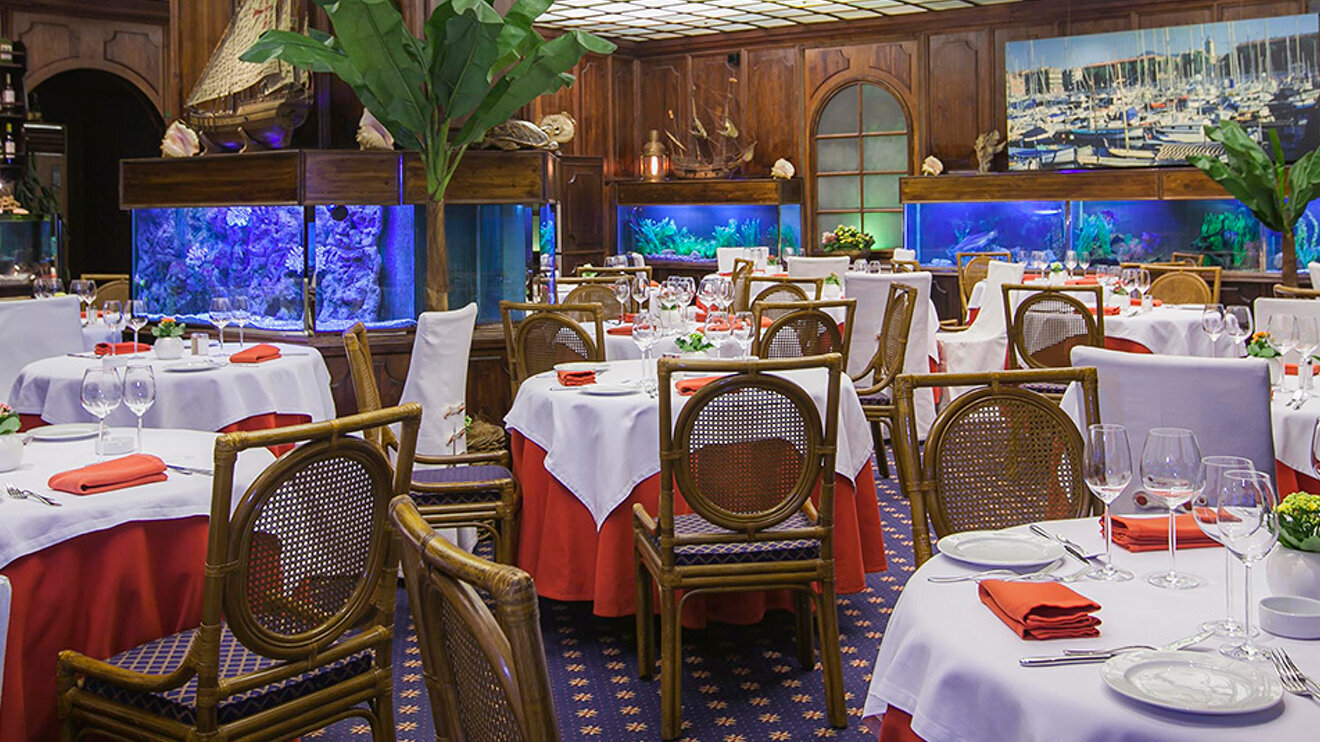
Sirena was the first, landmark venue in restaurateur Arkady Novikov’s culinary empire, opened in 1992 on Bolshaya Spasskaya Street in Moscow. By 1997, when the events described in the novel take place, Sirena had already spent five years as one of the capital’s most prestigious and expensive restaurants — a meeting place for Moscow’s elite and important business negotiations.
Origins and Concept
Arkady Anatolyevich Novikov (b. 1962), a graduate of culinary school and the food-service economics department of the Plekhanov Academy of National Economy, had worked as a chef at various Moscow venues before opening his own restaurant, including at Stas Namin’s restaurant in Gorky Park. Dreaming of a project of his own, he searched for a long time for the right space and eventually leased the entire ground floor of a college building on Bolshaya Spasskaya Street, across from the Volna hotel.
The choice of a seafood focus came down to more than Novikov’s personal taste — it was also practical: meat was scarce and expensive in the early 1990s, while fish remained more affordable. As the restaurateur himself put it, "Moscow is a city of seven seas — it’s always had plenty of fish, river and sea, domestic and foreign."
Status and Clientele by 1997
By the mid-1990s, Sirena had firmly established itself as a gathering place for Moscow’s elite. Its steep prices automatically weeded out casual visitors, turning the restaurant into a closed club for wealthy Muscovites, businessmen, senior officials, and the creative intelligentsia. Over the years, it hosted both domestic celebrities and world stars on the level of Liza Minnelli and Sting.
Sirena played a particular role in Moscow’s business life. Its cozy atmosphere, quality cuisine, and relative privacy made it an ideal spot for important negotiations and informal meetings between officials and businesspeople. That’s exactly why the novel’s appearance of a senior official from the presidential administration at Sirena reads as entirely natural — such meetings were part of the restaurant’s everyday life.
The Kitchen and Menu
In its early years, the young restaurateur devised the menu himself, drawing on various chefs. Sirena became a genuine trendsetter for Moscow cuisine in the mid-1990s — it was the first place in the capital to serve oysters, and delicacies like sterlet, sea bass, dorade, and turbot first appeared there. The restaurant offered guests both traditional Russian fish dishes and refined European delicacies.
A signature feature of the restaurant was its live aquariums, from which guests could select fish and seafood to be prepared to order. This not only guaranteed freshness but added an element of theater that patrons prized.
Interior and Atmosphere
Sirena’s design evoked a Spanish galleon: paneling in fine woods, English furniture, antiques, and miniature replicas of 18th-century sailing ships. Soft carpeting underfoot lent a sense of comfort and muffled sound. The restaurant’s particular pride was its aquariums, arranged around the perimeter of the main dining room, while the smaller room, styled after a ship’s hold, featured a unique aquarium set beneath a glass floor.
Arkady Novikov’s wife, Nadezhda, played an active role in designing the interior, lending the space a particular warmth and homeyness. It was this atmosphere, combining luxury with intimacy, that made Sirena ideal for both romantic dinners and business meetings alike.
Pricing and Exclusivity
By the mid-1990s, Sirena was already considered one of Moscow’s most expensive restaurants. Its high prices weren’t simply a reflection of quality ingredients and service, but a deliberate positioning strategy, marking the venue as elite. Dinner without alcohol could run to a sum comparable to an average Muscovite’s monthly salary, automatically limiting the restaurant to the very wealthy.
This exclusivity had a flip side: Sirena became a kind of social-status indicator. Being able to afford dinner there signaled membership in the upper strata of society — especially important amid the rapidly forming social hierarchy of post-Soviet Russia.
A Sign of the Times
By 1997, Sirena was more than a restaurant — it was an important element of Moscow’s new culture. With the old Soviet institutions of socialization gone and new ones not yet formed, places like Sirena became crystallization points for a new social order. Informal ties between power and business formed there, important deals were struck, political matters discussed.
The restaurant became a symbol of the new era — a time of opportunity, but also of sharp social stratification. Where status in Soviet years had been defined by Party or bureaucratic rank, the 1990s brought a new criterion: financial means. Sirena was one of the places where that new order showed itself most vividly.
Its Role in the Restaurant Industry
Sirena played a key role in shaping modern Moscow restaurant culture. Before it opened, Moscow had very few venues of European standard. Novikov was among the first to grasp that Russia’s new elite would pay top prices for quality food and matching atmosphere.
Sirena’s success became a catalyst for the whole industry. Novikov opened a second restaurant, Klub T, as early as 1994, and by 1996 his growing empire included Tsarskaya Okhota and Yolki-Palki. Each new venue found its own niche, but Sirena remained the flagship, setting the standard for quality and style.
So the mention of Sirena in the context of a novel set in 1997 Russia is no accident. This wasn’t just a restaurant — it was an important element of the era’s social landscape, a place where different strata of the new Russian society crossed paths, and where decisions were made that shaped the country’s fate.