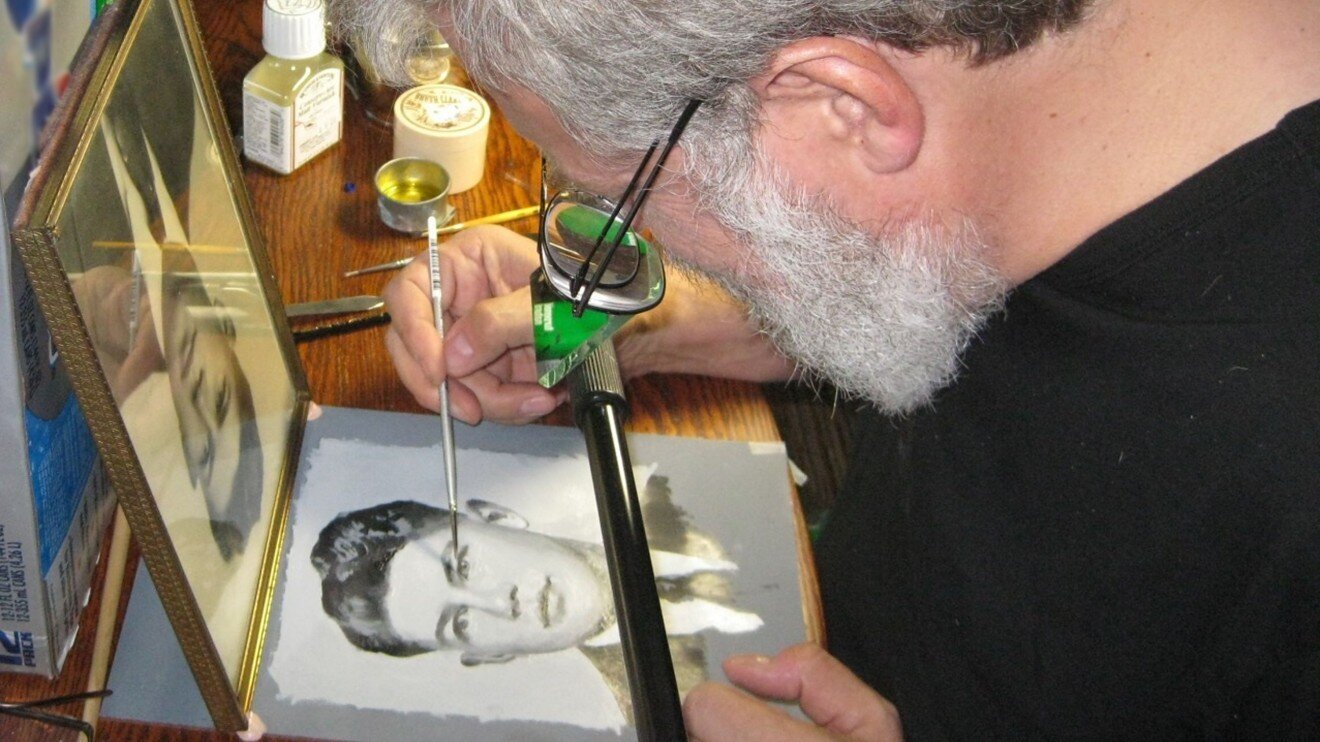
In an age when the word "Photoshop" had not yet entered common use, there were true wizards of the image — retouchers. These masters of their craft turned ordinary photographs into works of art, creating exactly the kind of flawless look that beckoned from magazine covers and advertising brochures.
What retouching is
Retouching (from the French "retouche," English "retouch") is the process and result of correcting, improving, and artistically processing images. Before the invention of computers and digital technology, retouchers worked exclusively with physical media — photographic prints, negatives, and slides.
The art of retouching arose almost simultaneously with the invention of photography itself. As early as the 19th century, soon after Joseph Nicéphore Niépce created the first photograph in 1825, photographers began experimenting with various ways to improve their images. Early techniques included hand touch-ups, the use of various chemical compounds, and mechanical processing of photographic plates.
The retoucher's profession: artist and technician in one
A professional retoucher is a unique specialist, combining the skills of artist, technician, and psychologist. These masters possessed not only an excellent knowledge of photographic processes, but also a subtle understanding of human perception of beauty.
A retoucher's work required exceptional precision, patience, and artistic taste. One careless brushstroke could ruin hours of painstaking work. That is why only the most talented and diligent masters entered the profession.
Retouchers worked in various fields:
- Portrait photography — eliminating skin flaws, correcting facial features, creating an ideal image
- Advertising and print — preparing images for catalogs, magazines, advertising materials
- Art photography — creating artistic effects, stylizing images
- Documentary photography — restoring damaged historical images
- The fashion industry — creating flawless looks for glossy publications
Tools and techniques of classical retouching
The retoucher's main arsenal
A professional retoucher's workspace resembled an artist's studio and a chemistry lab at once. The main tools included:
- Brushes of various sizes — from the finest, for detail work, to wide ones for processing large areas
- Special paints and inks — gouache, watercolor, special photographic dyes
- Pencils of varying hardness — for creating shadows and midtones
- Kneaded erasers — for gently removing excess material
- An airbrush — for creating smooth gradients and an "airy" effect
- Scalpels and knives — for carefully removing defects by mechanical means
- Magnifying glasses and microscopes — for working with the finest details
- Chemical reagents — for etching the emulsion and changing tonality
The "airbrush" technique
One of the most sophisticated techniques was working with the airbrush — a device that sprayed paint in the thinnest possible layer. This technique made it possible to create perfectly smooth tonal transitions, and to remove wrinkles and skin flaws so subtly that the result looked entirely natural. It is from airbrushing that the expression "airbrushed from history" originated, used to describe attempts to rewrite the past.
Chemical etching
Experienced retouchers mastered techniques for chemically treating photographic materials. With special solutions, it was possible to locally lighten or darken parts of an image, create blurring effects, or, conversely, sharpen individual details. This work required not only artistic skill but a deep knowledge of photochemistry.
Mechanical processing
Some defects were removed by purely mechanical methods. Retouchers carefully scraped problem areas on negatives with special knives, and created texture using needles and other sharp tools. Masters who worked with glass photographic plates were especially virtuosic with this technique.
Types of retouching
Technical retouching
Technical retouching aimed to eliminate the accidental defects that inevitably arose during shooting and printing:
- Dust and scratches — the most common problem, requiring painstaking painting-out of every speck of dust
- Spots on the emulsion — the result of improper storage or handling of materials
- Development defects — uneven density, chemical stains
- Damage to the medium — cracks in glass plates, creases in film
- Optical distortion — correction of lens distortion, vignetting
Restoring old photographs was a particularly complex task. Masters would recreate lost fragments of an image bit by bit, drawing on their knowledge of anatomy, perspective, and artistic principles.
Artistic retouching
Artistic retouching pursued aesthetic goals, and often radically changed how an image was perceived:
- Enhancing portraits — softening wrinkles, removing skin flaws, correcting facial shape
- Changing the composition — removing unwanted objects, adding new elements
- Atmospheric effects — creating fog, smoke, sun rays
- Stylization — giving an image a particular mood or style
- Color correction — even in black-and-white photography, masters could adjust tonal relationships to heighten dramatic effect
Retouching in advertising and the fashion industry
It was precisely in advertising and the fashion industry that the art of retouching reached its peak. The creators of glossy magazines and advertising materials understood: a perfect image sells better than reality. Retouchers created that very "glossy" standard of beauty that beckoned consumers from magazine covers and advertising brochures.
The secrets of "bronze goddesses"
Masters achieved especially impressive results when processing fashion photo shoots. Models' skin took on that exact bronze tone and porcelain smoothness that seemed unattainable in reality. Retouchers used a combination of techniques:
- Airbrushing to create a perfectly even skin tone
- Hand-painting highlights and shadows to emphasize dimension
- Chemical etching to enhance contrast
- Local correction of every imperfection
The result was so perfect that viewers could not believe their own eyes. It was exactly such images that adorned the brochures of five-star hotels, where "bronze-skinned enchantresses in bikinis paraded against desperately blue swimming pools."
The dark side of perfection: retouching as a propaganda tool
Unfortunately, the art of retouching was not used only for commercial purposes. History knows many examples of retouchers becoming a tool of political propaganda:
Soviet retouching
In the USSR, retouching was actively used to rewrite history. The best-known case involves a photograph in which Leon Trotsky was "erased" from a historical image showing him beside Lenin during a speech to Soviet troops in 1920. Such manipulations came to be known as "damnatio memoriae" — "the curse of memory."
Nikolai Yezhov, head of the NKVD, was removed from an official photograph in which he was pictured next to Stalin, after his execution in 1940. Historians later dubbed him the "vanishing commissar."
Western propaganda
Western retouchers were not far behind their Soviet counterparts. In 1860, one of the first known manipulated photographs was created: the head of President Abraham Lincoln was placed onto the body of the politician John Calhoun. The forgery was discovered only nearly a century later, when the photojournalist Stefan Lorant noticed that Lincoln's mole was on the wrong side of his face.
Retouching in the darkroom: technical subtleties
Most of a retoucher's work took place in the darkroom — the holy of holies of any photo studio. Here, under the red light of special lamps, the magic of turning a negative into a work of art took place.
Exposure correction methods
The legendary photographer Ansel Adams developed and popularized the techniques of "burning" and "dodging." These methods allowed the exposure of individual parts of an image to be locally adjusted right during the printing process:
- Burning — increasing exposure for individual areas with additional light
- Dodging — reducing exposure by partially shading areas of the photo paper
- Graduated exposure — creating smooth transitions between zones of different exposure
- Multiple exposure — overlaying several images to create complex compositions
Working with masks
One of the most complex techniques was working with masks — special stencils that allowed strictly defined parts of an image to be treated. Masks were made from various materials:
- Thin paper for simple geometric shapes
- Film for complex contours
- Fabric for creating soft edges
- Special photographic materials for especially precise work
Specialized equipment
Professional retouching tables
Serious retouching studios were equipped with special tables with adjustable tilt and a lighting system. The quality of the light was critically important — any inaccuracy in perceiving tones could ruin an entire piece of work.
Optical instruments
For working with the finest details, retouchers used:
- Magnifying glasses of various magnifications
- Binocular microscopes for especially fine work
- Projectors for enlarging an image onto the work surface
- Special light filters for analyzing tonal relationships
The birth of the digital era
In the late 1980s, the world of photography stood on the threshold of a revolution. In 1987, brothers Thomas and John Knoll began developing a program that would change the industry forever. The program was originally called Display, then ImagePro, and finally received the name Photoshop.
On February 19, 1990, the first version of Adobe Photoshop for Macintosh computers was released. Its price was $895 — a huge sum for the time. By comparison: an hour of work by a professional retoucher on a specialized Scitex system cost $300.
At first, many photographers were skeptical of digital technology, given the low image quality. Within a few years, however, it became clear that the era of hand retouching was coming to an end.
The legacy of classical retouching
Despite the rapid development of digital technology, classical retouching left an indelible mark on visual culture. Many principles and approaches developed by master retouchers are still used in modern digital image processing.
A philosophy of perfection
The main legacy of the hand-retouching era is the understanding that a perfect image is the result not only of a photographer's talent, but of painstaking post-processing. Retouchers created aesthetic standards that still shape our perception of beauty today.
Technical mastery
The experience of classical retouchers showed that high-quality image processing requires a deep understanding of:
- The laws of composition and perspective
- The psychology of color and form perception
- The technical features of photographic processes
- Artistic principles and aesthetic norms
Conclusion
The era of classical retouching was a time of true virtuoso artists, who turned photography into art using the simplest tools and incredible skill. Their work — those very "bronze-skinned enchantresses" that beckoned from magazine covers and advertising brochures — became a standard of beauty and perfection.
Today, in the age of Instagram filters and automatic image processing, it's worth remembering those masters who spent hours, and sometimes days, painstakingly creating every perfect image. Their art reminds us that behind every picture of perfection stands enormous human labor and talent.
When we see a model's flawless skin in a glossy magazine, or a perfect landscape in an advertising brochure, we are looking at the result of centuries of development in the art of retouching — from the first tentative attempts at hand touch-ups to the most complex techniques of chemical and mechanical processing. This is the art of creating the illusion of perfection, one that continues to captivate and inspire us today.