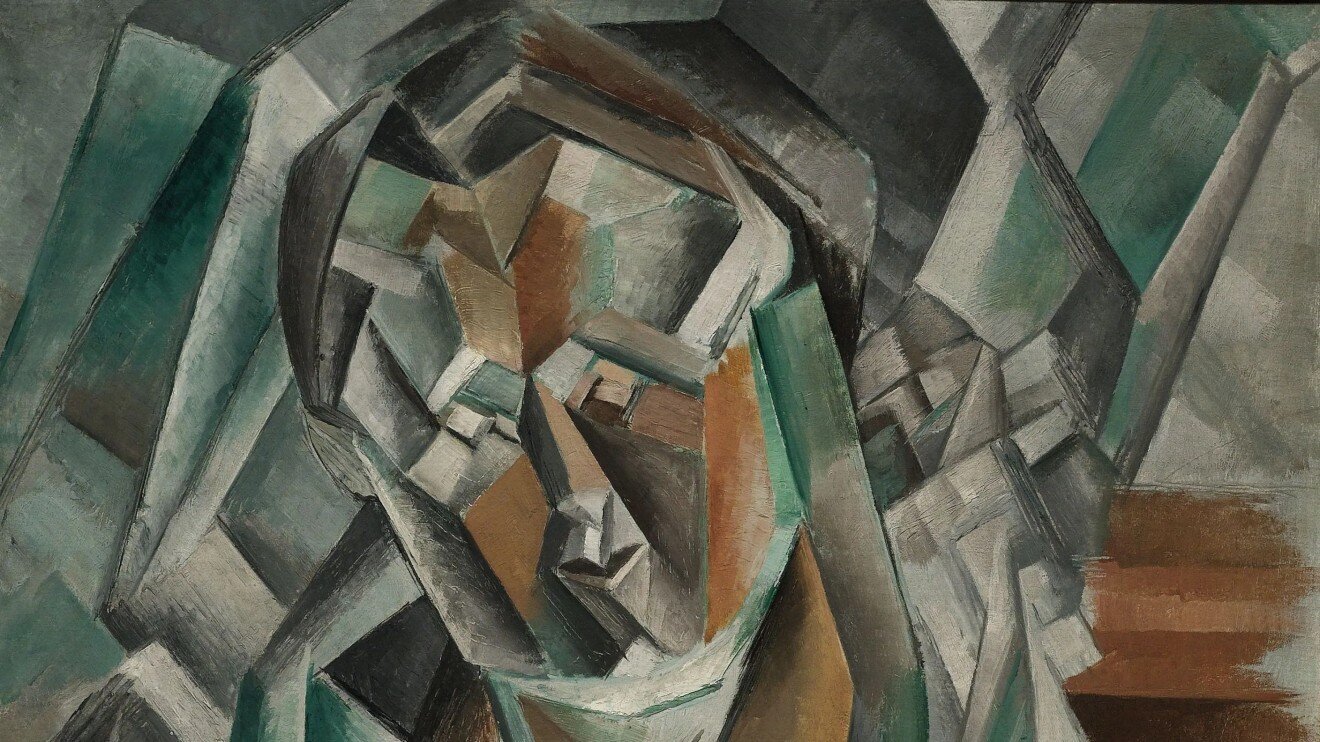
Pablo Picasso (1881–1973) was a Spanish and French artist, one of the founders of Cubism alongside Georges Braque and Juan Gris. Cubism became a revolutionary art movement of the early 20th century, radically transforming ideas about the visual arts.
What Cubism is
Cubism (from the French cubisme, from cube) is a movement in Western European art connected with the concepts of modernism. The name arose by chance in 1908, when critic Louis Vauxcelles described the painter Georges Braque as "a bold man who despises form, reducing everything, places, figures, and houses, to geometric schemas, to cubes."
The core idea of Cubism was a drive to reveal the geometric foundation of depicted objects, breaking them down into their component elements — planes and lines — and reassembling them into a new form. The artist could depict an object from several angles at once, using multiple points of view and the principle of simultaneity.
Picasso as the founder of Cubism
Pablo Ruiz y Picasso was born on October 25, 1881, in Malaga, Andalusia. The name given him at baptism — Pablo Diego Jose Francisco de Paula Juan Nepomuceno Maria de los Remedios Cipriano de la Santisima Trinidad Martir Patricio Ruiz y Picasso — is one of the longest in art history.
Picasso received his art training in Barcelona and Madrid, but as early as 1900 moved to Paris, where he met the future collaborators of the Cubist movement.
"Les Demoiselles d'Avignon" — the manifesto of Cubism
Pablo Picasso's painting "Les Demoiselles d'Avignon," painted in 1907, became a kind of pictorial manifesto for Cubism. The work caused a scandal and is considered a turning point in art history. The painting was inspired by ancient Iberian sculpture and the African masks that Picasso was drawn to at the time.
In May 1907, after visiting the Paris Ethnographic Museum, Picasso was struck by the masks of the peoples of Africa, Oceania, and Polynesia. This magical way of seeing an object, reflecting its essence rather than its outward appearance, became the foundation of a new artistic language. A person depicted this way turned into an idol, with a ritual mask in place of a face.
The stages of Cubism's development
The history of Cubism is traditionally divided into three main stages:
1. The Cezannian period (Proto-Cubism) — 1904-1910
The period preceding Cubism's establishment as a creative method. The name underscores its debt to the art of French painter Paul Cezanne. The "early Cubists'" motto became Cezanne's words: "Treat nature by means of the cylinder, the sphere, the cone..."
In this period, Picasso paid particular attention to turning forms into geometric blocks, enlarging and breaking up volumes, dividing them into planes and facets. Traditional African art fed the imagination and inspiration of the early Cubist painters.
2. Analytic Cubism — 1911-1912
The name "Analytic Cubism" was coined by Juan Gris. In this period, the forms of jugs, plates, and mugs were broken into small facets; table surfaces and drapery were "turned inside out," made parallel to the picture plane. The form of objects was revealed from several sides at once, from outside and within.
Depicting simple, everyday objects allowed the artists to focus attention on an object's form and structure. The painting became nearly monochrome — a limited palette of brownish, greenish, and ochre tones was used. Perspective disappeared, and Picasso's canvases often resolved into complex visual puzzles.
3. Synthetic Cubism — 1913-1914
The formal limits reached by Analytic Cubism prompted a reaction: a drive among artists to restore the integrity of artistic form and harmony of composition, building on the techniques developed earlier. This gave rise to Synthetic Cubism.
Pablo Picasso and Georges Braque began gluing pieces of newspaper, cardboard, and foil onto their canvases. Patches of color in various textures were combined with scraps of lettering, numbers, musical notation, and wallpaper patterns. Painting turned into decorative graphics, or a kind of "flat sculpture." This technique became known as collage.
A "Cubist cryptography" appeared in these compositions: encoded phone numbers, house numbers, scraps of lovers' names, street names, cafe names — details drawn straight from the bohemian artistic lifestyle of the early century.
The artistic principles of Cubism
Cubism rejected the traditions of naturalism and art's representational, knowledge-conveying function. The movement's core principles:
- Geometrization of form — reducing complex forms to simple geometric shapes
- Multiple points of view — depicting an object from several sides at once
- Deconstruction of space — breaking down traditional perspective
- An analytical approach — breaking form down into its component parts, followed by synthesis
- Conceptuality — depicting not what the eye sees, but what the mind knows
The viewer's gaze, in a sense, traveled through the conceptual space the artist had created. A spatiotemporal structure emerged in the image, more complex than under the system of classical linear perspective.
Its influence on depicting the human body
Cubism radically changed approaches to depicting the human figure. The body was broken down into geometric planes, angles, and facets. Picasso created images in which the human figure consisted of sharp angles, concave and convex surfaces, resembling sculptures built from cubes or geometric blocks.
This is especially visible in Picasso's female portraits from the Analytic Cubism period, where faces were shown simultaneously in frontal view and profile, and bodies turned into constructions of intersecting planes. The artist sought to show not outward resemblance, but the inner structure and multiplicity of perception of the human form.
Collaboration with the Ballets Russes
From 1917 onward, Picasso actively collaborated with Sergei Diaghilev's "Ballets Russes" troupe, designing sets and costumes for six ballets. The most famous was the scandalous ballet "Parade" (1917), created together with composer Erik Satie and librettist Jean Cocteau.
The premiere of "Parade" on May 18, 1917, at the Théâtre du Châtelet, caused an enormous scandal — the audience shouted "Russian Boches, down with the Russians, Satie and Picasso are Boches!" It came to blows, but this scandal significantly boosted Picasso's popularity among wider circles of Parisian society.
Legacy and influence
Cubism had an extraordinary influence on the development of 20th-century visual art, spreading far beyond painting into sculpture, architecture, literature, and music. Picasso created around 20,000 works over his lifetime, many of which became icons of modern art.
In Russia, avant-garde artists, drawing on the techniques of French Cubism and Italian Futurism, created their own variant — Cubo-Futurism. Kazimir Malevich declared: "If you want to study art, study Cubism."
By expert estimates, Picasso is the "most expensive" artist in the world. His paintings regularly set auction records, and the influence of Cubist principles can be traced in the work of many contemporary artists.
Criticism and reception
Cubism provoked mixed reactions from the very start. The philosopher Mikhail Lifshitz, in his book "The Crisis of Ugliness" (1968), noted: "The best thing about Cubism is that it hasn't yet reached full abstraction, hasn't entirely broken with representational art."
In the USSR, Picasso's work was received ambivalently. For Socialist Realist artists, Picasso was the "chief enemy" — on one hand a Communist and a fighter for peace, on the other a representative of "bourgeois formalism."
Nevertheless, Cubism became one of the most important movements of modernist art, radically reshaping ideas about what art could and should be in the 20th century.