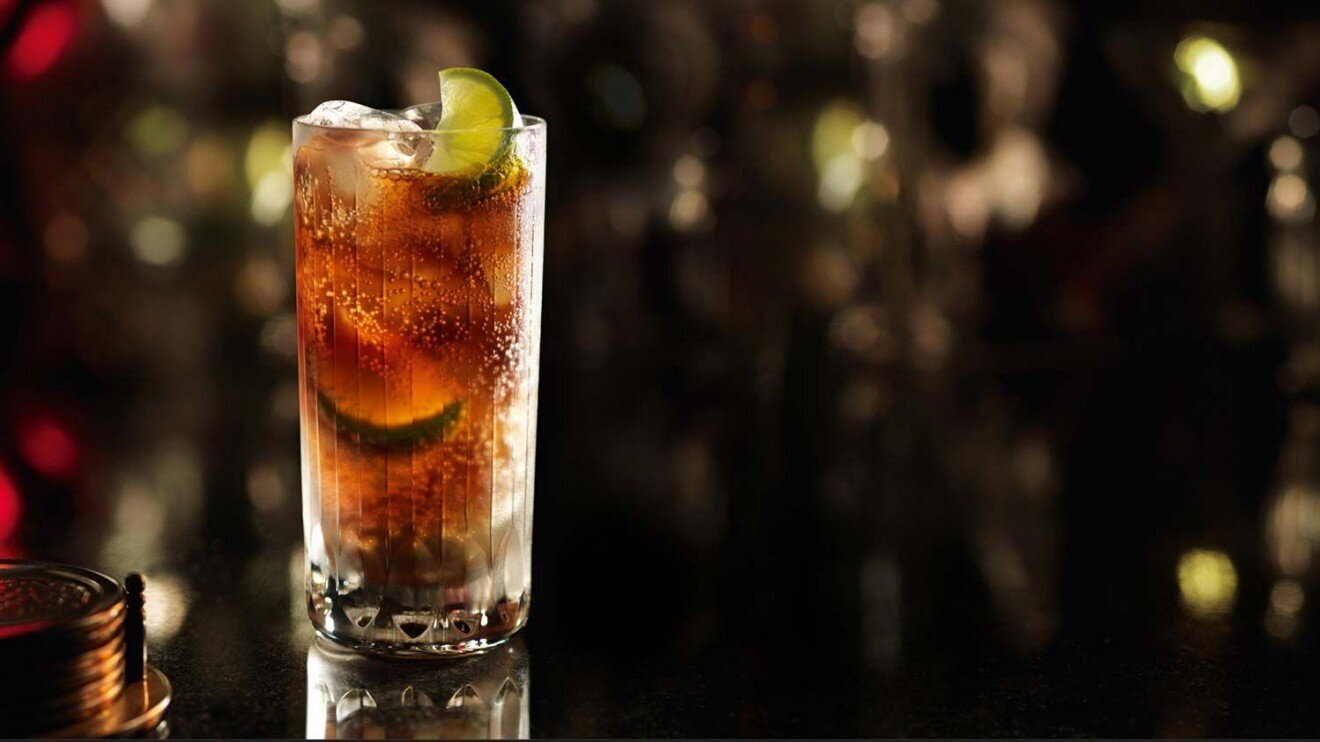
In the early 1990s, a cocktail that locals simply called "rum and cola" began appearing in Russian bars and clubs. Behind this unassuming name lay the famous "Cuba Libre" — one of the world's most popular cocktails, which was only just beginning to win over the post-Soviet space.
The cocktail's history
"Cuba Libre" (Spanish for "Free Cuba") was born at the turn of the 20th century, during Cuba's war of independence from Spain. According to one account, the cocktail was invented in 1900 at the "American Bar" in central Havana, when a captain of the US Army Signal Corps named Russell ordered a mix of Bacardi rum with Coca-Cola, recently brought to the island. The soldiers loved the drink and raised a toast "To free Cuba!" — hence the cocktail's name.
The classic recipe includes white rum, Coca-Cola, and lime juice, served over ice in a tall (highball) glass. Lime doesn't just add tartness — it was historically important, since citrus helped sailors and soldiers fend off scurvy in tropical climates.
The cocktail in the USSR and Russia
In the Soviet Union, "Cuba Libre" was known to few. In the 1970s-80s, the cocktail's recipe was printed on the back of bottles of Cuban Havana Club rum, which was supplied to the USSR under trade agreements with socialist Cuba. But Coca-Cola was practically unavailable to Soviet consumers in those years, except at hard-currency stores and in diplomatic circles.
The situation changed dramatically in the early 1990s. As the Russian economy liberalized, the first Western drinks appeared, including Coca-Cola. At the same time, private bars and nightclubs began opening, where the younger generation was introduced to cocktail culture.
"Rum and cola" in 1993
By 1993, ordering "rum and cola" at a Moscow or St. Petersburg club was no longer exotic, though the drink remained fairly expensive. Imported rum cost a considerable sum, and Coca-Cola had only just begun mass production in Russia (the Moscow plant opened in 1994).
Interestingly, Russian bartenders often made a simplified version of the cocktail without lime — partly because it was scarce in winter, and partly out of unfamiliarity with the classic recipe. That's how the local interpretation of "rum and cola" was born — the very drink that appears in the novel.
Ordering this cocktail in 1993 signaled a certain status and a connection to the new, "Western" leisure culture. It was a symbol of an era of change, when young Russians were eager to try everything that had been out of reach in Soviet times.