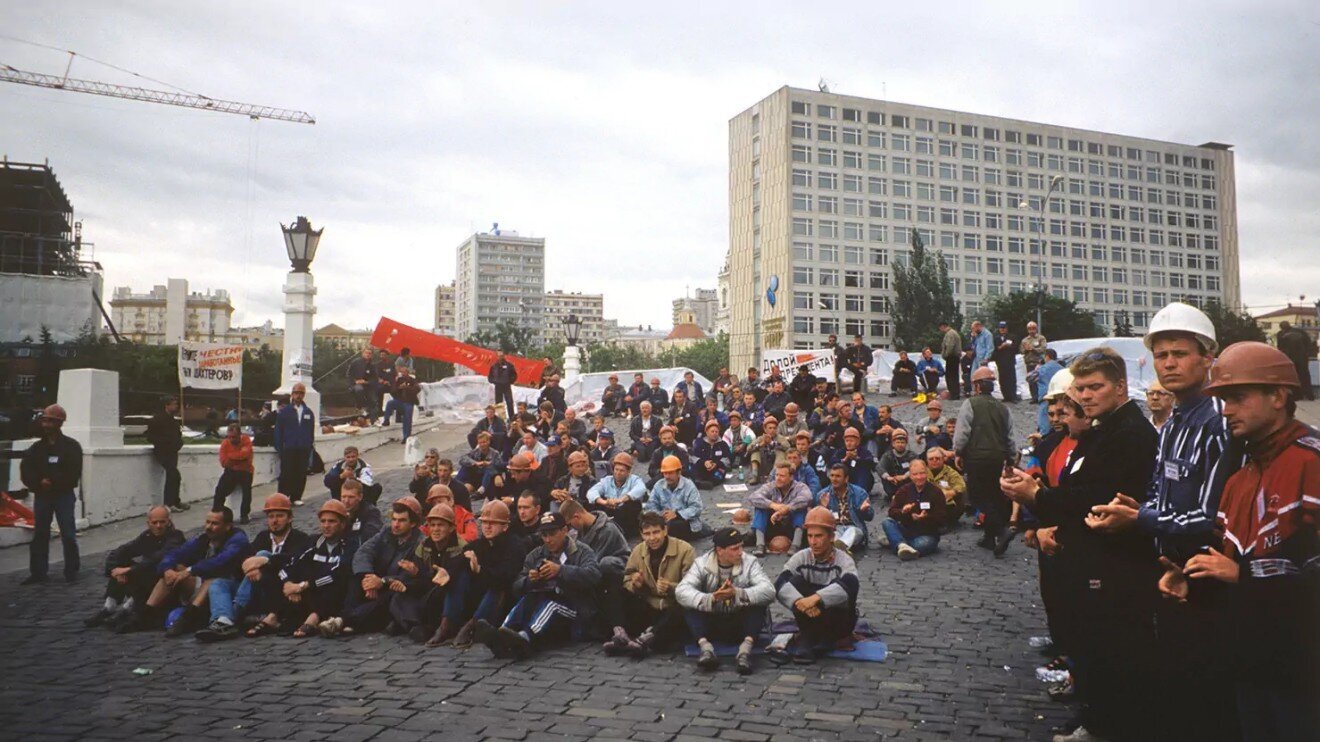
The period from 1993 to 1998 was one of the most dramatic and pivotal in modern Russian history. Over these five years, the country lived through a constitutional crisis with the tragic events of October 1993, the adoption of a new Constitution, the formation of a new political system, the continuation of painful economic reforms, and, finally, the largest financial crisis of the era, known as the "1998 default."
The 1993 constitutional crisis: new foundations of statehood
1993 began with the deepening confrontation between President Boris Yeltsin and the Russian Supreme Soviet, led by Chairman Ruslan Khasbulatov and Vice President Alexander Rutskoy. The conflict was fueled by the radical economic reforms of Yegor Gaidar's government, which caused a sharp drop in living standards and provoked resistance from parliament.
An attempt to resolve the political crisis through a nationwide referendum on April 25, 1993, did not succeed. Although 58.7% of voters expressed confidence in President Yeltsin, and 53% approved of the government's socio-economic policy, the questions on early elections did not gather the required number of votes. The constitutional crisis continued.
The confrontation reached its climax in the autumn of 1993. On September 21, Yeltsin issued a decree dissolving the Congress of People's Deputies and the Supreme Soviet, which parliament declared unconstitutional. In response, Alexander Rutskoy was declared acting president.
The political crisis escalated into armed confrontation. Supporters of parliament, led by retired general Albert Makashov and Russian National Unity leader Alexander Barkashov, stormed the Moscow mayor's office building, then headed toward the Ostankino television center. After bloody clashes, Yeltsin brought troops into Moscow. On October 4, tank fire on the White House ended the parliament's armed resistance.
These tragic events finally abolished the remnants of the Soviet system of power established in 1917. Lower-level Soviets of People's Deputies across the country were dissolved or transformed.
Adoption of the new Constitution
On December 12, 1993, a referendum was held on adopting Russia's new Constitution. The document established new foundations for Russian statehood: a presidential republic with strong powers for the head of state, a bicameral parliament (the State Duma and the Federation Council), a genuine separation of powers, and a federal structure with equal status for all constituent regions.
The first State Duma elections were held at the same time, unexpectedly won by Vladimir Zhirinovsky's LDPR, a sign of the growing radical mood in society.
Economic reforms: from shock therapy to stabilization
The 1993-1998 period was marked by the continuation and adjustment of the radical economic reforms begun in 1992. After Yegor Gaidar's resignation at the end of 1992, the government was headed by Viktor Chernomyrdin, who tried to restore a degree of state control over the economy.
Privatization and the formation of an oligarchy
Mass privatization, begun in the summer of 1992 through privatization vouchers, continued into the mid-1990s. Every Russian citizen received a voucher with a face value of 10,000 rubles, exchangeable for shares in enterprises. Most citizens, however, having no experience with securities, sold their vouchers for next to nothing or invested them in financial pyramid schemes.
As a result, the main beneficiaries of privatization were former enterprise directors and new entrepreneurs. The 1995 loans-for-shares auctions were especially significant, during which the largest state enterprises passed into the hands of a small group of oligarchs for symbolic sums. This is how a layer of major capital formed, one that gained enormous political influence.
Fighting inflation and stabilization
By the mid-1990s, the hyperinflation of the early part of the decade had been brought under control. Where inflation stood at 2,500% in 1992, it had fallen to 11% by 1997. This was achieved through tight monetary policy and the establishment of a currency corridor to maintain a stable ruble exchange rate.
International loans played an important role in stabilizing the economy. Chernomyrdin managed to negotiate loans from the IMF and the World Bank, which helped replenish currency reserves and support the ruble.
GKOs: a state-scale financial pyramid
To finance the budget deficit, the state began issuing government short-term bonds (GKOs). Initially, this measure helped improve the economy, and GDP growth appeared for the first time in years. Gradually, however, the GKO market turned into a financial pyramid scheme.
The high yield of these government securities (reaching 140% annually by 1998) drew investment away from the real economy and into the financial sector. To keep up demand for GKOs, the state was forced to keep raising the yield, which only increased the debt burden further.
The Chechen war: the burden of armed conflict
A serious test for the young Russian state was the First Chechen War (1994-1996). The conflict began in December 1994, when federal troops tried to restore constitutional order in the Chechen Republic, which had declared independence in 1991.
The war demanded enormous financial expenditure, adding further strain to an already stretched federal budget. The bloody fighting, especially during the taking of Grozny in early 1995, led to heavy casualties and eroded the authority of the federal government.
In August 1996, the Khasavyurt Accords were signed, effectively recognizing Chechnya's independence pending a final resolution of the republic's status. The war ended in defeat for the federal forces, creating a dangerous precedent for separatism and a lasting source of terrorist threat.
The 1996 presidential election
Amid economic hardship and military defeat in Chechnya, Boris Yeltsin's popularity had fallen to critically low levels by 1996. His main rival in the presidential election was Communist leader Gennady Zyuganov, who promised a return to a planned economy and the restoration of the USSR.
The 1996 election campaign was marked by massive support from the oligarchs, who understood that a Communist victory would mean the end of their businesses. A group called the "Semibankirschina" (the "seven bankers") was formed, uniting the country's biggest financiers behind Yeltsin.
In the second round, Yeltsin defeated Zyuganov, winning 53.8% of the vote. This victory came at a steep price, however — the oligarchs gained even greater influence over state policy.
Toward the crisis: 1997-1998
After the 1996 presidential election, Russia's economic situation began to gradually worsen. The 1997 Asian financial crisis had a serious impact on the Russian economy, driving down the price of oil and other raw materials that formed the basis of Russian exports.
By the end of 1997, interest rates on government securities and interbank loans had risen sharply. Where the average GKO yield stood at 19% in the third quarter of 1997, it had already reached 26.3% by the fourth quarter. This reflected investors' growing distrust of the Russian economy.
Change of government
In the spring of 1998, amid mass miners' strikes, Yeltsin dismissed Chernomyrdin's government. The new prime minister was the young reformer Sergei Kiriyenko, who advocated radical measures to stabilize the economy.
Kiriyenko submitted a package of stabilization measures to the State Duma, including tax increases and spending cuts. Parliament rejected these proposals, however, further deepening the budget crisis.
The default of August 17, 1998: the collapse of the financial system
By the summer of 1998, the situation had become critical. GKO yields reached 140% annually, making it impossible to service the state debt. The Central Bank had nearly exhausted its currency reserves for maintaining the ruble within the currency corridor.
On August 17, 1998, Kiriyenko's government announced a technical default on government short-term bonds and abandoned the fixed ruble exchange rate. These decisions marked the beginning of the most severe financial crisis in Russian history.
Consequences of the default
The default had catastrophic consequences for the Russian economy and society:
- Ruble collapse: Over six months, the dollar exchange rate rose from 6 to 21 rubles — more than tripling
- Banking crisis: Most Russian banks went bankrupt, and depositors lost their savings
- Rising unemployment: Hundreds of thousands of people lost their jobs as enterprises went bankrupt
- Falling living standards: The population lost its savings for the second time in a decade
- Political crisis: Kiriyenko's government was dismissed on August 23
Causes of the crisis
The 1998 default resulted from the accumulation of systemic problems in the Russian economy:
Fiscal problems: A chronic federal budget deficit was financed through borrowing on financial markets, leading to uncontrolled growth in the state debt.
The currency corridor: Artificially maintaining an overvalued ruble required enormous currency reserves and made Russian goods uncompetitive.
External factors: The 1997 Asian crisis triggered capital outflow from emerging markets and a fall in commodity prices.
Structural imbalances: The Russian economy remained excessively dependent on raw-material exports, with underdeveloped manufacturing.
Political instability: The Chechen war, corruption, and the absence of clear economic legislation deterred investors.
Social consequences of the crisis
The 1998 default was a devastating blow to Russian society. For the third time in a decade (after the 1992 price liberalization and the confiscation of savings), the population lost its savings. Unemployment rose sharply, and real incomes fell.
The crisis undermined trust in financial institutions and the ruble. Many Russians began keeping their savings in US dollars or euros, leading to a partial dollarization of the economy.
At the same time, the crisis had some positive consequences as well. The sharp weakening of the ruble made Russian goods more competitive both domestically and abroad, promoting import substitution and the development of domestic production.
Lessons of the 1993-1998 period
The five years from 1993 to 1998 were a time of painful formation for the new Russian statehood and market economy. This period demonstrated both the possibilities and the limits of radical reform in a transitional economy.
Political lessons: The events of October 1993 demonstrated the fragility of democratic institutions amid a deep socio-economic crisis. Adopting the new Constitution created a foundation for stable political development, but at the cost of significantly curtailing parliament's role.
Economic lessons: The experience of the 1990s showed the inadequacy of purely monetary methods of economic stabilization. The attempt to finance the budget deficit through domestic borrowing led to the creation of a state-scale financial pyramid.
Social lessons: Radical reforms without sufficient social support led to a sharp rise in inequality and a decline in living standards for most citizens.
The legacy of the crisis
The 1998 default was a turning point in modern Russian history. The crisis forced a reconsideration of many of the economic policy principles of the 1990s. The course of maintaining an artificially overvalued ruble was abandoned, the state's role in the economy was strengthened, and a policy of accumulating currency reserves was begun.
Paradoxically, the 1998 crisis laid the groundwork for the economic growth of the 2000s. The devaluation of the ruble stimulated domestic production, while rising world oil prices ensured a flow of currency revenue.
Politically, the crisis accelerated a change of elites. By the end of 1998, Yeltsin had already begun searching for a successor, which ultimately led to Vladimir Putin coming to power and the start of a new stage in Russian history.
The 1993-1998 period remains one of the most contradictory and painful in the history of modern Russia. These years showed that the transition from a totalitarian state to democracy and a market economy cannot be a quick or painless process. At the same time, this experience laid the groundwork for understanding the need for a more balanced approach to reforming society and the economy.