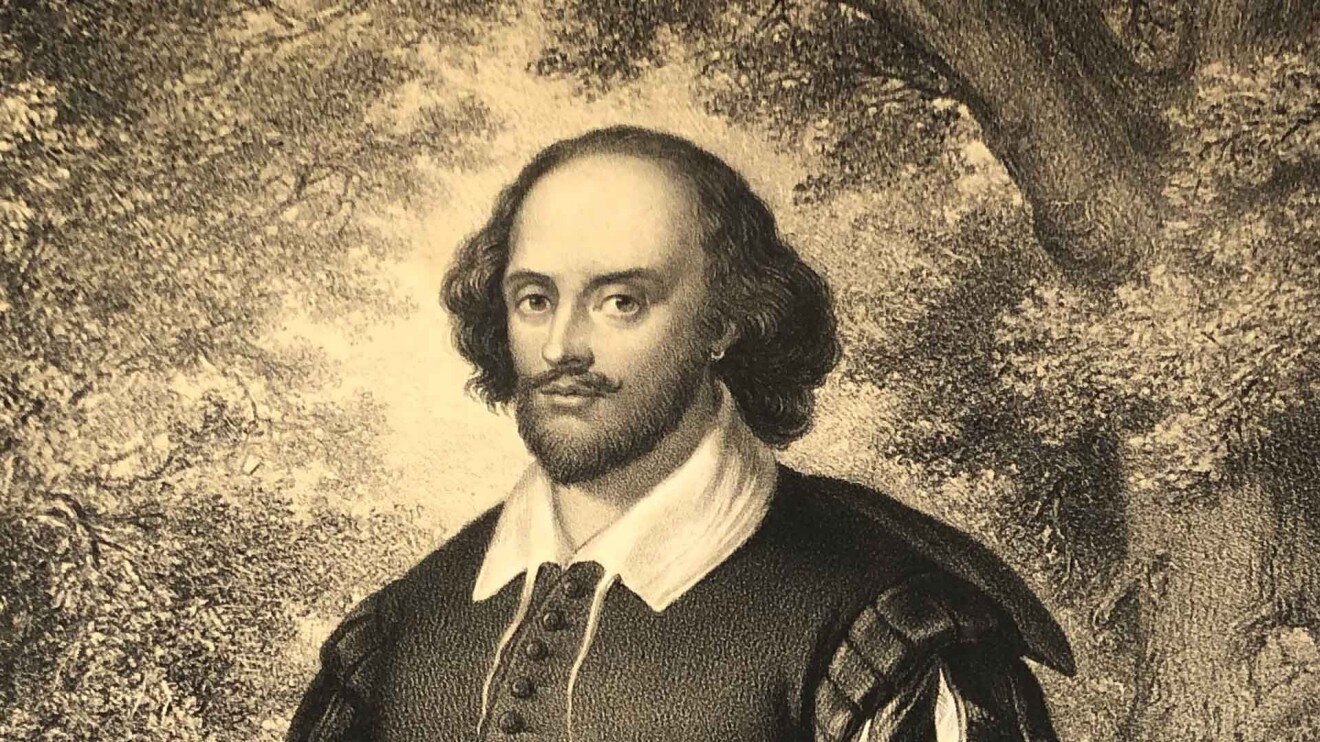
William Shakespeare (1564–1616) was an English poet and playwright, generally considered the greatest writer in the English language and one of the world's finest dramatists. His works have been translated into every major language and are performed more often than those of any other playwright.
Biography
Early years
William Shakespeare was born in the town of Stratford-upon-Avon (Warwickshire) in 1564, and baptized on April 26. His exact birth date is unknown, but tradition places it on April 23 — a date that coincides with the precisely known date of his death.
His father, John Shakespeare (1530–1601), was a prosperous craftsman (a glover), often elected to various significant civic posts. In 1565 he was an alderman, and in 1568 a bailiff (head of the town council). Shakespeare's mother, Mary Arden (1537–1608), belonged to one of the oldest Saxon families in the region.
Shakespeare is believed to have attended Stratford's "grammar school," where he would have received a solid education in Latin. In 1582, at 18, he married Anne Hathaway, the daughter of a local landowner, eight years his senior. The couple had three children: a daughter, Susanna (1583), and twins — a son, Hamnet, and a daughter, Judith (1585).
His London career
Very little is known about Shakespeare's life between 1585 and 1592 — scholars call this his "lost years." The first mentions of his London theatrical career date to 1592, when the playwright Robert Greene, in a pamphlet, viciously attacked Shakespeare, sneering at him as an "upstart Crow" who "shake-scenes" the stage.
From 1594 on, Shakespeare's plays were performed exclusively by the company "Lord Chamberlain's Men," of which he became a part-owner by the end of that year. After Queen Elizabeth's death in 1603, the company received a royal patent from James I and became known as the "King's Men."
In 1599, the partnership built the Globe Theatre on the south bank of the Thames. In 1608, they also acquired the indoor Blackfriars Theatre. His theatrical work made Shakespeare a wealthy man — in 1597 he bought the second-largest house in Stratford.
His final years
Around 1613, Shakespeare returned to Stratford, where he died on April 23 (May 3) 1616, at age 52. Every surviving signature of his from these final years shows poor penmanship, suggesting he was seriously ill.
Shakespeare was buried in Stratford's Holy Trinity Church. His gravestone bears the epitaph: "Good friend, for Jesus' sake forbear / To dig the dust enclosed here; / Blessed be the man that spares these stones, / And cursed be he that moves my bones."
His literary legacy
His plays
Shakespeare's literary legacy comprises 38 plays, traditionally divided into four periods:
The early period (1590-1594)
This period saw the writing of the history plays ("Henry VI," "Richard III"), Renaissance comedies ("The Comedy of Errors," "The Taming of the Shrew," "The Two Gentlemen of Verona"), and the "horror tragedy" "Titus Andronicus." His early plays are marked by the more traditional style of the era, at times overloaded with elaborate metaphor.
The mature period (1594-1600)
This was when his finest comedies were written: "A Midsummer Night's Dream," "The Merchant of Venice," "Much Ado About Nothing," "As You Like It," "Twelfth Night." The same period produced the history plays "Richard II," "Henry IV" (Parts 1 and 2), "Henry V," and his first mature tragedy, "Romeo and Juliet."
The period of the great tragedies (1601-1608)
The era of the greatest tragedies in world literature: "Hamlet," "Othello," "King Lear," "Macbeth," "Antony and Cleopatra," "Coriolanus." The same period produced the "problem plays": "Troilus and Cressida," "All's Well That Ends Well," "Measure for Measure."
The late period (1609-1613)
Shakespeare turned to the genre of romantic tragicomedy: "Pericles," "Cymbeline," "The Winter's Tale," "The Tempest." These works are less bleak than the tragedies, yet more serious than the early comedies, and end in reconciliation and deliverance from misfortune.
"The Tempest"
"The Tempest" (1611) is one of Shakespeare's last, and most philosophical, plays. It is a romantic tragicomedy about Prospero, the deposed Duke of Milan, who uses magic to command an island and the spirit Ariel. The play touches on themes of power, forgiveness, illusion, and reality.
The line used as an epigraph comes from Act I, Scene 2, where Ariel tells Prospero how he unleashed the storm on the ship carrying the King of Naples and his retinue. The words "Hell is empty / And all the devils are here" are spoken by Prince Ferdinand, in despair, as the ship goes down. This line has become one of Shakespeare's most famous quotations, symbolizing chaos and evil in the human world.
His poetry
Besides his plays, Shakespeare wrote 154 sonnets and several narrative poems. The sonnets, written mainly between 1592 and 1599, fall into two cycles: those addressed to a friend (1–126) and those to the "Dark Lady" (127–154). They explore themes of friendship, love, beauty, time, and death.
His best-known narrative poems are "Venus and Adonis" (1593) and "The Rape of Lucrece" (1594), written while the theaters were closed due to plague.
Artistic features
Language and style
Shakespeare wrote mainly in blank verse (unrhymed iambic pentameter), though his style evolved considerably over time. His early plays show a more traditional, sometimes declamatory style. In his mature period, he learned to break sentences across the end of a line, giving his verse power and flexibility.
In his later works, Shakespeare made use of enjambment, unstructured pauses, and varied sentence constructions. His vocabulary, by various counts, ranges from 17,500 to 29,000 words.
Characters and themes
Shakespeare created a gallery of unforgettable characters, from the comic to the tragic. His figures are psychologically complex and multifaceted. Central themes in his work include:
- The conflict between good and evil
- Power and its effect on people
- Love in all its forms
- Betrayal and loyalty
- Illusion and reality
- Time and mortality
- Justice and revenge
Influence and legacy
His impact on literature
Shakespeare's work had an enormous influence on the development of world literature and theater. He expanded what drama could do in characterization, plotting, language, and genre. Before "Romeo and Juliet," romantic love was not considered a fitting subject for tragedy.
Shakespeare's soliloquies evolved from a simple device for informing the audience into a means of revealing a character's inner world. His psychological realism influenced writers of every era that followed — from the Romantics to the Modernists.
His influence on language
Shakespeare had a significant hand in shaping modern English. He is the most-quoted author in Samuel Johnson's first English dictionary. Many phrases from his plays have entered everyday speech.
Worldwide recognition
Shakespeare's works have been translated into every major world language and are performed constantly in theaters. Thousands of adaptations have been made of his works, including operas, ballets, and films. His influence extends well beyond literature — into painting, music, and psychology.
Sigmund Freud drew on Shakespearean psychology in his own theories. Composers have written more than 20,000 pieces of music based on his plays, including Verdi's operas "Otello" and "Falstaff."
Disputes and mysteries
The "Shakespeare authorship question"
Since the 19th century, some scholars have expressed doubts about Shakespeare's authorship, proposing alternative candidates — Francis Bacon, Christopher Marlowe, the Earl of Oxford. Their main arguments: the lack of documented evidence of Shakespeare's education, set against the enormous vocabulary of his works and their deep knowledge of history, literature, and law.
The overwhelming majority of Shakespeare scholars, however, reject these alternative theories as insufficiently substantiated.
His religious views
The question of Shakespeare's religious beliefs remains unclear. Some researchers believe his family was Catholic, at a time when Catholicism was outlawed. The playwright's father did not attend Church of England services, and paid fines for it.
Conclusion
William Shakespeare remains a central figure in world culture, four centuries after his death. His works continue to move readers and audiences, finding new interpretations in every era. The universality of his themes, the psychological depth of his characters, and the richness of his language ensure his work's immortality.
As his contemporary Ben Jonson wrote: "He was not of an age, but for all time." Those words hold true today — Shakespeare's work belongs to all of humanity, and continues to shape the development of world culture.