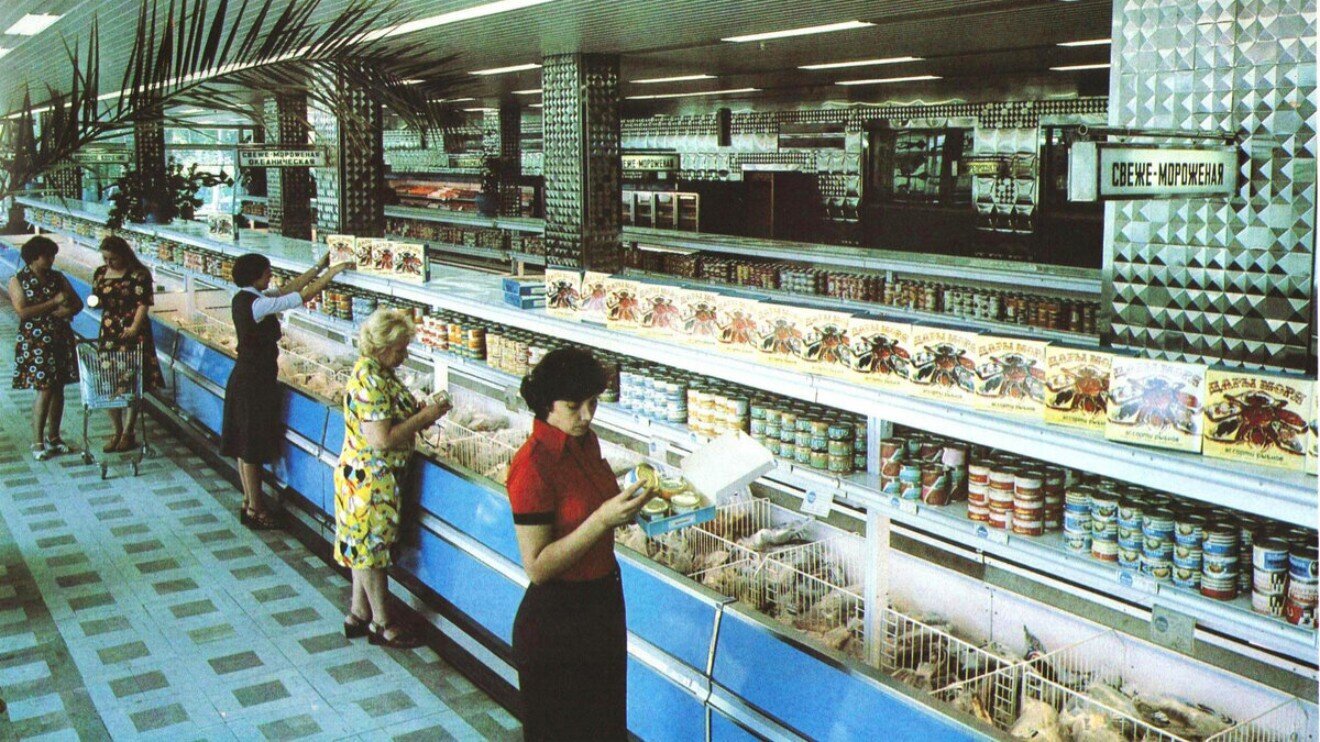
The chain of specialized seafood stores called «Okean» («Ocean») became one of the most famous retail projects of the late USSR — known not only for quality seafood, but for a massive corruption scandal as well.
Founding History
The idea for the chain was born in the early 1970s, when Alexander Akimovich Ishkov, the USSR’s Minister of Fisheries, visited Spain. He was struck by how Spanish fish shops were run: goods displayed in modern refrigerated cases, customers able to choose products themselves, and large aquariums holding live fish, caught to order at the customer’s request.
Inspired by what he’d seen, Ishkov, on returning to the USSR, initiated the creation of a similar retail chain. The first Okean store opened in Sochi in 1972, and by 1976 specialized fish shops under this brand had appeared across the Soviet Union.
Distinctive Features of the Stores
Okean stores differed radically from ordinary Soviet grocery shops. They used imported display cases and refrigeration equipment, and the selection was astonishing in its variety: fresh and frozen fish of every kind, seafood, canned fish, and semi-prepared products. By the standards of a chronically shortage-plagued USSR, this was a genuine «fish paradise.»
The Okean chain became the first Soviet retail brand and was seen as the start of a new era in trade. Customers practically swept the shelves clean, and the stores themselves came to be seen as a symbol of abundance and quality service.
Corruption Schemes
But behind the bright display cases lurked large-scale abuse. Thanks to the special status of the Ministry of Fisheries, which handled not just retail sales but fishing and processing as well, various fraudulent schemes became possible:
- Overstating catch weight: Because of rolling seas, fishermen deliberately added 2–3 kilograms to every crate, afraid of being accused of shortweighting. The surplus was then sold off «on the side.»
- Abuse of write-offs: Officially, writing off 0.1% of the catch was allowed, but fraudsters wrote off scarce, in-demand fish and sold it on the black market.
- Caviar smuggling: Black and red caviar were repacked into cans meant for cheap canned fish, letting them slip through transport unnoticed for later illegal sale.
Exposing the «Fish Mafia»
The corruption scheme’s collapse began with an absurd incident in 1979. A Great Patriotic War veteran bought a can of sprats at a Moscow Okean store, and at home discovered black caviar inside instead. Rather than simply enjoying the find, he went back to the store with police and made a scene. The story spread across Moscow instantly, and residents rushed to buy up cans of sprats, hoping for similar luck.
At the same time, the KGB received information from Czechoslovakia that Yefim Feldman, general director of the Okean trade-and-production firm, and Vladimir Fishman, director of one of the chain’s stores, were actively buying up jewelry, spending enormous sums, and preparing to emigrate.
The Investigation and the Sentences
The investigation into the «fish case» was carried out jointly by the Soviet Ministry of Internal Affairs (MVD) and the KGB. A sprawling criminal network was uncovered, involved in caviar smuggling and other schemes. The investigation reached the industry’s highest ranks: Vladimir Ivanovich Rytov, deputy minister of fisheries of the USSR, was arrested.
The sentences were severe: Feldman and Fishman each received 12 years in prison, while Rytov was sentenced to death and executed by firing squad. Roughly 1,500 officials were convicted in connection with the case, and around 3,500 more were dismissed from their jobs.
Legacy
The «fish case» became one of the most sensational corruption scandals in the USSR. The Okean chain went down in history not just as the first Soviet fish supermarket, but as a symbol of large-scale corruption in the late Soviet era.
After the collapse of the Soviet Union, Okean stores lost their specialization and became ordinary grocery shops. By the early 2000s, the chain had ceased to exist entirely, but memory of it survived as an example of how cutting-edge retail technology could serve as cover for criminal schemes.