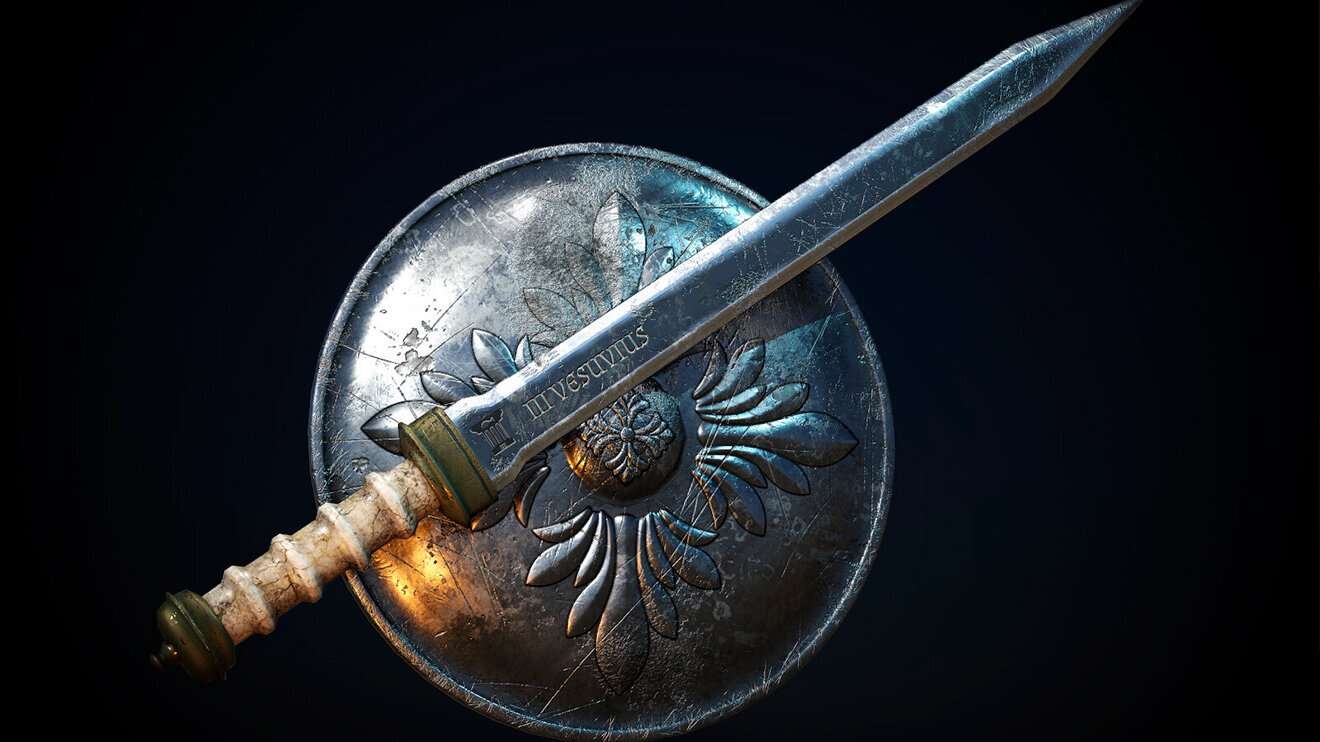
Ancient Roman soldiers had several main types of shields:
Scutum
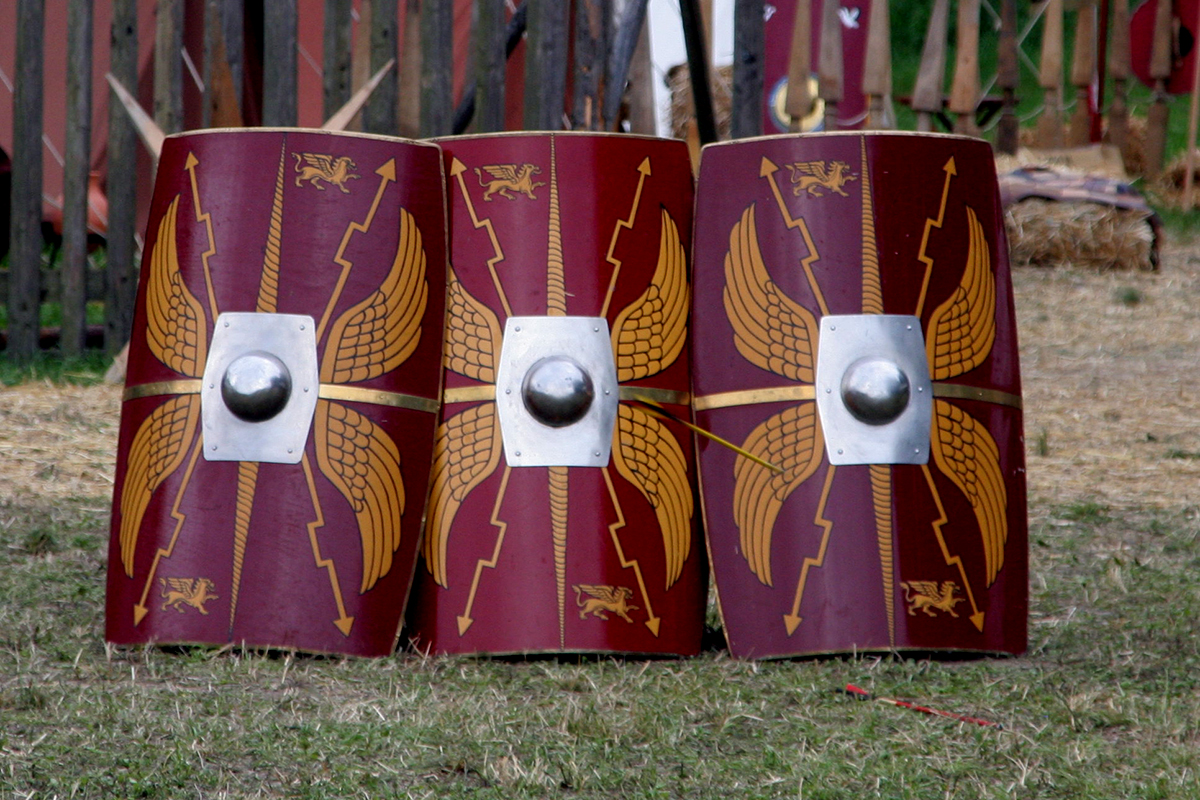
The main shield of the Roman legionary. Rectangular with rounded top and bottom, curved, with a central grip (fist grip) and a metal boss. Used from the fourth century BC, when the Romans abandoned the Greek phalanx, until the third century AD. It originally had an oval shape, which by the period of the civil wars had transformed into an oval with straightened edges, and later into a fully rectangular form. The dimensions of the Republican-era scutum were about 75 cm wide and 120 cm tall, weighing 8-10 kg. An archaeological find from the Fayum oasis measures 128×63.5 cm. The shield was made from several layers of wooden planks (birch, in the recovered example), glued crosswise, covered with felt and calfskin. The shield’s thickness ranged from 0.9 cm at the edges to 1.2 cm at the center. An iron boss and metal edging along the top and bottom rims reinforced the construction. The scutum’s design was ideally suited to the famous "tortoise" formation (testudo) and to fighting in close ranks. By the third century AD it was gradually displaced by a flat oval shield. Cetratus is the name for the oval version of the scutum.
-
Parma — a round shield about 90 cm in diameter, used in Ancient Rome. It was made from horizontally arranged wooden boards, covered in leather, with a metal rim around the edge and a metal boss at the center. Handles were fitted on the inside for holding the shield. During the early Republic, the parma was used by legionaries, but was later replaced by the scutum. This shield survived in the equipment of light infantry (velites), auxiliary troops (auxiliaries), and cavalry, where it was called the parma equestris (cavalry parma). Interestingly, the legion’s standard-bearers (signiferi) and musicians also carried a parma instead of the standard scutum. Besides regular troops, the parma was part of the equipment of certain types of gladiators, including the hoplomachi, essedarii, and equites. The shield was sometimes called by the diminutive form "parmula."
-
Clipeus — a round shield used in the army of Ancient Rome in its early period. The origin of the name (variants "clipei," "clupeus" also occur) is uncertain, though it’s traditionally linked to the Ancient Greek word "kalyptō" ("to cover"). In the early Roman army, the clipeus was a large round shield similar to the Greek hoplon (aspis). Around the start of the fourth century BC, the Romans replaced the round clipei with large oval scuta about 1.2 m tall and about 75 cm wide. After the scutum fell out of use in the third century AD, the Roman army returned to oval and round shields, which were once again called clipei. The construction of the late clipeus, established from finds at Dura-Europos and Nydam Mose, consisted of vertical planks glued together and covered on both sides with dyed leather. A distinctive feature of the clipeus was the use of rawhide to bind the shield’s rim — as it dried, it drew the planks tightly together, providing a strong join and reducing the shield’s weight compared to metal edging.
-
Caetra — a light round shield of Spanish origin, widely used by Iberian, Celtiberian, Gallaecian, and Lusitanian warriors. The shield’s diameter ranged from 30 to 90 cm, making it versatile for different types of warriors. It was attached to the warrior’s body with cords or leather straps slung over the shoulder, allowing greater mobility both on foot and on horseback.
The caetra’s construction consisted of wooden sections held together by two metal strips of bronze, copper, or iron, over which leather was stretched. At the center of the shield sat an iron boss, meant to deflect blows from swords, arrows, and spears. The decoration and metal trim on the shield’s face varied by region and the warrior’s status.
Such a shield weighed 3 to 5 kg, letting light infantry, called "caetrati," use it effectively in battle. Its compact size made it possible to sling the shield on a belt or across the back while marching, without burdening the soldier, while keeping the weapon within reach as the enemy approached. In battle, the caetra served not only for defense but as a secondary offensive weapon — warriors used the boss to strike opponents.
Gladiators’ Shields
Different types of gladiators had their own characteristic shields:
-
Thraeces used the parma shield. The Thracians were a type of gladiator originally representing Thracian warriors. They wore a crested helmet, a short curved sword (sica), and tall greaves. Their fights were marked by high mobility and quick attacks.
-
Hoplomachi also used the parma shield. These gladiators were armed with a spear or javelin and a short sword. They wore a visored helmet, arm guards, and greaves, in imitation of Greek hoplites.
-
Secutores fought with the scutum. They were "pursuers," created specifically to face the retiarii. They wore a smooth, unadorned helmet with minimal eye-holes, so the opponent’s net couldn’t catch in them.
-
Equites used the parma equestris. These were mounted gladiators who began the fight on horseback, then dismounted to continue the duel. They wore helmets without visors and light armor.
-
Murmillones used a large rectangular shield resembling the legionary’s scutum. They were heavily armed gladiators with a distinctive helmet decorated with a fish emblem. Their main weapon was the gladius.
-
Provocatores fought with a medium-sized flat rectangular shield. These gladiators often fought duels against other provocatores and had the most complete protective gear, including a breastplate, a visored helmet, and a greave on the left leg.
-
Retiarii fought with no shield at all. They represented fishermen, armed with a trident, a dagger, and a net. They wore minimal protective gear — only a shoulder guard (galerus) on the left shoulder.
Swords of the Roman Legionaries
Ancient Roman legionaries had several types of bladed weapons:
-
Gladius — the main short sword of the Roman infantry. Several types existed:
- Gladius Hispaniensis — the "Spanish sword," borrowed from the Celtiberians, 60-70 cm long with a pointed tip.
- Mainz-type gladius — with a long point and parallel edges.
- Pompeii-type gladius — with a short point and parallel edges.
-
Spatha — a longer sword (70-100 cm), originally used by cavalry, which from the third century AD gradually replaced the gladius among the infantry as well.
-
Pugio — a dagger 20-35 cm long, carried as a secondary weapon.
-
Semispatha — an intermediate form between the gladius and the spatha.
Gladiators’ Swords
Gladiators used a variety of weapons depending on their type:
-
Gladius — used by many types of gladiators, including:
- Murmillones
- Secutores
- Provocatores
-
Sica — the curved sword of the Thracian gladiators (Thraeces), resembling a sickle, 30-40 cm long.
-
Spatha — used by the mounted gladiators known as equites.
-
Daggers and knives — various short blades that could serve as secondary weapons.
-
Dimachaeri — a rare type of gladiator who fought with two short swords.
Some gladiators, such as the retiarii, used no swords at all, relying instead on a trident (tridens) and a net (rete).