The model's history
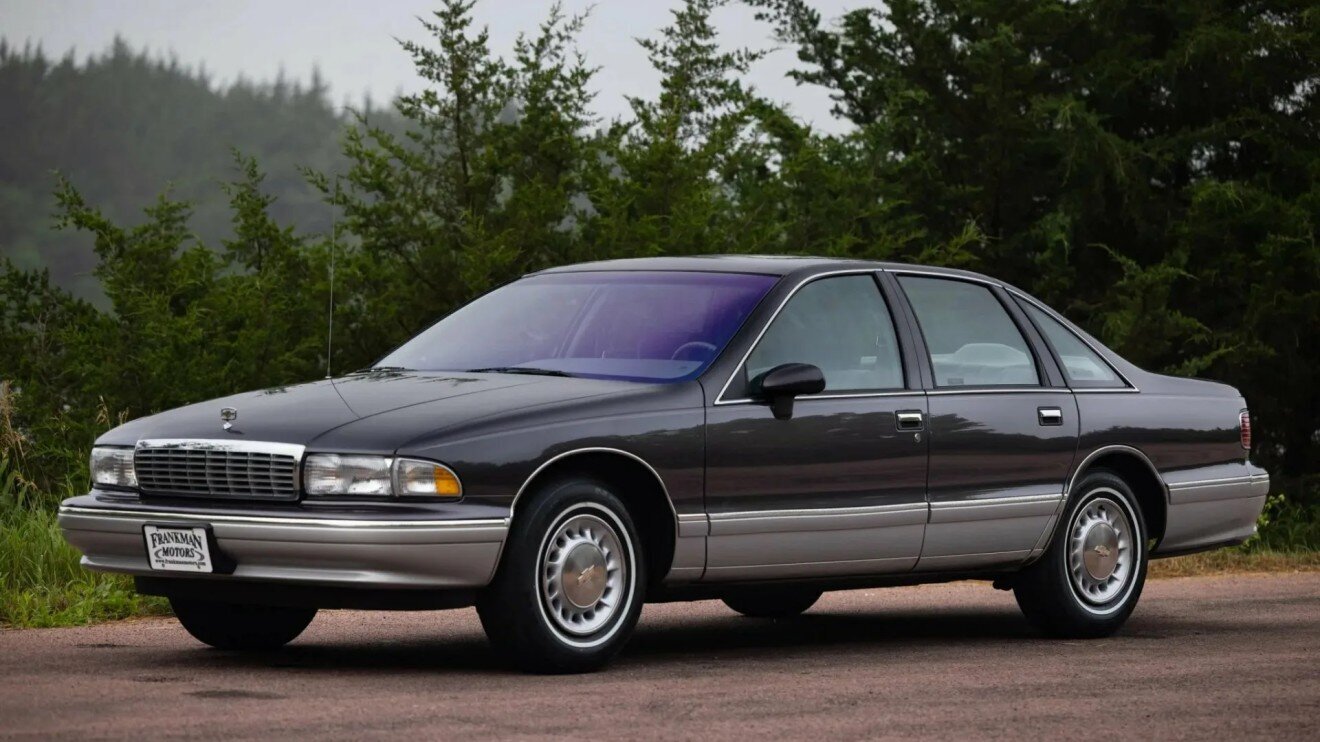
The Chevrolet Caprice was produced by General Motors from 1965 to 1996 and served as the flagship model in Chevrolet's full-size lineup. Originally, in 1965, the Caprice was positioned as a luxury version of the popular Impala, but by 1966 it had become a separate model line in its own right.
In the context of the novel, set in 1993, the reference is to the fourth-generation Caprice (1991-1996), which differed radically from earlier versions with its rounded, aerodynamic design. Contemporaries nicknamed it "the bubble" or "the upside-down bathtub" for its distinctively smooth body lines.
Technical specifications
The 1993 Caprice was offered with several engine options. The base engine was a 4.3-liter V6 producing 140 horsepower, but the more popular choice was the 5.0-liter V8 with 170 hp. The most powerful option was the 5.7-liter LT1 V8 with 260 hp, fitted to the Impala SS version and police-spec models.
The car was imposingly sized: about 5.3 meters long overall, with a 2.84-meter wheelbase. It was a true "American" — big, comfortable, with a spacious cabin and a huge trunk.
The Caprice in 1990s Russia
In the early 1990s, the Chevrolet Caprice reached Russia through various channels — from official imports to "gray-market" imports through various routes. For a Russian buyer of the time, it was a car of an entirely different class compared to a domestic Lada or GAZ.
A distinctive feature of the era was that few understood the car's real price and status in the US. While in America the Caprice was considered an ordinary mid-range family sedan, in Russia it was perceived as an elite car on par with a BMW or Mercedes-Benz.
Cultural context
The novel's mention of the character Antokha, who "had a Cadillac delivered a month ago" but drives a Caprice anyway, reflects a typical situation of the time. Many "New Russians" collected American cars without always understanding their actual pecking order back in the US.
The nickname "the crocodile," which the character Zhorik gives the car, aptly captures how Russian onlookers perceived these massive American sedans. Big, chrome-laden, with a distinctive grille — they really did resemble some kind of prehistoric reptile against the backdrop of Russia's modest car fleet.
Symbolic meaning
In the context of 1993 Russian reality, the Chevrolet Caprice embodied more than just transportation — it was a symbol of success, a connection to Western culture, and a display of financial means. It was a statement car, a status car, telling everyone around that its owner had "made it" — succeeded in the new economic reality.
Paradoxically, it was often these "ordinary" American cars, like the Caprice, that made a bigger impression on Russian onlookers than genuinely expensive European marques, which were less familiar to the general public.