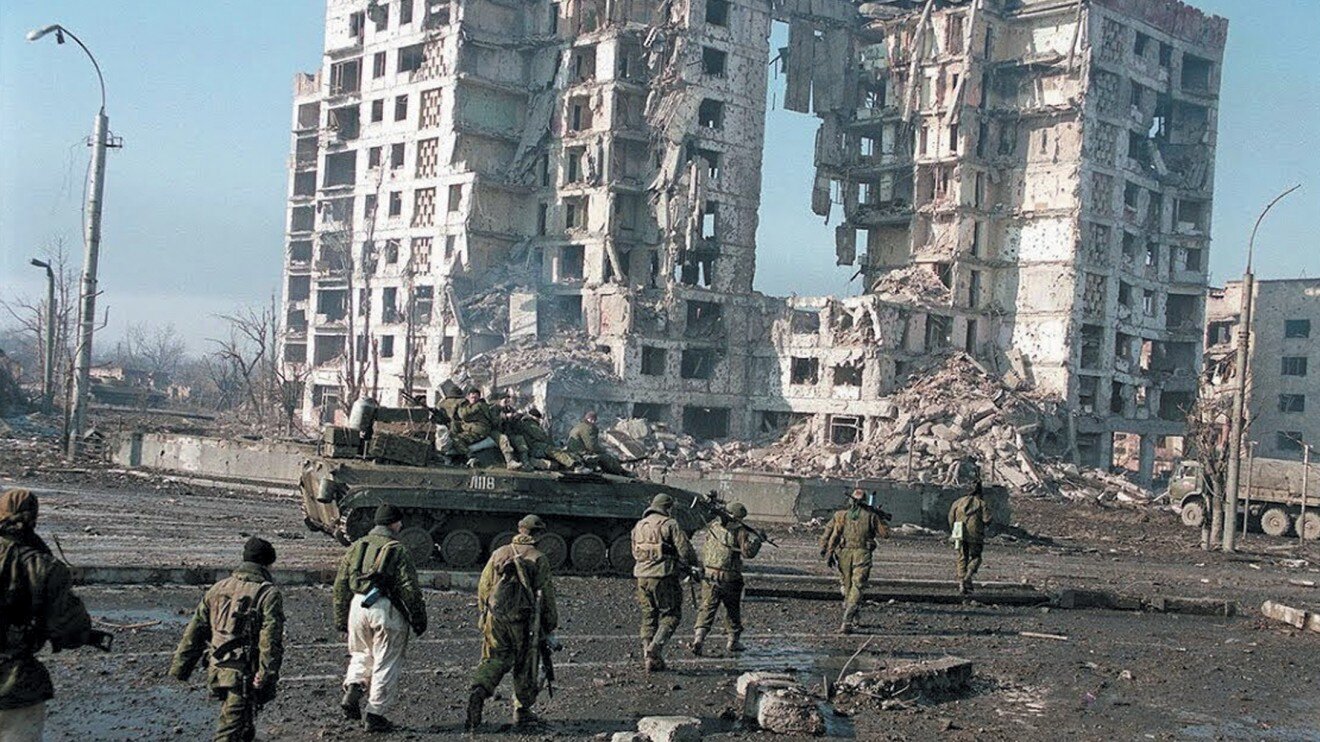
One of the most tragic and disastrous military episodes of the First Chechen War, named for its timing — the New Year’s Eve of 1994–1995.
Background
After the USSR’s collapse in 1991, the Chechen Republic of Ichkeria was formed under General Dzhokhar Dudayev, declaring independence from Russia. By 1994, an internal conflict had broken out in the republic between Dudayev’s supporters and an opposition backed by Moscow.
On December 9, 1994, President Boris Yeltsin signed a decree calling for the «disarmament of all illegal armed formations» in Chechnya. On December 11, Russian forces began advancing on the republic’s capital, Grozny, in four columns.
The Plan of Operations
The operation called for taking the city with four federal-force groupings:
- The Northern Group (Major General K. Pulikovsky) — tasked with capturing the Presidential Palace
- The Western Group (Major General V. Petruk) — advancing on the railway station
- The Eastern Group (Major General N. Staskov) — advancing from Khankala airport
- The Northeastern Group (Lieutenant General L. Rokhlin) — advancing along the Petropavlovskoye highway
The assault force totaled more than 15,000 personnel, around 200 tanks, over 500 infantry fighting vehicles and armored personnel carriers, and 200 guns and mortars.
How the Operation Unfolded
On the morning of December 31, 1994, troops entered Grozny. The operation was planned as a swift «clean-up» without serious resistance, but Chechen forces fought back fiercely, using urban guerrilla tactics.
The Northern Group suffered especially heavy losses near the railway station. The 131st Motorized Rifle Brigade under Colonel I. Savin and the 81st Motorized Rifle Regiment were ambushed and nearly wiped out. The fighters used a column-blocking tactic: they’d first knock out the lead and rear vehicles, trapping the rest of the column with no room to maneuver on the narrow city streets, then methodically pick off the trapped troops with grenade launchers and sniper rifles.
The Tragedy of the 131st Brigade
The most dramatic events unfolded near the railway station, where units of the 131st Motorized Rifle Brigade found themselves surrounded. Colonel Ivan Savin tried to break out of the encirclement with a group of about 80 men on the night of January 1, but the group was wiped out entirely. The brigade commander died along with most of his subordinates.
Attempts to relieve the encircled units led to more casualties, as both special-forces and airborne units ran into ambushes of their own.
Results and Losses
By the end of January 1, 1995, it was clear the operation had failed. Only General Rokhlin’s Northeastern Group managed to establish a foothold in the city, near the hospital complex.
Federal-force losses in the Northern Group alone came to
- Up to 343 killed
- 74 missing
- Several hundred wounded
- Up to 48 tanks destroyed
- Up to 159 infantry fighting vehicles lost
Why It Failed
The chief causes of the disaster were:
- Underestimating the enemy — the operation was planned as a «police action» expecting little resistance
- Poor preparation — many soldiers were fresh recruits straight out of training
- Outdated maps — commanders were using maps from the 1970s–80s with Soviet-era street names
- Faulty equipment — roughly 20% of the armored vehicles arrived non-operational
- Lack of coordination — the groups operated independently, with communications constantly breaking down
- A rushed timetable — the operation was launched ahead of schedule
Historical Significance
The New Year’s storming of Grozny became a symbol of the tragedy of the First Chechen War and exposed the Russian army’s lack of readiness for a new kind of conflict. The failure forced military leadership to rethink tactics for urban combat.
Many of those who were wounded or concussed in that fighting later went to work in private security firms, putting their combat experience to use in civilian life — exactly the kind of veterans that mid-1990s corporate security departments were looking for.