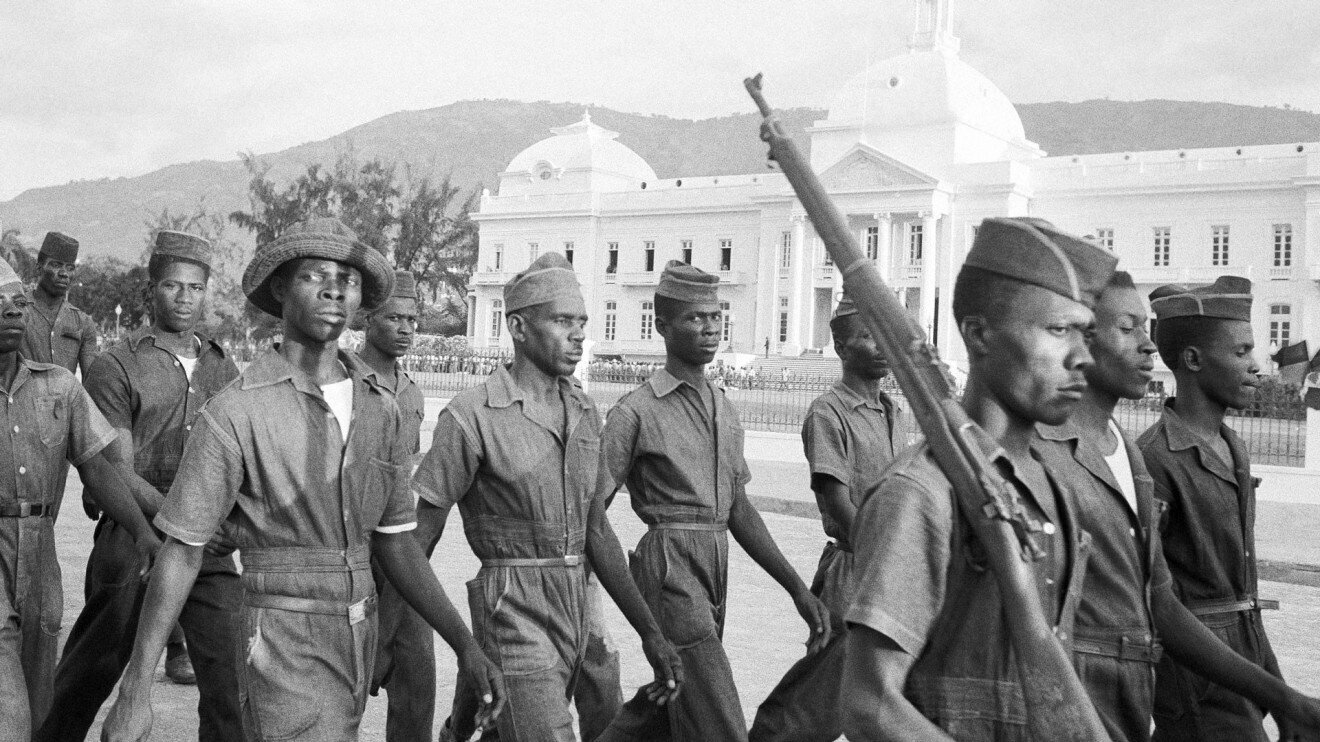
The Historical Prototype
The Tonton Macoutes (from Haitian Creole for «Uncle with the sack») were the infamous paramilitary force created by dictator François Duvalier in Haiti in 1959. The name references a local folklore figure who kidnaps disobedient children. In reality, they served as the dictator’s personal guard, combining the functions of secret police, death squads, and an instrument of economic racketeering.
How the Original Tonton Macoutes Operated
Their defining traits included:
- Direct personal loyalty to the leader (first Duvalier senior, later his son)
- Use of voodoo rituals to intimidate the population
- A blend of state and criminal functions
- No fixed salary, but a right to «self-finance»
- A distinctive, intimidating look — sunglasses, straw hats
The Russian Adaptation of the Term
In the context of the novel «Roman Peskov» (set in 1996), the term «Tonton Macoutes» takes on a new meaning while preserving the essence of the phenomenon. That’s what the main characters call:
«A combined detachment of financiers and Chicha’s athletes»
These are professional «raiders» of a new type, who:
- Operate on the pattern «seize the enterprise → change its legal form → purge management»
- Combine legal savvy with brute force («Chicha’s athletes»)
- Work for shadow bosses («Zhorik» in the novel)
- Get a cut of successful operations instead of a fixed salary
Parallels With the Haitian Prototype
Despite the gap in culture and era, Russia’s 1990s «Tonton Macoutes» reproduce the key traits of the original:
| Trait | Haitian Tonton Macoutes | Russian «Tonton Macoutes» |
|---|---|---|
| Legal status | Semi-official formations | Unofficial «working groups» |
| Methods | A mix of legal and illegal | Legal schemes plus forceful pressure |
| Funding | Racketeering and confiscation | A cut of seized assets |
| Image | Sunglasses, straw hats | Expensive suits, an «athletic» build |
Social Context
The appearance of such formations in Russia in 1996 was driven by:
- A weak law-enforcement system
- The ongoing redistribution of property
- The merger of organized crime and business
- The militarized aesthetic of a transitional era
The term «Tonton Macoutes» here isn’t just a metaphor — it’s a precise label for a new social type: professional enforcer-raiders, operating at the seam between law and crime in a weak state.
Literary Meaning
In the novel, this image:
- Symbolizes the wild capitalism of the 1990s
- Underscores the era’s grotesqueness
- Provides historical perspective through the parallel with the Haitian dictatorship
- Creates a recognizable «enforcer-entrepreneur» type
Through this image, the author shows how, in a legal vacuum, archetypal forms of violent property redistribution reproduce themselves, only dressed up in new economic terminology.