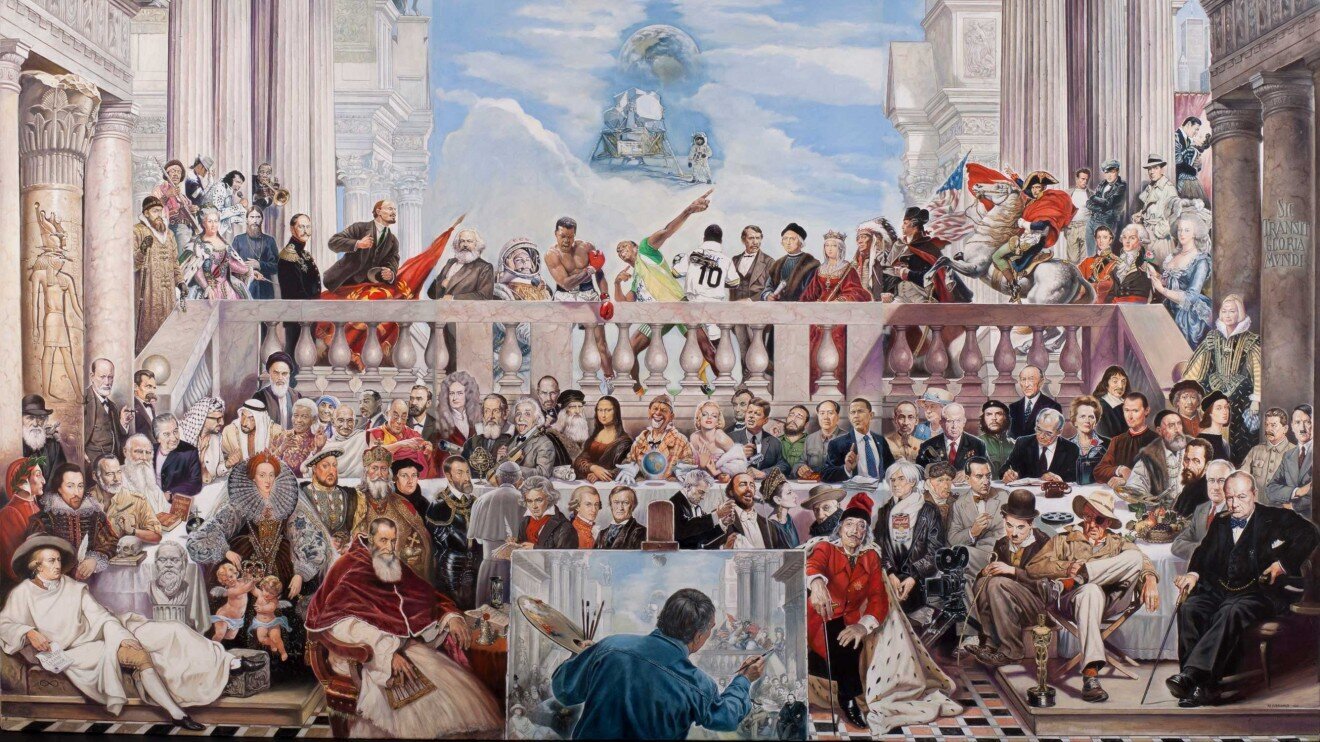
The Latin catchphrase "Sic transit gloria mundi" translates as "Thus passes the glory of the world," and is one of the best-known philosophical sayings about the transience of earthly greatness.
Origin of the phrase
The phrase is a slight reworking of a line from the famous book by the German mystic philosopher Thomas a Kempis (15th century), "The Imitation of Christ." Kempis's original reads: "O quam cito transit gloria mundi" — "Oh, how quickly passes the glory of the world."
The phrase became widespread thanks to the Catholic tradition. These words are spoken during the solemn ceremony enthroning a new pope. A scrap of cloth or tow is burned three times before the pontiff, symbolizing the transience of all earthly things — power, glory, wealth. It is a reminder to the new head of the Catholic Church that even the highest earthly honors are fleeting.
Context in the novel
In the context of 1990s Russia, the phrase takes on a particular bitter relevance. Robert (Robik), the son of a defecting diplomat, learns the truth of this ancient Latin wisdom through his own fate. Not long before, he had lived comfortably, with an apartment and a dacha, enjoying all the benefits his father's position in the diplomatic corps provided.
But after his father "abandoned his post and his colleagues," becoming a renegade, the family instantly lost every privilege. The dacha was seized, the apartment faced confiscation, and Robert was forced to live with his grandmother in a modest two-room apartment in Zyuzino — a residential district on the outskirts of Moscow.
Symbolic meaning
The mention of the Latin maxim at the close of the account of Robert's fall is no accident. The author underscores that the young man, who received a good education (he's a university student), can now grasp the meaning of these words fully — not as an abstract philosophical truth, but as a painful personal reality.
"The dust of Zyuzino's streets" — a metaphor for his current existence — stands in contrast to his former comfort. Robert learns firsthand what it means to fall from social heights, to lose status and privilege.
Historical relevance
For Russia in the early 1990s, the theme of the collapse of old authorities and values was especially painful. Many families of the Soviet nomenklatura, diplomats, party functionaries, lost their standing overnight. Robert's story is the story of an entire generation of children of the Soviet elite, who suddenly found themselves in harsh new conditions.
The Latin phrase, in the character's mouth, sounds not like pompous recitation but like a bitter acknowledgment of reality. The classical education given to diplomats' children now serves only to phrase one's own defeat more elegantly.
Thus passes the glory of the world — a truth that, in an age of social upheaval, takes on a particular, almost physically tangible weight.
In the context of the novel, "Sic transit gloria mundi" becomes the leitmotif of an era — a time when not only individual fates but an entire system of values was collapsing, when yesterday's privileged citizens found themselves at the bottom of society, and yesterday's outcasts got their chance at a rise.
Used here as an attention-grabbing image is a painting by the Italian artist Renato Casaro, titled "Sic transit gloria mundi." Casaro is a noted artist specializing in movie posters and historical compositions.
The painting depicts a grand allegorical composition in the style of classic Renaissance canvases, but with a modern subject. At the center of a classical temple or palace are gathered dozens of famous historical figures from different eras — from ancient philosophers and artists to 20th-century political leaders, scientists, writers, musicians, and other outstanding figures of human history.
Among the figures one can recognize:
- Leonardo da Vinci (with a palette, at the bottom)
- Albert Einstein
- The Mona Lisa
- Various political leaders
- Writers and artists
- Scientists and inventors
The title "Sic transit gloria mundi" ("Thus passes the glory of the world") fits the painting's concept perfectly — all these great figures, for all their fame and achievements in life, are ultimately subject to the law of time and mortality.
The composition recalls famous group portraits like Raphael's "School of Athens," but with a contemporary take on the theme of the transience of earthly glory. The painting is available as a limited edition (150 copies of each size), signed and numbered by the artist.