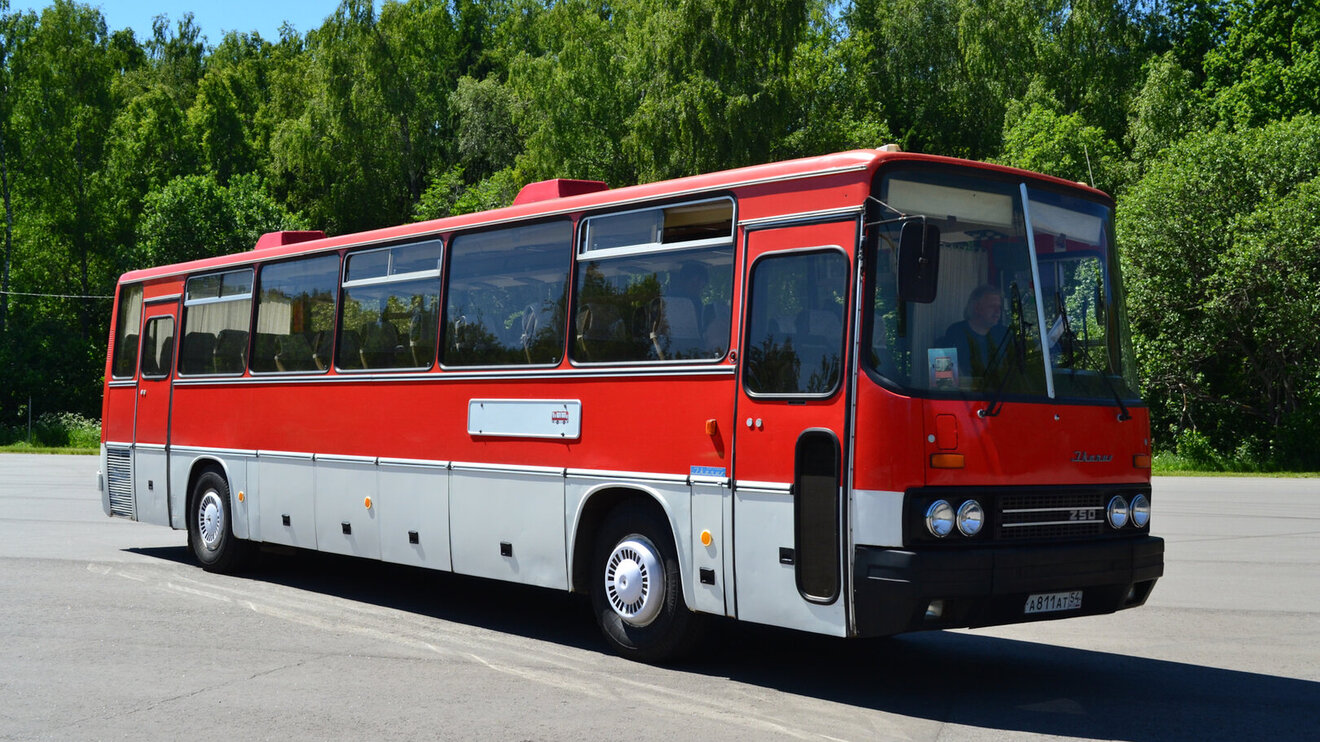
The mention of an "Ikarus" bus in the novel's text is no accident — these Hungarian vehicles were an inseparable part of the post-Soviet Russian urban landscape of the early 1990s. By 1993, when the novel is set, "Ikaruses" were firmly established in Russian cities and had become a symbol of quality public transit.
History of its arrival in the USSR
The Hungarian company Ikarus was founded in 1895 as a blacksmith and carriage-making workshop in Budapest. Its name comes from the mythical Icarus, the figure who, according to ancient Greek myth, tried to fly to the sun on wings of wax. Mass deliveries of buses to the USSR began in the 1960s, under trade and economic agreements between the socialist bloc countries.
The first 804 buses arrived in the Soviet Union in 1966. By the mid-1980s, annual deliveries reached nearly 8,000 vehicles. Between 1966 and 1990, more than 100,000 Hungarian buses were delivered to the USSR, making up a significant share of the public transit fleet in major cities.
Design features and public perception
"Ikaruses" differed radically from Soviet buses in appearance and comfort. Huge panoramic windows, a square cabin cross-section (unlike the rounded shape of Soviet vehicles), and a spacious interior — all of this was seen as a mark of Western comfort and quality. Soviet citizens, especially residents of border cities like Leningrad, could compare them to Western European buses and found "Ikaruses" fully competitive.
That comfort had a downside, however. In winter, the spacious cabins with their large windows were noticeably colder than Soviet-made LiAZ or Lviv buses, despite a powerful heating system. This was especially true of the articulated models — long buses made of two sections joined by an accordion-style connector.
Economic realities
"Ikaruses" were the most expensive buses in the Soviet fleet. By the late 1980s, a single Hungarian bus cost around 75,000 transferable rubles (equivalent to roughly $83,000), four to five times the price of a Soviet LiAZ-677. According to Hungary's Minister of Heavy Industry, the USSR paid for each "Ikarus" with 19 to 21 Zhiguli cars.
Such a high price made operating "Ikaruses" cost-effective only on long intercity routes. In cities, where a ride cost 5 kopecks regardless of distance, and monthly passes were even cheaper, operating them ran at the very edge of profitability.
"Ikaruses" in 1990s Russia
After the collapse of the USSR and the dissolution of the Council for Mutual Economic Assistance (COMECON), mass deliveries of Hungarian buses stopped. Thousands of vehicles delivered over the preceding decades, however, kept running on Russian routes. By 1993, "Ikaruses" had become a familiar part of the urban landscape, especially in major cities — Moscow, St. Petersburg, Kyiv, and other hubs.
In the early 1990s, Russia even organized local assembly of new "Ikarus" buses — in Kurgan at the KAvZ plant, in Arzamas, in Moscow, and in other cities. This reflected the fact that Hungarian vehicles still had a reputation for quality and comfort.
Cultural significance
For an entire generation of Soviet and Russian people, "Ikarus" became a symbol of quality and of "foreignness." Riding a Hungarian bus was associated with comfort, especially compared to domestic vehicles. The distinctive look, the sound of the engine, the spacious cabin — all of this became firmly lodged in the collective memory of people who lived in the USSR and post-Soviet Russia.
In the context of the novel, the mention of an "Ikarus" as company transportation in 1993 is entirely plausible. Many enterprises and organizations used these buses to move employees around, including for corporate events. Renting an "Ikarus" was seen as a mark of an organization's solidity and its concern for staff comfort.
By the late 1990s and early 2000s, most "Ikaruses" had reached the end of their service life and were retired, giving way to more modern vehicles. In the memory of Russians, however, these buses remained a symbol of an entire era — the time of transition from Soviet to post-Soviet Russia, when the old still worked and the new was only just beginning to appear.