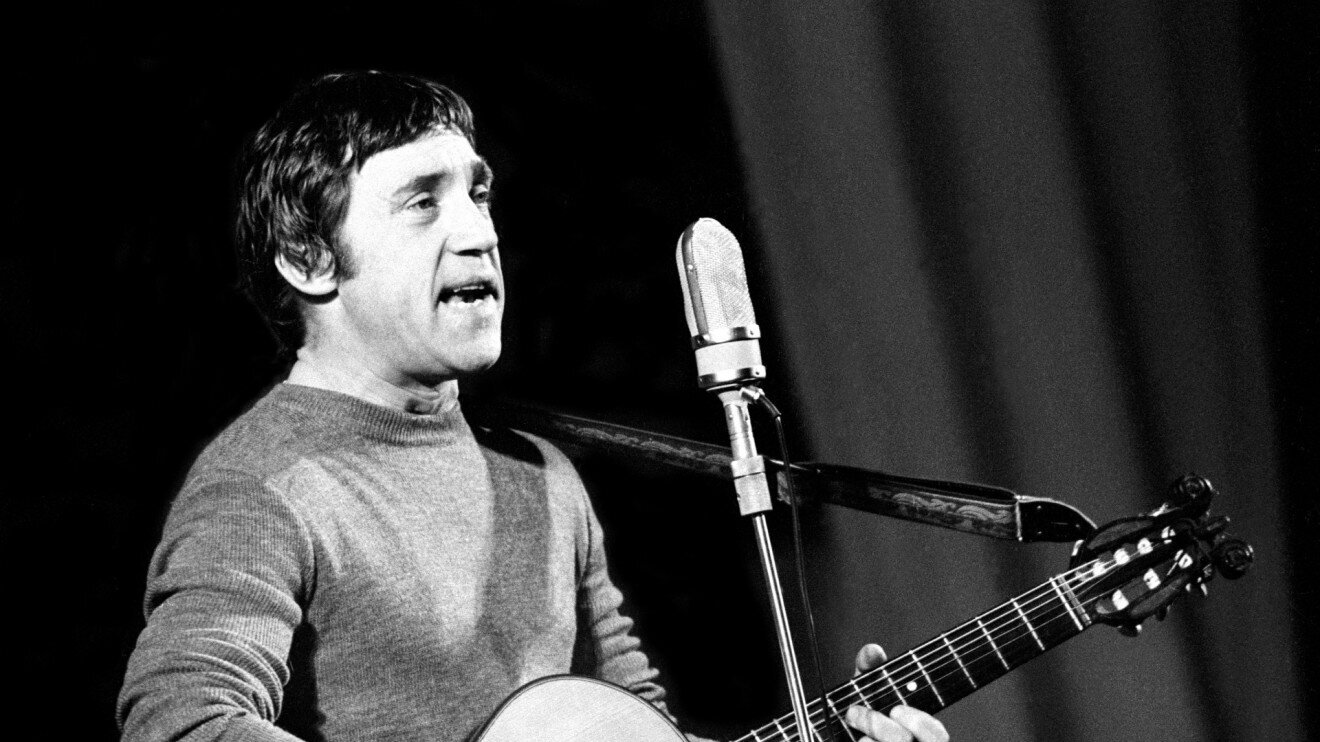
The phrase "say thanks you're alive," which the novel's protagonist hears, refers to one of the most poignant and autobiographical works by Vladimir Semyonovich Vysotsky — the poem "My Black Man in a Grey Suit," written in 1979. This poem belongs to the poet's late period, and stands as confessional lyric verse, in which the author takes stock of his life and creative path.
Its history and context
The phrase "thanks that you're alive" has a particular history in Vysotsky's body of work — the poet returned to it three times over the course of his career, and each time it took on a new, deeper resonance.
The first instance (1969) — a humorous poem, where the phrase serves as an ironic refrain to life's everyday troubles:
"So what if things with your wife aren't quite right,
So what if your head's not all there,
So what if you got robbed in the entryway, —
Just say thanks that you're still alive!"
In this early version, Vysotsky, with his characteristic black humor, runs through various life troubles — from marital problems to illness and beatings — ending each verse with the phrase "just say thanks that you're still alive." The poem closes with a philosophical question: "Whom should I thank, that I'm alive!"
The second instance (1977) — a poem dedicated to Yuri Lyubimov, artistic director of the Taganka Theatre. Here, the phrase takes on a more serious tone, tied to the fate of the theater and its founder under Soviet conditions:
"Ah, how lucky you were to be born
Almost at the same time as the country!
You lived through with it everything it went through.
Just say thanks that you're alive."
In this poem, Vysotsky recreates biographical moments from the life of the Taganka and Yuri Lyubimov, mentioning specific productions and events. Especially notable is this quatrain: "'To be or not to be?' we didn't cross out for nothing. / Of course — to be, but only staying alert. / Do you remember, the rigging came crashing down? — / But everyone's alive, thanks to Dupak." This refers to a real incident, when a heavy metal rigging structure for the stage curtain, designed by artist David Borovsky, collapsed during rehearsals for "Hamlet." By some miracle, no one was hurt, even though the structure fell directly onto the spot where the actress playing Ophelia was meant to be lying.
The third instance (1979) — the poem "My Black Man in a Grey Suit," written a year before the poet's death. Here the phrase no longer serves as a refrain, but appears just once, with maximum emotional force and tragic weight. It marks the culmination of the theme of survival throughout Vysotsky's work.
Analysis of the final version
Vysotsky's threefold return to the phrase "thanks that you're alive" shows the evolution of his worldview and creative method — from a humorous reworking of everyday troubles in 1969, through reflections on the fate of a theater and a specific man under Soviet reality in 1977, to a deeply personal confession and philosophical reckoning with his own fate in 1979.
Each version reflects a stage of the poet's life: youth, with its ironic attitude toward troubles; maturity, with an understanding of the complexity of human fates under a totalitarian society; and finally, a premonition of the end, when life itself comes to be seen as a gift one must give thanks for.
The poem's central line — "Thanks that you're alive" — rings with bitter irony. The lyrical speaker addresses his "black man" — a composite image of those who pressed down on the poet, broke him, but could not destroy him entirely. This "black man" appears in various guises: "He was a minister, a building superintendent, an officer," symbolizing the entire system of Soviet bureaucracy and control.
The image of the "black man" runs deep in Russian literature — one need only recall Pushkin's poem "The Black Man," or the work of other poets. In Vysotsky's hands, this image takes on a social and political resonance, becoming the embodiment of a repressive machine that "struck below the belt suddenly, without reason."
Autobiographical context
The poem is dense with autobiographical detail. Vysotsky really did "burst into offices," trying to explain himself to officials, making promises: "Never again!" He traveled abroad often, which stirred resentment and envy: "He jets off to Paris the way we'd go to Tyumen." The poet was accused of living beyond his means, of receiving huge fees: "They gossiped about his dacha and his pay: / Saying he's rolling in money, forging it by night."
Especially painful were the rebukes of fellow poets, who, "patting him on the shoulder, just a touch condescending," offered "helpful advice": "You shouldn't rhyme: 'I cry — I'm high'!" This line refers to Vysotsky's famous song "Ornery Horses" ("Koni Priveredlivye"), which contains that very rhyme, criticized at the time as supposedly lowbrow.
Its philosophical resonance
The poem carries "Hamlet-like" motifs, characteristic of Vysotsky's late work. The poet reflects on choice, on an artist's calling, on the fact that "there's one path, only one, friends — / luckily, I'm given no choice." This echoes his famous poem "My Hamlet," written in 1972 after the play's premiere at the Taganka Theatre.
The image of death in the poem is no accident — by 1979, Vysotsky's health had been seriously undermined. "She's been circling near me for a long time, / The only thing she feared was my hoarse voice" — these lines proved prophetic. His hoarseness was Vysotsky's trademark, his recognizable signature, which became a symbol of his sincerity and raw intensity.
Its place in the poet's body of work
"My Black Man in a Grey Suit" belongs to the confessional lyric poetry that especially defined Vysotsky's work in the 1970s. As the scholar S.I. Kormilov has noted, the poet's lyric verse in this period "takes on a quality of deepened philosophical reflection, meditating on the fundamental questions of existence." Other poems in this vein include "I'm Not Here — I've Left Russia...," "On Fatal Dates and Numbers," and "When I Have Sung My Last and Played My Last...".
A hallmark of Vysotsky's poetics is the fusion of the intensely personal and intimate with the socially significant and public. In "My Black Man in a Grey Suit," the poet's individual fate becomes a symbol of the fate of the artist under a totalitarian society, where a creative individual is forced to constantly justify their own existence.
Its cultural influence
The phrase "Thanks that you're alive" became proverbial, often used in situations where a person has survived critical circumstances, where the outcome could have been fatal. In the context of the 1990s, when the novel is set, this phrase takes on a particular resonance — an era of criminal violence and economic chaos, when one genuinely could "say thanks you're alive."
Vysotsky's work saw a fresh surge of popularity in the 1990s. Songs that had been semi-banned in the Soviet era now played openly. The poet became a symbol of truth, sincerity, and resistance to the system. His poems and songs were seen as prophetic — much of what he wrote about in the 1960s and '70s had become reality by the 1990s.
Its literary significance
"My Black Man in a Grey Suit" is a unique example of 20th-century Russian confessional lyric poetry. It fuses the traditions of classical Russian poetry (from Pushkin to Yesenin) with the sharpness of contemporary social commentary. Vysotsky created a new type of lyric hero — not an abstract Romantic, but a concrete man of his own time, with all his troubles and pain.
The poem's poetics rest on contrast: a living, colloquial intonation combined with elevated poetic imagery, everyday detail alongside philosophical generalization, irony alongside tragedy. This layering makes the work not just an autobiographical document, but an artistic distillation of an era.
Conclusion
Using the phrase "say thanks you're alive" in a novel about 1996 Russia is no accident. It points the reader toward one of Vysotsky's most powerful works, about an artist's survival in a hostile environment, about the price of talent, and about how sometimes mere existence can already be counted a victory. In the context of the wild nineties, this phrase carries particular weight, a reminder that under extreme conditions, the highest value is life itself.
Vladimir Vysotsky died on July 25, 1980, but his words continue to resonate, especially sharply at history's turning points, when people once again find themselves facing a choice between life and death, between truth and compromise, between creation and conformity.