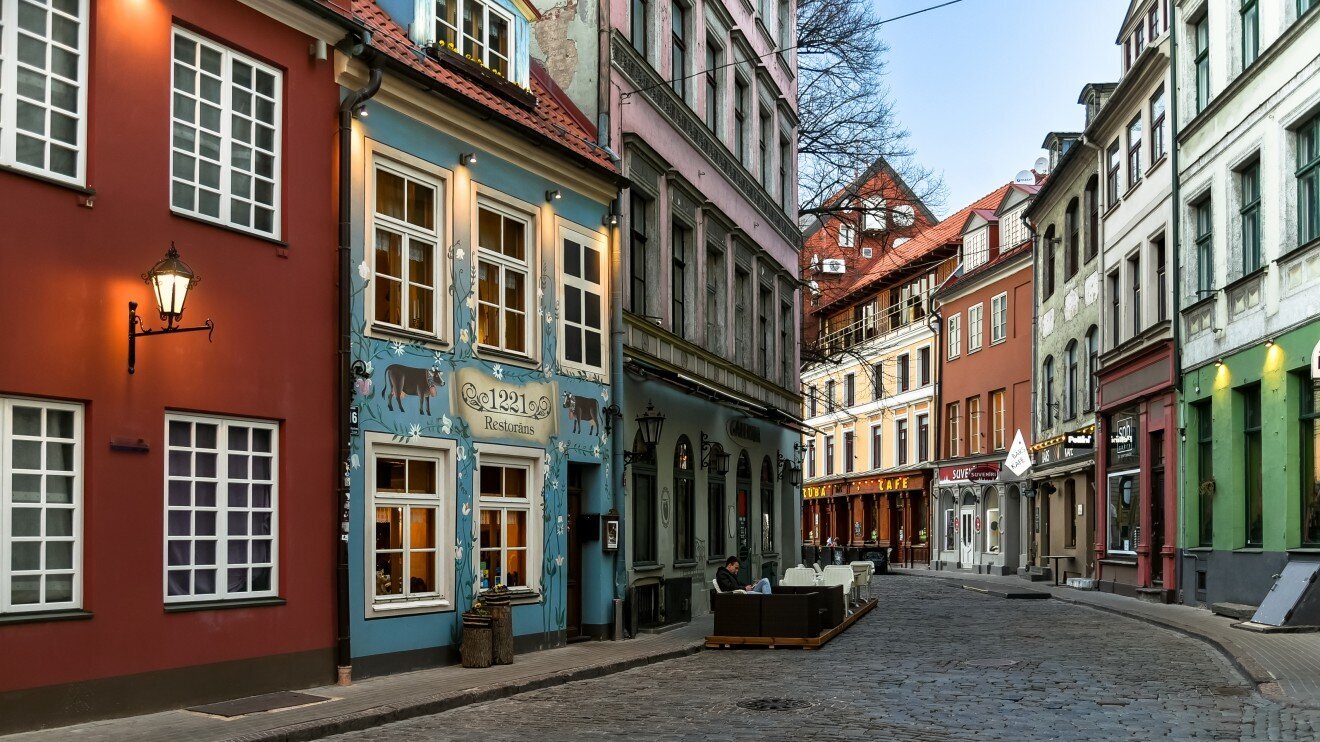
The hero’s mention of Tallinn and Riga in connection with London calls back to one of the most vivid phenomena of Soviet cinema: director Igor Maslennikov’s television cycle «The Adventures of Sherlock Holmes and Doctor Watson» (1979–1986).
Why London looked like Tallinn and Riga
For Soviet viewers, the image of London was shaped largely by the famous Sherlock Holmes series, in which Victorian London was portrayed using the architecture of Baltic cities, above all Tallinn and Riga. The impossibility of filming in the real London during the Iron Curtain era forced the filmmakers to look for suitable locations within the USSR.
Tallinn, with its medieval Old Town architecture, was ideally suited to conjuring the atmosphere of foggy late-nineteenth-century London. Narrow cobbled streets, the Gothic silhouettes of churches, ancient buildings with distinctive facades – all of it created a convincing illusion of the English capital.
Riga played a particularly important role in constructing the image of London. The famous Baker Street, where Holmes and Watson lived, was filmed on Riga’s Jauniela Street (No. 22). Interestingly, that same street stood in for Flower Street in Bern in «Seventeen Moments of Spring.» In the first installment of the saga, «The Acquaintance» (1979), when Stamford leads Watson to his first meeting with Holmes through a park, the Latvian Academy of Art is visible in frame, and Enoch Drebber descends the steps of the Latvian National Museum of Art.
Filming of «The Hound of the Baskervilles» (1981) took place mainly on two streets of Old Tallinn – Hobusepea and Pikk. It was here that the city scenes played out: Holmes and Watson tailing Sir Henry Baskerville, visiting Barrymore’s office. The famous Baskerville Hall was played by two Tallinn castles at once – Glehn Castle and the Orlov-Davydov castle in Pirita.
The phenomenon of the Soviet Holmes
Igor Maslennikov’s series became a genuine cultural phenomenon. The first film premiered on March 22, 1980, and immediately gained enormous popularity. Vasily Livanov and Vitaly Solomin, in the roles of Holmes and Watson, became the definitive performers of these characters not just for Soviet audiences but for foreign ones as well.
Interestingly, the series received positive reviews in England itself. British critics noted that its creators had treated the source material with great care, and that the atmosphere of Conan Doyle’s works had been conveyed with genuine love for the classic detective genre. In 2006 Vasily Livanov was made an honorary Officer of the Order of the British Empire for his portrayal of the famous detective.
Baltic cities as «abroad» in Soviet cinema
The Estonian and Latvian capitals played the role of «abroad» not only in the Sherlock Holmes films. As film scholars note, Tallinn and Riga appeared in Soviet cinema in three main guises: the fairy-tale city, the medieval city, and abroad. Their old streets were transformed into medieval France and England, becoming backdrops for everything from children’s fairy tales to adult science fiction.
Riga was so popular as a filming location that dozens of Soviet films were shot there. Sherlock Holmes so thoroughly entered the life of the Latvian capital that Riga residents took to marking his birthday every year with costumed festivals featuring parades, quests, and Victorian-style tea parties.
Among other notable films shot in Tallinn and Riga
- «Hamlet» (1964) by Grigori Kozintsev — a model of Elsinore Castle was built on the Türisalu cliff in Tallinn;
- «The Arrows of Robin Hood» (1975) — filmed in Riga and Liepāja;
- «Theatre» (1978) — London street scenes were shot in Riga;
- «An Ideal Husband» (1980) — London street scenes were filmed in Old Riga;
- «Midshipmen, Forward!» (1987) — the series finale was shot in Tallinn;
- «The Black Arrow» (1987) — the narrow streets of old Tallinn became the setting for the cinematic battles between the supporters of Lancaster and York;
- «The Musketeers, Twenty Years Later» (1992) — the musketeers’ reunion scenes were filmed at St. Brigitta’s Convent.
Architectural authenticity
Why exactly did Tallinn and Riga so convincingly stand in for London? The truth is that the architecture of the old quarters of these cities genuinely has much in common with the historic districts of European cities. Hanseatic traditions, Gothic elements, distinctive street layouts – all of it created the necessary atmosphere.
The filmmakers were meticulous about detail. The Kaplan family of art directors studied Sidney Paget’s illustrations to capture the atmosphere of a Victorian English home. Cinematographer Yuri Vexler devised the famous pipe-smoking silhouette of Holmes that became the series’ calling card.
Influence on the popular imagination
By the mid-1990s, the Soviet Sherlock Holmes series had already become a classic and had shaped an entire generation’s idea of what London ought to look like. Lines from the film became household phrases, and Livanov’s and Solomin’s portrayals of Holmes and Watson became the standard against which all others were measured.
That’s precisely why, for a hero who’d grown up in the Soviet era, London was associated with the narrow streets of Tallinn and Riga from his favorite film. The real London, with its wide streets and utterly different architecture, came as a surprise.
Interestingly, Baker Street in the real London has always been, and remains, far wider and busier than film typically depicts it.
The legacy of Soviet cinema
The phenomenon of «The Adventures of Sherlock Holmes and Doctor Watson» shows how Soviet cinema knew how to construct convincing images of inaccessible foreign realities. The impossibility of traveling abroad forced directors to seek creative solutions within the country, and those solutions often turned out to be so successful that they became definitive.
Tallinn and Riga became a kind of «window onto Europe» for Soviet cinema, allowing it to create believable images of Western cities. This was especially important under conditions of isolation, when most Soviet viewers had no way to compare cinematic «abroad» with reality.
The mention of Tallinn and Riga in connection with London in a novel set in 1996 reflects this cultural phenomenon — for an entire generation of Soviet people, the image of London remained inseparable from the Baltic capitals, thanks to Igor Maslennikov’s brilliant series.