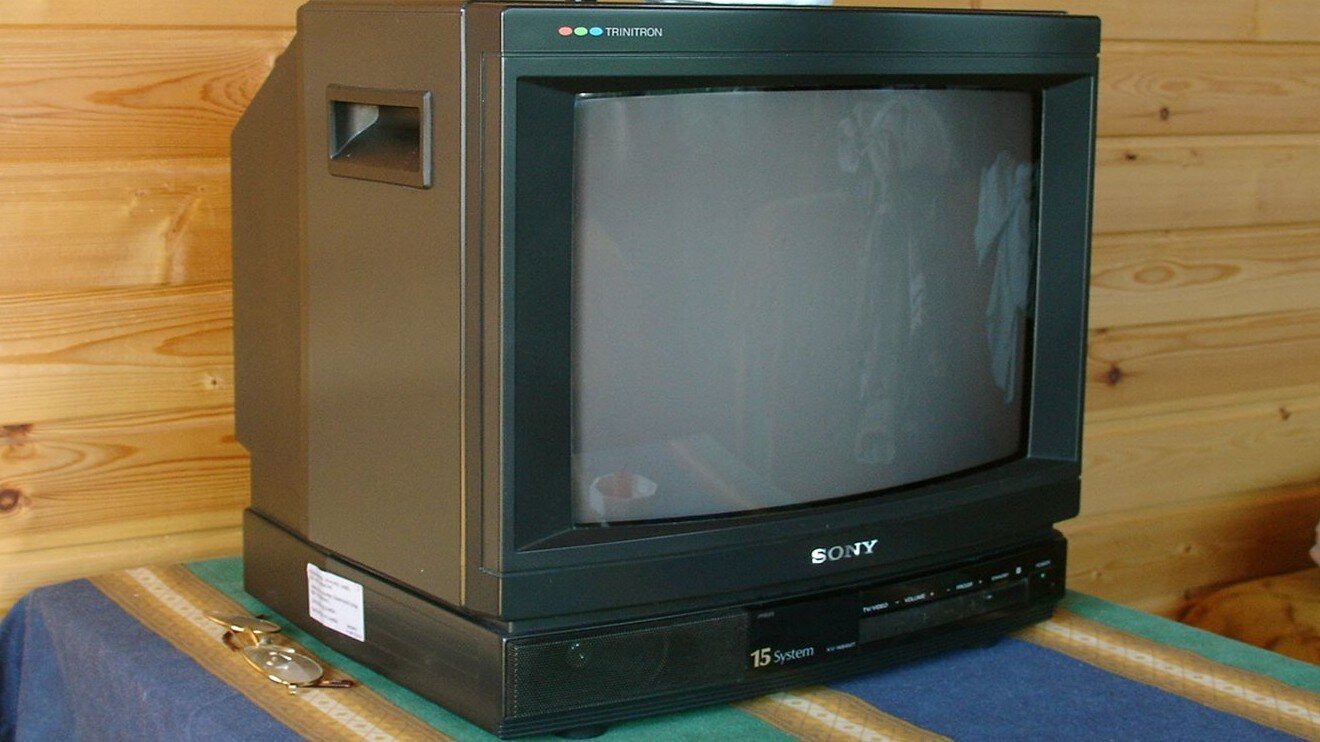
Sony Trinitron was a revolutionary line of televisions and monitors developed and produced by the Japanese corporation Sony starting in 1968. The name «Trinitron» combines «trinity» and «electron,» reflecting the technology's use of three electron beams.
Trinitron's major technical breakthrough was a single-gun, three-beam cathode ray tube with a cylindrical, vertically flat screen surface and an aperture grille in place of a shadow mask. Traditional color CRTs used a shadow mask — a metal plate with tiny holes that restricted where electron beams could strike the phosphor dots. Trinitron replaced this mask with a grille of vertical metal strips, which allowed image brightness to increase by 25 to 100 percent compared to conventional televisions.
Features of Trinitron technology:
- Enhanced brightness and contrast
- Improved color rendering thanks to a single electron gun
- A distinctive cylindrical screen shape (flat vertically, slightly curved horizontally)
- One or two horizontal damper wires, visible against a bright image background
- A cleaner, sharper picture than competing technologies
By 1993, Sony Trinitron televisions had become synonymous with top-tier picture quality. Models with a 29-inch screen were considered large and prestigious. In early-1990s Russia, owning such a television was a mark of considerable wealth and status, since the cost of such equipment was many times an average monthly salary.
In the USSR and post-Soviet Russia, Sony Trinitron televisions first appeared as imported items, brought in by shuttle traders or purchased at specialty shops for diplomats and foreigners. After the borders opened, imported electronics flooded the Russian market, but remained affordable only to well-off citizens.
About Sony
Sony Corporation is a Japanese multinational corporation, founded May 7, 1946, by Akio Morita and Masaru Ibuka. The company was originally called Tokyo Telecommunications Engineering Corporation, renamed Sony in 1958. The name derives from the Latin word «sonus» (sound) and the English slang word «sonny» (a young boy).
By the start of the 1990s, Sony had already established itself as one of the world's leading consumer electronics makers, known for innovative products:
- The world's first transistor radio (1955)
- The Walkman, a personal cassette player (1979)
- Trinitron televisions (from 1968)
- The Betamax videocassette format (1975)
- Compact discs, co-developed with Philips (1982)
- Handycam camcorders
In 1989, Sony acquired the American film studio Columbia Pictures, marking the company's expansion into entertainment. By 1993, Sony was no longer just an electronics manufacturer but a significant player in the music and film industries as well.
In early-1990s Russia, Sony was associated with the highest quality, prestige, and Western technology. Sony products were the object of many Soviet and Russian citizens' dreams and were a standard item among the goods brought back by shuttle traders from abroad.