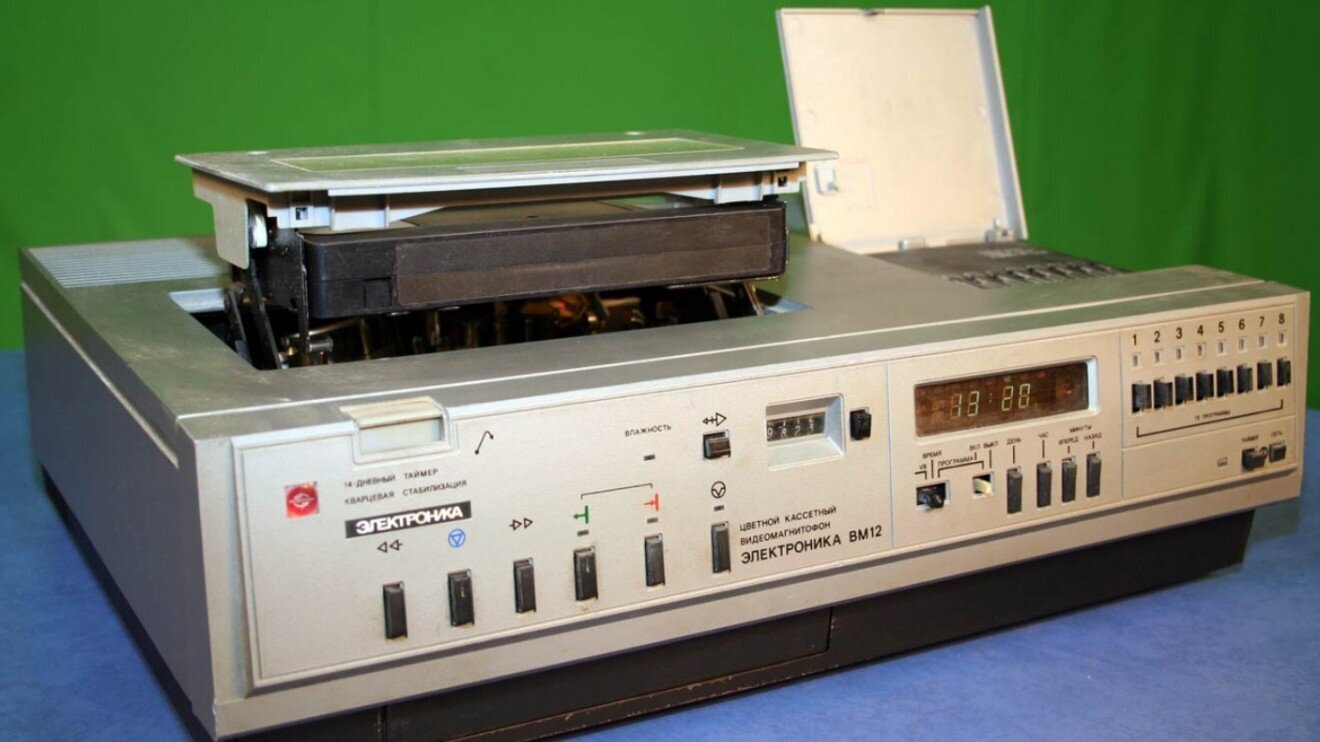
Elektronika VM-12 was the first mass-produced Soviet home VHS-format VCR, manufactured from 1984 to 1995. It was developed from the Japanese Panasonic NV-2000 VCR, whose specialized production equipment had been purchased from Japan.
The prototype was initially called «Video-82.» Production was set up at the Elektronika research-and-production association (Voronezh) and Pozitron (Leningrad), as well as the Videofon plant (Voronezh), Spektr (Novgorod), the «24th Party Congress» plant (later renamed Transvit, Novgorod), and Tantal (Saratov). Individual components were manufactured across different cities: the tape-transport mechanics at Tantal, the video heads at the Ferrit plant, and the housings in Belgorod.
Initially the VCR was produced with two front-panel variants: one with wide horizontal buttons and a dark, semi-transparent insert like the Japanese prototype, and another with the same insert covering the full front panel and color-coded mode indicators. Later models featured narrow black vertical control buttons and housings in various colors: silver-gray (the classic option), dark gray, brown, and, in later models, unpainted black ABS plastic.
Despite its considerable price (1,200 rubles), the Elektronika VM-12 was a scarce commodity. Early in production, manufacturing costs exceeded the retail price, and the state subsidized output. To cut costs the design was continually refined and simplified, and it wasn't until 1988 that the VCR stopped being a money-losing product.
The unit featured top-loading (container-style) cassette insertion, an eight-channel tuner, a digital clock with a four-program, 14-day timer, and a mechanical tape counter. The VCR could record color and black-and-white television broadcasts from an antenna onto VK-30, VK-60, VK-90, VK-120, and VK-180 format cassettes, and could handle VHS-C tapes with an adapter.
Its technical specifications included: 625-line television signal resolution, a 50 Hz field frequency, a luminance resolution of at least 240 lines, support for both PAL and SECAM color systems, a slant-track FM recording system with two rotating video heads, a tape speed of 2.339 cm/s, an audio frequency range of 100-8,000 Hz, and power consumption up to 43 watts.
By the end of 1991, production of the Elektronika VM-12 had dropped significantly, the model having become technologically obsolete as more advanced imported alternatives entered the market following market reforms. Even so, it remains the most widely produced VCR ever manufactured in the USSR and Russia, both by production run and total units sold.
Note: The VCR came with vouchers for the purchase of 10 videocassettes, since blank cassettes were themselves a scarce item, rarely found in open retail.