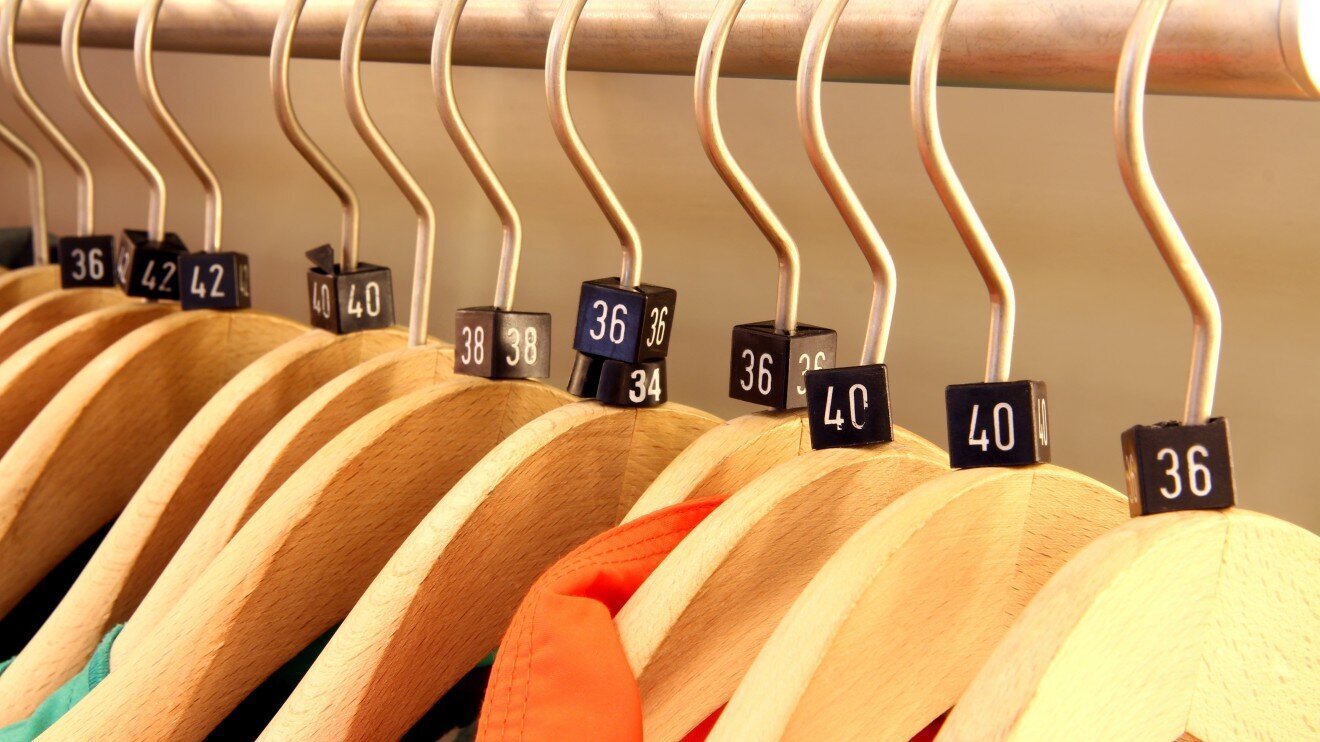
Introduction to clothing size systems
A clothing size designation is a code corresponding to certain linear measurements of the human body a given garment is designed for. Many different sizing systems exist around the world, which often creates confusion when choosing clothes, especially when buying imported goods.
The Soviet size chart was developed based on anthropometric studies of the USSR's population, and differed significantly from European standards. These differences persisted into the 1990s, when Russia's light industry still used Soviet GOST standards, while imported clothing came labeled with European sizes.
The Soviet (Russian) sizing system
Principles of the Soviet size chart
In the USSR, clothing sizes were set by GOST standards, which established precise measurements for each size. Key measurements formed the basis for determining size:
- For men's clothing: chest circumference (the primary parameter)
- For women's clothing: chest and hip circumference
- For trousers: waist and hip circumference
- For shoes: foot length in millimeters
Men's sizes in the USSR
Men's clothing sizes in the USSR were denoted by even numbers from 44 to 64 and above. The size was calculated as half the chest circumference in centimeters:
| USSR size | Chest circumference (cm) | European equivalent |
|---|---|---|
| 44 | 88 | 38 |
| 46 | 92 | 40 |
| 48 | 96 | 42 |
| 50 | 100 | 44 |
| 52 | 104 | 46 |
| 54 | 108 | 48 |
Thus, size 48 under the Soviet system corresponded to a chest circumference of 96 centimeters, and was a fairly common size among average-build men.
Women's sizes in the USSR
Women's sizes were likewise determined by chest circumference, but additional measurements were factored in — waist and hip circumference:
| USSR size | Chest circumference (cm) | European equivalent |
|---|---|---|
| 40 | 80 | 34 |
| 42 | 84 | 36 |
| 44 | 88 | 38 |
| 46 | 92 | 40 |
| 48 | 96 | 42 |
The European sizing system
The development of European standards
In Europe, each country traditionally had its own sizing system, creating considerable inconvenience for international trade. In an attempt at unification, the EN 13402 system was developed, using centimeters as the unit of measurement.
National quirks in European sizing
The German system
German sizes are calculated using the formula: size = (chest circumference - 12) / 2. For example, with a chest circumference of 96 cm: (96 - 12) / 2 = size 42.
The French system
French sizes: size = (chest circumference - 8) / 2. For the same 96 cm chest circumference: (96 - 8) / 2 = size 44.
The Italian system
Italian sizes: size = chest circumference / 2. At a 96 cm circumference, this gives size 48, which happens to match the Soviet system — but this is coincidental.
| Chest circumference (cm) | USSR/Russia | Germany | France | Italy |
|---|---|---|---|---|
| 88 | 44 | 38 | 40 | 44 |
| 92 | 46 | 40 | 42 | 46 |
| 96 | 48 | 42 | 44 | 48 |
| 100 | 50 | 44 | 46 | 50 |
Letter-based size labels
The international S, M, L, XL system
Alongside numeric sizing, a letter-based system built on English words is widely used around the world:
| Label | Stands for | Meaning | Soviet size (men's) |
|---|---|---|---|
| XS | eXtra Small | very small | 44 |
| S | Small | small | 46 |
| M | Medium | medium | 48 |
| L | Large | large | 50 |
| XL | eXtra Large | very large | 52 |
| XXL | eXtra eXtra Large | very very large | 54-56 |
Thus, Soviet size 48 corresponds to M (Medium) in the international letter-based system.
Shoe sizes
The Soviet shoe-sizing system
In the USSR, shoe sizes were determined by foot length in millimeters, rounded to the nearest whole number. The interval between sizes was usually 5 mm.
The European shoe-sizing system
European shoe sizes are based on foot length as well, but use a different scale. The European size is usually 1–2 units smaller than the Russian one:
| Foot length (cm) | USSR/Russian size | European size | US size (men's) | UK size |
|---|---|---|---|---|
| 25.5 | 40 | 40 | 7.5 | 6.5 |
| 26.0 | 41 | 41 | 8 | 7 |
| 26.5 | 42 | 42 | 8.5 | 8 |
| 27.0 | 43 | 43 | 9.5 | 9 |
| 27.5 | 44 | 44 | 10 | 9.5 |
Shoe size 42 in the Soviet system corresponded to a foot length of about 26.5 centimeters, and was one of the most common men's sizes.
Practical aspects of size conversion
Basic conversion rules
Men's clothing
European size = Russian size - 6
Example: 48 (Russian) = 42 (European)
Women's clothing
European size = Russian size - 6
Example: 48 (Russian) = 42 (European)
Shoes
European size ≈ Russian size - 1
Example: 42 (Russian) ≈ 41 (European)
How this played out in the 1990s
During the 1990s, Soviet GOST standards and the newly appearing European standards on imported clothing were used simultaneously in Russia. This created a certain amount of confusion, especially for consumers accustomed to the Soviet sizing system.
Store clerks were often forced to explain the size equivalents to customers, and many imported goods began carrying dual labeling — both European and Russian.
Standardization and the present day
GOST R 53230-2008
Russia currently follows GOST R 53230-2008, which sets size designations for certain kinds of clothing (underwear, nightwear, men's and boys' dress shirts). This standard largely preserves continuity with the Soviet system.
The European standard EN 13402
Europe has attempted to introduce a unified standard, EN 13402, which uses centimeters as its unit of measurement. The standard includes several parts:
- EN 13402-1: Terms, definitions, and body measurement procedure
- EN 13402-2: Primary and secondary dimensions
- EN 13402-3: Body measurements and intervals
- EN 13402-4: Coding system
Conclusion
Understanding the differences between the Soviet (Russian) and European clothing size systems remains relevant even today. Knowing that Russian size 48 corresponds to European size 42 and to size M in the international letter-based system helps in choosing clothing correctly when buying imported goods.
It's worth remembering that size charts can vary between different manufacturers and brands, so when buying clothing it is always advisable to check a specific manufacturer's size chart and, where possible, try items on before buying.