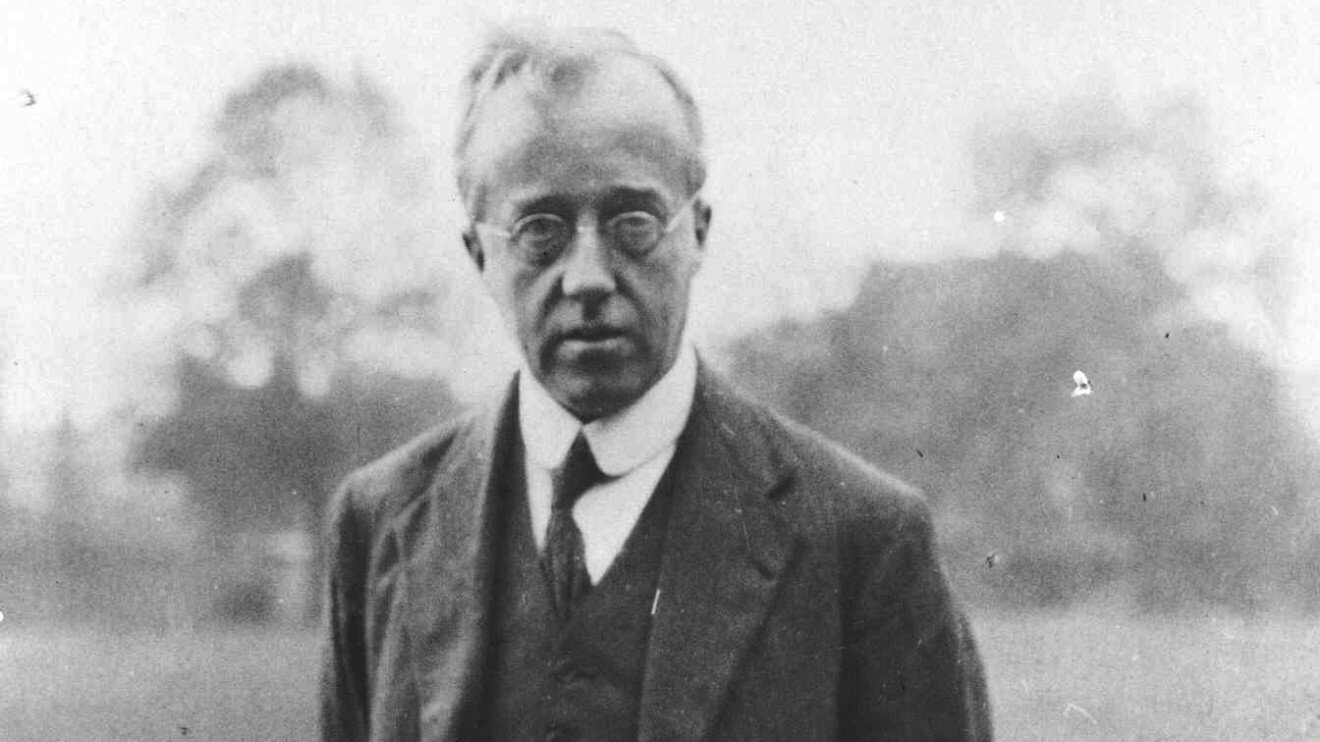
Gustav Theodore Holst (1874-1934) was an English composer whose name is permanently written into the history of music thanks to his revolutionary orchestral suite "The Planets." This work, created at a turning point in European history, became one of the most influential and recognizable compositions of the 20th century.
The composer's biography
Gustav Holst was born on September 21, 1874, in Cheltenham, Gloucestershire, into a family of professional musicians. His full name at birth was Gustavus Theodore von Holst — the family was of mixed Swedish-Latvian-German descent. The composer's great-grandfather, Matthias Holst, served as a composer and harp teacher at the court of the Russian emperor in St. Petersburg.
Holst's musical abilities showed early, but his road to recognition was a difficult one. Poor health — asthma, weak eyesight, and neuritis affecting his hands — seriously complicated his musical studies. As a child he studied piano and violin, later taking up the trombone, hoping that playing a wind instrument would help his asthma.
In 1893, Holst entered the Royal College of Music in London, where he studied composition. Money was desperately short, which led him to become a vegetarian and teetotaler, partly out of economy, partly out of conviction. After finishing college, he worked as a trombonist in various orchestras, including the Carl Rosa Opera Company, while also teaching in schools.
In 1901, Holst married Isobel, and in 1907 their daughter Imogen was born, who later became a musicologist and her father's biographer. From 1905 until his death, Holst held the post of director of music at St Paul's Girls' School in Hammersmith, and from 1907 to 1924 he also taught at Morley College.
Creative influences
Holst's work took shape under a variety of influences. In his early years, he was strongly influenced by Richard Wagner and Richard Strauss. Then came the significant role played by the early-20th-century revival of interest in English folk music, as well as the work of contemporary composers such as Maurice Ravel.
A special place in Holst's work was occupied by his fascination with Sanskrit literature. After reading the works of Max Müller, he became interested in the texts of the Rigveda, and even studied Sanskrit at University College London so he could make his own translations. This fascination is reflected in works such as the opera "Sita" (1899-1906), the chamber opera "Sávitri" (1908), and the "Choral Hymns from the Rig Veda" (1908-1914).
Holst was also influenced by the revival of the 16th-century English madrigal tradition. He was especially drawn to the work of Thomas Weelkes, whom he considered his favorite Tudor-era composer.
The road to "The Planets"
The idea for "The Planets" arose in 1913, during a trip Holst took to Spain with friends, including the writer Clifford Bax, who introduced the composer to astrology. Holst became so absorbed in the subject that astrology became his "pet vice" — he cast horoscopes for friends for the rest of his life.
Holst wrote to a friend: "I only study things that suggest music to me. That is why I worked at Sanskrit. Recently the character of each planet has suggested lots to me, and I have been studying astrology fairly closely." The composer described "The Planets" as "a series of mood pictures," working as "foils to one another."
Composing the suite "The Planets" (1914-1917)
Work on "The Planets" continued for nearly three years, from 1914 to 1917. Holst could only work on the composition on weekends and during holidays, given his heavy teaching schedule. The situation was made worse by a flare-up of neuritis in his right hand — without the help of his colleagues Vally Lasker and Nora Day, whom he called his "scribes," he would not have been able to complete the 198-page score.
"Mars" was the first to be written, in mid-1914, followed by "Venus" and "Jupiter" later that year, "Saturn" and "Uranus" in mid-1915, "Neptune" later in 1915, and "Mercury" in early 1916. Holst completed the orchestration in 1917.
The suite is scored for a huge orchestra, unusual for the time. Ralph Vaughan Williams noted: "Holst uses a very large orchestra in 'The Planets,' not to make his score look impressive, but because he needs the extra coloring, and knows how to use it."
The orchestra's makeup
- Woodwinds: four flutes, three oboes, English horn, three clarinets, bass clarinet, three bassoons, contrabassoon
- Brass: six horns, four trumpets, three trombones, tenor tuba, tuba
- Percussion: six timpani, triangle, snare drum, tambourine, cymbals, bass drum, tam-tam, bells, glockenspiel, xylophone
- Other instruments: organ, celesta, two harps
- Strings: a full string section
- Chorus: a women's chorus in the finale of "Neptune"
The suite's structure
The suite consists of seven movements, each named for a planet and its astrological character:
- Mars, the Bringer of War — 8 minutes 19 seconds
- Venus, the Bringer of Peace — 8 minutes 21 seconds
- Mercury, the Winged Messenger — 4 minutes 24 seconds
- Jupiter, the Bringer of Jollity — 8 minutes 29 seconds
- Saturn, the Bringer of Old Age — 7 minutes
- Uranus, the Magician — 5 minutes 20 seconds
- Neptune, the Mystic — 5 minutes 33 seconds
"Mars, the Bringer of War" — an analysis of the first movement
"Mars," the suite's opening movement, creates the atmosphere of a relentless war machine. It is one of the most innovative and influential parts of the whole work, anticipating many musical discoveries of the 20th century.
Musical features
The movement is written in 5/4 time, extremely unusual for the period. This uneven rhythm creates a sense of a mechanical, yet at the same time menacing, tread. The music begins quietly — the first two bars are played by percussion, harp, and strings using col legno (striking the strings with the wood of the bow). Gradually the music builds in power, reaching a climax at quadruple forte.
Colin Matthews, a contemporary British composer, notes that for Holst himself, "Mars" was "an experiment in rhythm and the collision of tonalities," and that its violence in performance "could have startled him as much as it electrified early audiences."
Harmonic innovations
Michael Short highlights the abundance of harmonic dissonance in "Mars," often arising from collisions between moving chords and static pedal tones. He compares this effect to a similar device in the finale of Stravinsky's "Firebird," adding that although battle music had been written before (for example, by Richard Strauss in "Ein Heldenleben"), "it had never expressed such violence and sheer terror."
Historical significance
Paradoxically, "Mars" was completed before the start of the First World War, which makes it all the more prophetic. Holst had no interest in glorifying military feats — on the contrary, his aim was to show the reality of war in all its brutality. This was a radical departure from traditional heroic war music.
The relentless 5/4 ostinato, the grim trumpet calls, and the mounting dissonance create an image not of romanticized war but of mechanized conflict, anticipating the horrors of the First World War. In this sense, "Mars" can be considered one of the first works to foretell the character of modern warfare.
The premiere and first performances
"The Planets" premiered on September 29, 1918, at the Queen's Hall in London. Adrian Boult conducted before an invited audience of about 250 people. The story of this concert is a notable one: Holst was about to leave for service with the YMCA in Salonika, and the composer Balfour Gardiner arranged a farewell concert for him, providing the hall and orchestra for an entire Sunday morning.
Imogen Holst left a vivid account of the premiere's impression: "Even those listeners who had studied the score for months were staggered by the surprise of hearing the actual sound of 'Mars.' During 'Jupiter' the charwomen, who had been cleaning the passages, put down their brooms and began dancing. During 'Saturn' the few listeners in the dark, half-empty hall found themselves growing older with every bar."
The first public performance took place in February 1919, when Boult presented the work to a general audience. Interestingly, the conductor considered half an hour of such radically new music the limit for a first hearing, and performed only five of the seven movements.
Critical reception
The initial critical reaction was mixed. Of the 37 reviews of the first four public performances, 28 were positive. A minority of critics, however, was hostile. The Globe called the music "noisy and pretentious," The Sunday Times called it "pompous, blatant and unattractive," and The Times called it "a great disappointment... laboriously contrived and painful to the ear."
Notably, The Times quickly changed its view. By July 1919, the paper already called Holst the most intriguing of his contemporaries, and by the composer's death in 1934 it rated "The Planets" as "Holst's greatest work."
The influential critic Ernest Newman noted that Holst could do "easily, without fuss" what other composers could only do "with a grunt and a grimace," and that in "The Planets" he had revealed "one of the subtlest and most original minds of our time."
Innovations and influence
The musical language of "The Planets" was revolutionary for its time. Holst used unusual time signatures, ascending and descending scales, ostinati, bitonality, and occasionally polytonality. These devices set him apart from other English composers.
Especially innovative was the finale of "Neptune," with its gradually fading wordless women's chorus — a device unusual for orchestral works of the period, though Debussy had already used a similar effect in his "Nocturnes" (1900).
Orchestration
Holst, as an experienced orchestral musician, understood music from the performer's point of view. Ralph Vaughan Williams noted that the confident command of the orchestra distinguishing Holst's orchestral works owed much to the fact that he was himself an orchestral musician, and had learned his craft "not at second hand, from textbooks and models, but from real, lived experience."
The astrological concept
Although astrology served as the starting point for "The Planets," Holst reworked traditional astrological characteristics to suit his own artistic design. He ignored certain important astrological factors, such as the influence of the Sun and Moon, and assigned the planets certain non-astrological qualities of his own.
The order of the movements does not follow the order of the planets' orbits around the Sun — Holst's only criterion was maximum musical effectiveness. This approach made it possible to create a dramatically compelling sequence, beginning with the disquieting "Mars" and closing with the mystical "Neptune."
Characteristics of the suite's movements
1. Mars, the Bringer of War
The suite's best-known and most influential movement. Its relentless 5/4 rhythm, martial trumpet calls, and harmonic dissonances create a unique expression of the violence and terror of war. The music embodies the reality of war, not heroic deeds.
2. Venus, the Bringer of Peace
A contrast to "Mars" — calm, resigned music with elements of nostalgia. Holst incorporated music from his unfinished vocal work "A Vigil of Pentecost" into this movement.
3. Mercury, the Winged Messenger
Fast music with irregular meters and rapid changes of theme, depicting the swift flight of the winged messenger. This was the last movement of the suite to be written, and contains Holst's first experiments with bitonality.
4. Jupiter, the Bringer of Jollity
Lively, exuberant music, embodying "the abundance of life and vitality." The movement's central melody, which came to be called "Thaxted," later became the basis for the patriotic hymn "I Vow to Thee, My Country" (1921), which, in the view of the composer's daughter, somewhat compromised the original intent.
5. Saturn, the Bringer of Old Age
Holst's own favorite movement. A slow procession, rising to a frightening climax, then fading away, as if into the far reaches of space. Repeated chords depict the inexorable approach of old age.
6. Uranus, the Magician
A clumsy dance that gradually spins out of control (much like Dukas's "The Sorcerer's Apprentice"), until everything is swept away by the magic wand. The movement contains elements reminiscent of Berlioz's "Symphonie Fantastique."
7. Neptune, the Mystic
Quiet music in a swaying, irregular meter, with abundant use of dissonance. The orchestra falls silent at the end, and the work closes with a gradually fading, wordless women's chorus in an indeterminate key.
Influence on later music
"The Planets" had an enormous influence on the development of 20th-century orchestral music. The work influenced various rock bands, and became a source of inspiration for many film composers, including John Williams in composing the music for "Star Wars."
Holst became an important influence on younger English composers, including Edmund Rubbra, Michael Tippett, and Benjamin Britten. His student Edmund Rubbra noted how he and other young English composers adopted the economy of Holst's style: "With what enthusiasm we pared our music down to the bare bones."
Recordings and performances
Holst himself recorded "The Planets" twice with the London Symphony Orchestra: the first time in 1922-1923, acoustically, and the second time in 1926, using the new electrical recording process. Interestingly, Holst's tempos in these recordings were significantly faster than those of most later conductors.
By the start of the 21st century, at least 80 commercial recordings of "The Planets" had been made. The work is regularly performed by orchestras around the world, and remains one of the most popular works of classical music.
Adaptations and sequels
The suite has been adapted for numerous instruments and ensembles, including organ, synthesizer, brass band, and jazz orchestra. After the discovery of Pluto in 1930, attempts were made to add an eighth planet to the suite. The best known of these is Colin Matthews's "Pluto, the Renewer" (2000), commissioned by the Hallé Orchestra.
Holst's legacy
Although Holst is known above all for "The Planets," his creative legacy is much broader. He wrote many works in various genres, though none achieved comparable success. His distinctive compositional style was marked by an economy of expression, steeped in the simplicity of folk song.
Holst did not found a school of composition of his own, but had a significant influence on both his contemporaries and those who followed. Vaughan Williams called Holst "the greatest influence on my music." Among later composers, Michael Tippett is recognized as Holst's most significant artistic successor.
Holst believed a composer should write music for practical purposes — festivals, celebrations, ceremonies. As Michael Short notes, "many people who may never have heard any of his large-scale works... have nevertheless taken great pleasure in performing or singing such small masterpieces as the Christmas carol 'In the Bleak Midwinter.'"
The context of its creation
The creation of "The Planets" fell during a period of enormous upheaval in European history. Holst began work on the suite in 1914, the year the First World War began, and finished it in 1917, the year of the October Revolution in Russia. The composer himself tried to enlist in the army, but was declared unfit for military service because of his poor health.
This period was marked by heavy losses among Holst's musician friends: the composers George Butterworth and Cecil Coles were killed in action. A feeling of helplessness, and a desire to contribute to the war effort, found expression in the music of "The Planets," especially in the grim "Mars" and the pacifying "Venus."
The change of surname
In 1918, when Holst finally got the chance to serve his country as a YMCA music organizer in the Middle East, he ran into an unexpected obstacle: his surname "von Holst" sounded too German for such a role in wartime. In September 1918, he officially changed his surname to "Holst" by deed poll.
Mysticism and spirituality
Holst's fascination with astrology was part of a broader interest in mysticism and Eastern philosophy. His study of Sanskrit and ancient texts reflected a search for spiritual truth that runs through many of his works. In "The Planets," this mystical element shows most vividly in the final "Neptune," with its enigmatic, fading chorus.
Technical mastery
Vaughan Williams emphasized that Holst always said, in his music, exactly what he wanted to say, directly and concisely: "He was not afraid to be obvious when the circumstances demanded it, and he did not hesitate to be aloof when aloofness expressed his purpose."
As an experienced instrumentalist and orchestral player, Holst understood music from the performers' point of view, and made sure that, however difficult the parts, they always remained playable. According to his pupil Jane Joseph, Holst cultivated in performance "a spirit of practical fellowship... no one could know better than he the boredom possible for a professional musician, and the music that made boredom impossible."
Conclusion
"The Planets" remains the pinnacle of Gustav Holst's work, and one of the most significant works of 20th-century English music. The suite united ancient mystical traditions with modernist musical devices, creating a unique artistic statement about humanity and the cosmos.
Holst created a work that speaks a universal language about eternal themes: war and peace, youth and old age, magic and mystery. "Mars, the Bringer of War," with its prophetic depiction of mechanized conflict, became one of the most influential musical images of war in history, foreshadowing the horrors the 20th century would bring.
Holst's music, despite its sometimes stern beauty, always served people. He believed that music should be an integral part of everyday life, not a secret preserve for a leisured elite. This conviction found expression not only in "The Planets," but in all his work — from school suites to Christmas carols.
Today, "The Planets" continues to sound in concert halls around the world, inspiring new generations of composers and listeners. Holst's work remains a testament to how a great artist can transform personal passions and mystical searching into a universal artistic statement, capable of touching people's hearts across the centuries since its creation.