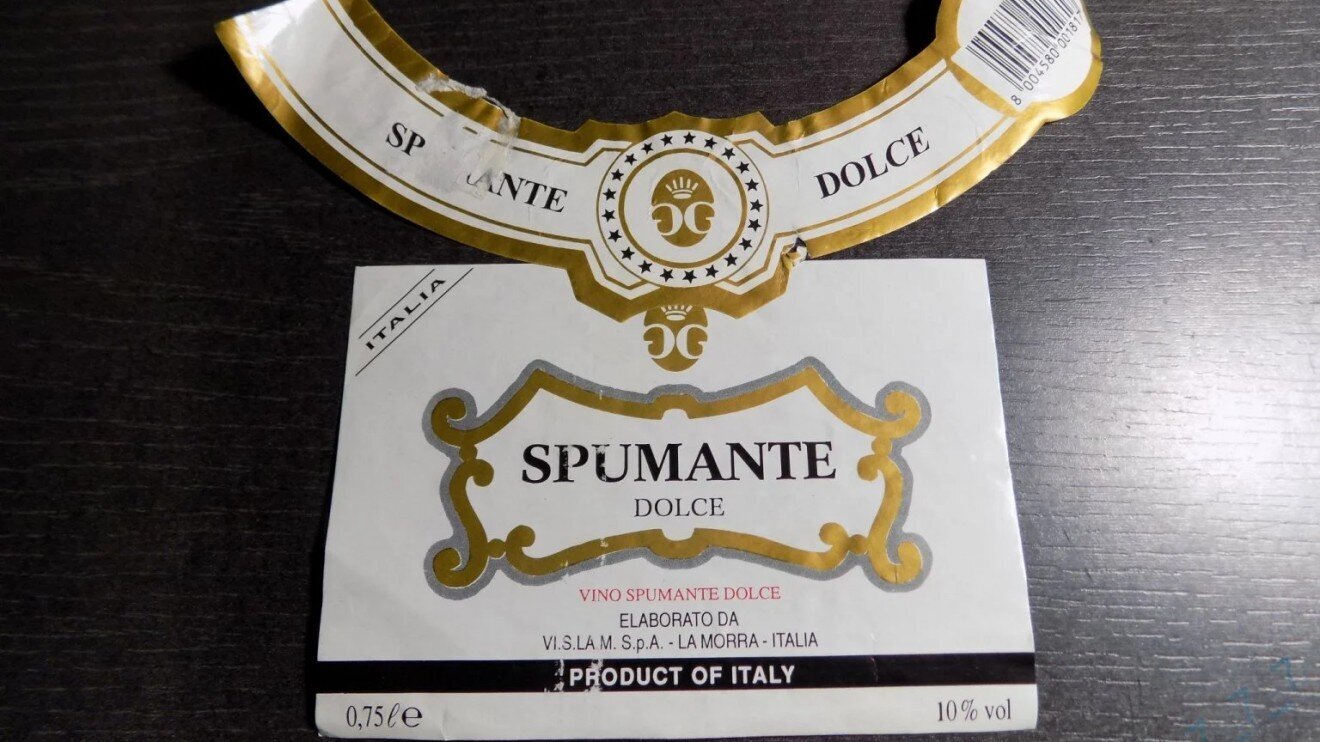
The early 1990s brought a genuine revolution to the Russian alcohol market. After decades of shortage and limited choice, Soviet consumers were suddenly confronted with an abundance of imported drinks, many of them entirely unfamiliar. One such «mysterious» product was the Italian sparkling wine with the word «Spumante» on the label.
Most Russian buyers of those years took «Spumante» for a trade mark or a grape variety, in the same way they knew «Martini» or «Cinzano.» The importers’ advertising encouraged this, since it frequently presented Spumante as a brand rather than as a description of the drink. In reality Spumante (from the Italian verb spumare, to foam, to froth) is simply the designation for sparkling wine, and may appear on the labels of a great many different Italian producers.
The term Spumante is used for sparkling wines produced by secondary fermentation — either in bottle (the metodo classico) or in stainless-steel tanks. The most popular members of the category are Prosecco (from the Glera grape) and Asti (from Moscato Bianco). By the beginning of the 1990s, Prosecco production already ran to hundreds of millions of bottles a year, making it one of the most widely made sparkling wines in the world.
Spumante on the Russian market of the 1990s
In the Russia of early capitalism, Spumante became a symbol of affordable European luxury. Unlike expensive French champagne, the Italian sparkler was relatively cheap while still carrying the prestige of «foreign» status. It was bought eagerly for office celebrations, small parties and corporate occasions.
Several factors explain Spumante’s popularity in Russia. First, Soviet citizens were thoroughly familiar with sparkling wine thanks to «Soviet Champagne,» so the new product did not feel entirely alien. Second, Italian producers were actively opening up the Russian market, offering goods across a wide price range, from budget options to the premium segment.
Characteristically, Russian consumers often preferred Spumante to other imported alcohol because of its «softness.» After strong Soviet wines and vodka, the Italian sparkler seemed lighter and less aggressive on the stomach, which was particularly prized in the corporate culture of those years, when business meetings were frequently accompanied by drink.
Cultural context
In the context of 1993, drinking Spumante in a Russian office was a marker of a certain status and of being «advanced.» It showed that the company or its staff were keeping up with the times, mastering Western standards of doing business and of consumption. The choice of sparkling wine specifically for workplace celebrations also reflected an attempt to build a more civilized corporate culture, to move away from the Soviet tradition of the vodka-and-cognac table.
It is worth noting that many Russian consumers of the 1990s, without any grasp of winemaking terminology, constructed their own hierarchy of imported sparkling wines: French champagne counted as elite, Spumante as middle-class, and domestic «champagne» as the budget option. That classification survived in the popular mind for many years, even after sparkling wines from other countries came onto the market.
The mention of Spumante in a Russian office in 1993 thus captures the spirit of the time precisely — a period of active adoption of Western consumer practices, when familiarity with imported brands was becoming part of the new social identity of an emerging middle class.