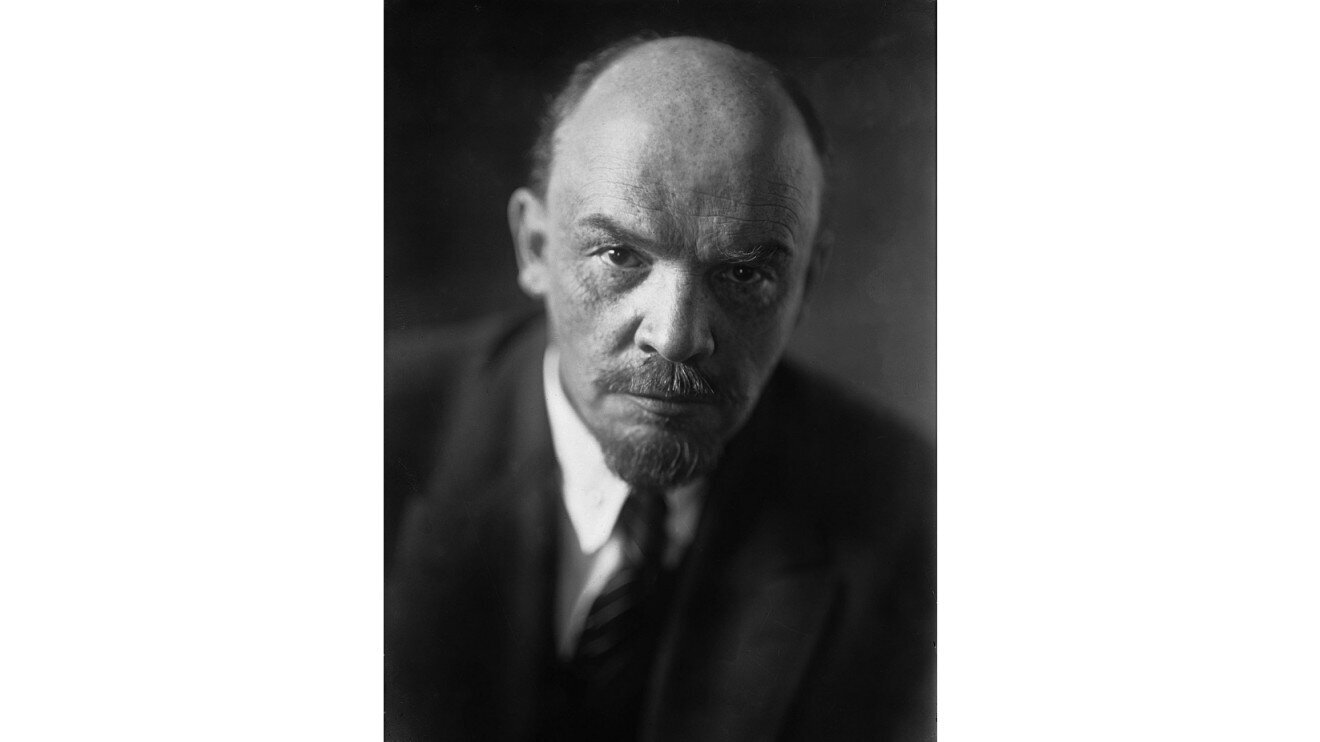
The line quoted in the novel — «I was drowning in a heap of business, in a tumult of happenings» — alludes to Vladimir Mayakovsky’s famous poem «A Talk with Comrade Lenin» (1929), in which the poet addresses the dead leader with a report on the state of the Soviet state.
How it came to be written
The poem was written at the beginning of 1929 and first published in the newspaper Komsomolskaya Pravda. By that time Vladimir Lenin had been dead for five years (he died in January 1924), and illness had removed him from affairs of state two years before his death. Mayakovsky was at the height of his creative powers: he performed constantly before audiences, wrote plays, traveled, and carried on his agitational work.
It is worth noting that Lenin himself, while alive, regarded Mayakovsky’s work with considerable reserve. The leader considered Futurism «foolishness» and the poet’s verse «artificial and bombastic.» Even so, he acknowledged the popularity of Mayakovsky’s work among young people and took that fact into account.
Composition and artistic features
The poem is built as an imagined dialogue between the lyric hero (the poet himself) and a portrait of Lenin. Its composition is circular — the ending repeats the opening motifs. In genre it combines the ode with the petition, which reflects the double nature of the author’s attitude toward his addressee: praise on one side, a plea for understanding and support on the other.
Mayakovsky uses his characteristic accentual verse with alternating rhyme and the famous «ladder» of stepped lines. The portrait of Lenin swells to mythological scale: starting with fine detail («the bristle of the mustache,» «the half-open mouth»), the poet moves to the image of an «enormous thought» on an «enormous brow.» The tautology is meant to underline the sheer power of the intellect of the man in the photograph.
Content and meaning
In the poem the lyric hero reports to Lenin on the achievements and the failings of the young Soviet state. He speaks of «hellish work» (an idiom with a telling ambiguity), of the struggle against «the destitute and the ragged» (archaic colloquialisms), of industrial successes and, at the same time, of the «trash and rubbish,» the scoundrels and shady characters who have attached themselves to the building of the new society.
Especially telling are the enumerated gradations of enemies: «kulaks, drunkards, toadies and red-tape men,» many of them occupying responsible posts. The poet sees this as a deviation from the Leninist course, but expresses confidence in the coming «purges of the ranks.»
The lyric hero stakes his hope above all on «the factories and the stubble fields,» symbolizing the worker–peasant union, the foundation of Soviet power. The closing section sounds almost like a prayer: «in your name we live and struggle.»
The context of 1993
For the novel’s hero, Roman Peskov, in 1993, this line of Mayakovsky’s takes on a particular meaning. Russia is living through a period of fundamental change: the collapse of the USSR, the emergence of a new economic system, political convulsions. The «tumult of happenings» of the 1990s echoes the revolutionary epoch Mayakovsky described — except that now it is the tumult of the destruction of the world the poet helped to build.
The line’s appearance in the context of the hero’s business troubles (the connection to the plant, the queues in the office) creates a bitter irony: where Mayakovsky «drowned in a heap of business» in the name of building a radiant future, Peskov is drowning in the chaos of its demolition. The Soviet industry the poet celebrated is now in crisis; the «sinecures are over,» and the genuinely strenuous workdays have arrived.
Its place in Mayakovsky’s work
«A Talk with Comrade Lenin» is one of the key works of Mayakovsky’s «Soviet» period. The poet returned repeatedly to the image of Lenin in his lyric verse, although he never knew the leader personally. Their acquaintance was entirely at a distance, through the poet’s work and the leader’s political activity.
The poem became a kind of manifesto of the poet’s loyalty to Soviet power, an attempt to find his place in a new system of coordinates. The tragic irony is that less than a year after writing it, in April 1930, Mayakovsky would shoot himself, unable to bear the internal contradictions of the era and of his own nature.
A Talk with Comrade Lenin
By a heap of business,
by a tumult of happenings
the day has gone,
darkening bit by bit.
Two in the room.
I
and Lenin —
a photograph
on the white wall.
The mouth open
in the strain of speech,
the bristle
of the mustache
jutting upward,
in the folds of the brow
is clenched
the human,
in that enormous brow
an enormous thought.
Beneath it, no doubt,
thousands are marching…
A forest of flags…
a grass of hands…
I rose from my chair,
lit up with gladness,
wanting —
to march,
to salute,
to report!«Comrade Lenin,
I report to you
not in the line of duty,
but from the heart.
Comrade Lenin,
the hellish work
will be
done,
and is being done already.
We are lighting,
clothing the destitute and the ragged,
the output
of coal and ore
widens…
And alongside that,
of course,
there is much,
much
assorted
trash and rubbish.
You tire
of fighting them off and biting back.
Many,
without you,
have got out of hand.
A great
many
assorted scoundrels
walk
about our land
and around it.
They have
neither
number
nor name,
a whole
filmstrip of types
unreels.
Kulaks
and red-tape men,
toadies,
sectarians
and drunkards —
they walk,
proudly
thrusting out their chests,
fountain pens all down the front
and badges on their lapels…
The lot of them
we’ll wring out,
of course,
but wringing out
the lot of them
is terribly hard.
Comrade Lenin,
across the smoking factories,
across the lands
covered
with snow
and stubble,
by your heart,
comrade,
and by your name
we think,
we breathe,
we struggle
and we live!..»
By a heap of business,
by a tumult of happenings
the day has gone,
darkening bit by bit.
Two in the room.
I
and Lenin —
a photograph
on the white wall.1929