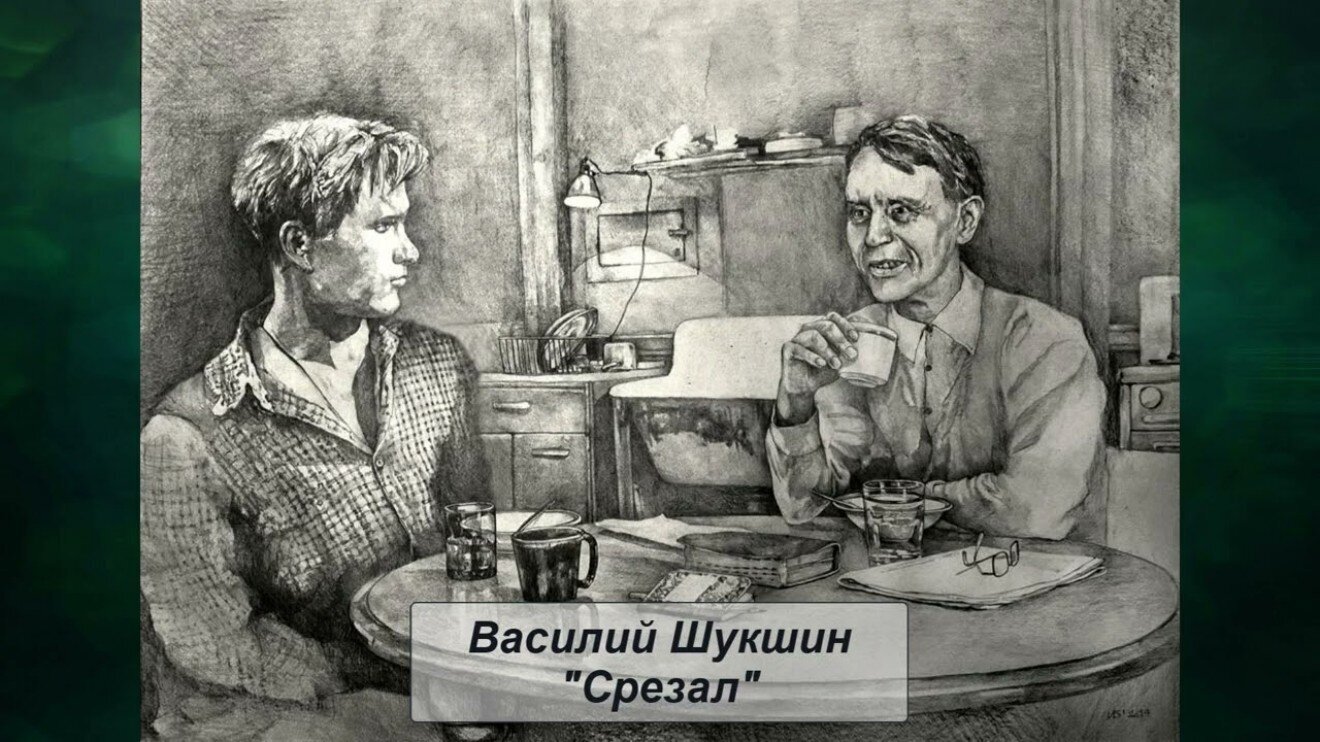
An allusion to Vasily Shukshin’s short story of the same name, written in 1970 and first published in the journal «Novy Mir.» The work appears in the collections «Characters» (1973) and «Conversations Under a Clear Moon» (1974).
In the story, the protagonist, a village resident named Gleb Kapustin, is renowned for his particular knack for «cutting down to size» educated fellow villagers who come back from the city. His method involves cornering his opponent with demagogic tricks and pseudo-intellectual questions. Gleb deliberately prepares his «intellectual traps» in order to demonstrate to the other villagers his superiority over city-educated people.
The story’s plot centers on a confrontation between Konstantin Zhuravlev, a candidate of sciences who has returned to his home village, and Gleb Kapustin, who comes to visit the scholar with the sole aim of publicly humiliating him with elaborate questions about the primacy of spirit versus matter, weightlessness in philosophy, and the problems of shamanism.
Shukshin himself called «Srezal» his favorite story in the collection «Characters,» noting that the character’s behavior stems from certain complexes — as he put it, it’s a kind of spiteful revenge for having been, so to speak, passed over at the feast.
The story has become a textbook example of social demagoguery and verbal manipulation. The character of Gleb Kapustin joined the gallery of Shukshin’s famous «chudiki» — eccentric, idiosyncratic village characters with contradictory inner lives. In contemporary linguistics and communication theory, «Srezal» is used as a classic example of an artificially manufactured verbal conflict and demagogic dialogue.