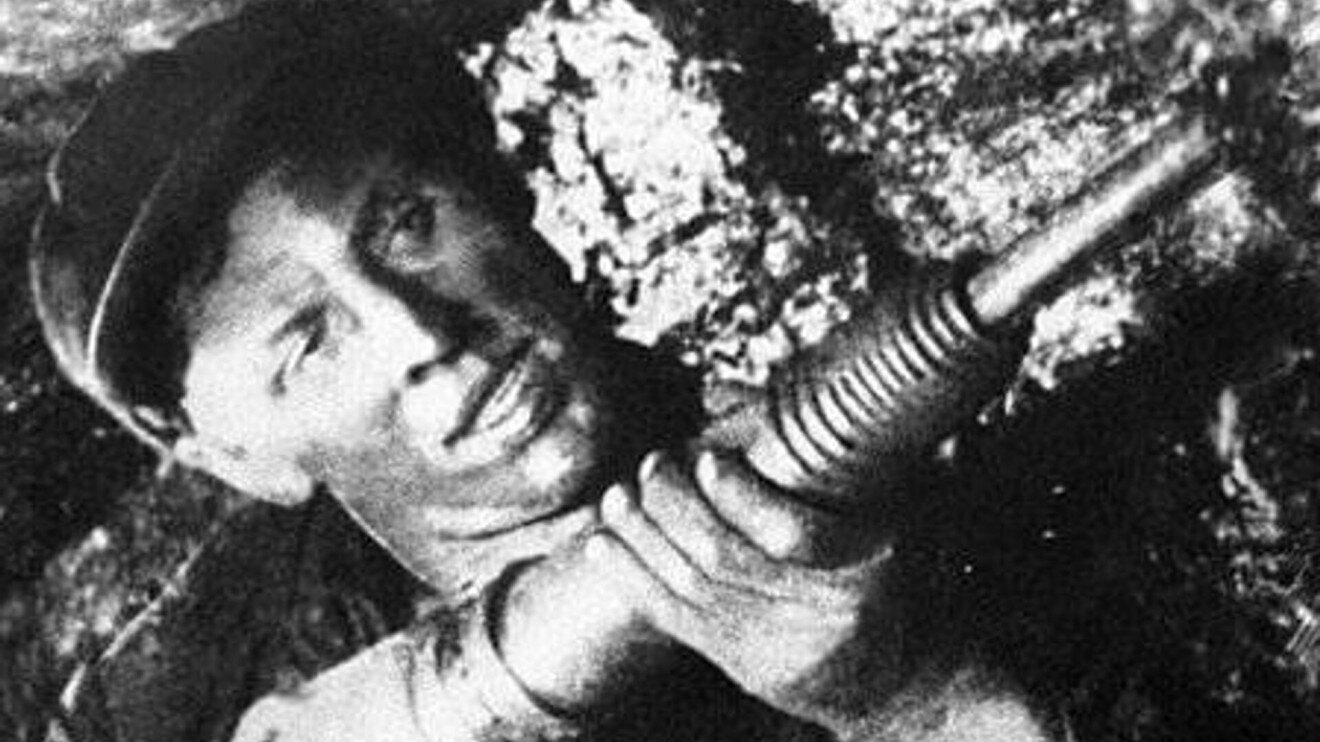
The Stakhanovite movement was a mass movement in the USSR from the 1935s through the 1950s, named after the miner Alexei Stakhanov, who set a labor productivity record. The movement became a symbol of socialist competition and an attempt to sharply raise labor productivity in Soviet industry.
The Movement’s Origins
In August 1935 the USSR was in the midst of its Second Five-Year Plan, and coal was urgently needed for industrialization. The Soviet authorities pushed for increased productivity among miners, though the modernization of Soviet mines proceeded slowly.
The “Tsentralnaya-Irmino” mine in the settlement of Kadiyevka (now the city of Stakhanov) was one of the most backward in the region and was contemptuously called “the dump.” But during the First Five-Year Plan the mine underwent technical reconstruction: electricity was installed, allowing pickaxes to be partly replaced with pneumatic hammers.
Alexei Stakhanov: The Man and His Biography
Alexei Grigoryevich Stakhanov (1905-1977) was born in the village of Lugovaya in Oryol Province, to a peasant family. He completed only three years of parish school, and worked as a shepherd and a watchman. In 1927 he came to hire on at the “Tsentralnaya-Irmino” mine wearing bast shoes, with no industrial experience whatsoever.
He started as a “brakeman” (pushing coal carts from behind), then worked as a horse driver and a timberman. In 1933 he learned to use the pneumatic hammer, considered a technical marvel at the time, and by 1935 had become one of the mine’s best face-workers.
Myths and the Reality of His Name
One version holds that the miner’s real name was Andrei, not Alexei. According to legend, journalists at the newspaper “Pravda,” preparing an article, deciphered “A. Stakhanov” as “Alexei.” When the mistake was reported to Stalin, he supposedly replied: “Pravda doesn’t make typos,” or “Alexei… a beautiful Russian name… I like it.” However, Stakhanov’s daughter Violetta denied this, and modern researchers consider the story a myth.
The Record Shift: August 31, 1935
The idea of setting a record belonged to the mine’s Party organizer, Konstantin Petrov, who, due to the enterprise’s poor performance, faced the threat of being accused of sabotage. Mine director Iosif Zaplavsky considered the plan a technical gamble and opposed it, for which he was later repressed.
On the night of August 30-31, 1935 (other sources say July 31 to August 1), Stakhanov went down into the coal face with two timbermen and two haulage workers. The key innovation was a division of labor: whereas before a face-worker both cut coal and timbered the workings himself, now Stakhanov could focus solely on working the pneumatic hammer.
Over a shift lasting 5 hours 45 minutes, Stakhanov extracted 102 tons of anthracite against a quota of 7 tons — that is, he fulfilled 14 quotas. For this he received 220 rubles — more than half a face-worker’s average monthly wage.
The event was political from the start: the mine’s Party organizer and the editor of the local paper “Kadiyevsky Rabochy” were both present at the face. Everything had been carefully prepared: the air pressure in the hoses was checked in advance, timbering wood was stockpiled, and a rich, convenient coal seam was set aside.
Awards and Recognition
Already on September 1, the mine’s Party committee resolved to:
- Award Stakhanov a bonus equal to a month’s salary
- Provide him a furnished apartment with a telephone
- Reserve named seats in the club for him and his wife
- Provide him with a personal horse (a dapple-gray one, which Stakhanov named Buket, “Bouquet”)
A note about the feat made it into “Pravda,” drawing the attention of top Party leadership. Stakhanov was soon awarded the Order of Lenin, admitted to the Party without the usual candidacy period, and sent to study at the Industrial Academy in Moscow.
The Movement Spreads
The Stakhanovite record set off a chain reaction. Already in September 1935:
- M. Dyukanov extracted 115 tons of coal in a shift
- D. Kontsedalov — 125 tons
- Stakhanov himself broke his own record, first to 175, then to 227 tons
- N. Izotov pushed output to a record 607 tons per shift
The movement quickly spread beyond the coal industry:
- Pyotr Krivonos — a train engineer, exceeded technical speed by 9 km/h
- Alexander Busygin — a blacksmith at the Gorky Automobile Plant, forged 1,050 crankshafts instead of 675
- The Vinogradov sisters — textile workers, operated 144 looms instead of 24
Stakhanovite Methods
“Stakhanovite methods” included several principles:
Division of Labor
Freeing skilled workers from auxiliary tasks. This was the main secret of the early successes — deepening specialization allowed workers to focus on their primary task.
The Scientific Organization of Labor
Advance preparation of the workplace, fewer smoke breaks, rationalization of tools and technology. The Soviet Central Institute of Labor’s system showed high efficiency: while the American Gilbreth method allowed a bricklayer to lay 452 bricks an hour, the Central Institute of Labor’s method achieved 907.
Material Incentives
A shift from time-based to piece-rate pay, on the principle “pay matches the percentage of quota fulfilled.” The average wage of a Stakhanovite face-worker was 1,600 rubles, versus 400 rubles for an ordinary one.
The All-Union Conference of Stakhanovites
On November 14-17, 1935, the First All-Union Conference of Stakhanovites was held in the Kremlin. There, Stalin uttered his famous line:
“Life has become better, comrades. Life has become merrier. And when life is merry, work goes well… If our life had been bad, unpleasant, joyless, we wouldn’t have had any Stakhanovite movement at all.”
A sarcastic popular version soon appeared: “Life has become better, life has become merrier — our necks got thinner, but longer.”
Contradictions and Problems of the Movement
Social Stratification
The Stakhanovite movement created a “labor aristocracy,” living materially far better than the mass of workers. Official “beacons” were given special conditions, better tools and materials, and apartments out of turn.
Falsification and Manipulation
Outstanding results were often achieved by the labor of an entire crew but credited to a single record-setter. To set records, the production process was often disorganized, machinery run to the point of failure, and technological regulations violated.
Repression of Opponents
According to an NKVD memo from December 1935, in the Donbas alone 110 investigative cases were opened against “saboteurs of the Stakhanovite movement.” Stalin declared: “More decisive measures will have to be taken” against those “systematically obstructing the spread of the Stakhanovite movement.”
Alexei Stakhanov’s Personal Life
The Moscow Period (1936-1957)
In 1936 Stakhanov was elected a deputy to the USSR Supreme Soviet and settled in the famous “House on the Embankment.” The former miner’s neighbors included Khrushchev, Mikoyan, Zhukov, and Stalin’s daughter Svetlana Alliluyeva.
Stakhanov befriended Stalin’s son Vasily and “took to the bottle,” earning the nickname “Stakanov” (from “stakan,” glass). He caused scenes at the “Metropol” restaurant, lost his medals and Party card in drunken brawls, and played piano loudly, disturbing his neighbors.
In 1945 Stakhanov wrote to Stalin asking for a new car and an apartment renovation: “Some people get their walls upholstered in silk twice a month, and get all kinds of furniture. This isn’t right.” Stalin instructed Malenkov to look into it, and a commission was formed that noted Stakhanov’s alcoholism and recommended he receive a “book ration” instead.
Disfavor Under Khrushchev
After Stalin’s death, relations with the new leadership didn’t work out. According to legend, when French communist Maurice Thorez asked Khrushchev about Stakhanov, Khrushchev lied that the hero was working at a mine in the Donbas. Upon learning the truth, Khrushchev ordered Stakhanov out of Moscow within 48 hours.
In 1957 Stakhanov was demoted to assistant chief engineer of the “Torezantratsit” trust and effectively exiled to the Donbas. His family did not follow him.
The Final Years and Death
In Torez the former hero went a long time without an apartment, staying in dormitories and rented rooms. Without family support, he drank himself to ruin. As contemporaries recalled:
“We go into the room, and there’s almost nothing there — a rusty bed with no mattress, just a dirty padded jacket lying right on the springs, an empty wardrobe with cardboard instead of a mirror, and empty bottles everywhere.”
In 1970, learning from a radio broadcast that Stakhanov had never received the Hero of Socialist Labor star, Brezhnev ordered him awarded it and given a small apartment.
Stakhanov spent his last three years in a psychiatric clinic, diagnosed with “multiple sclerosis with partial memory loss.” On November 5, 1977, he slipped on an apple peel, hit his head, and died without regaining consciousness.
Historical Significance
The Stakhanovite movement reflected the contradictions of Soviet industrialization. On one hand, it contributed to a real increase in labor productivity and the introduction of scientific production organization. Many rationalization proposals brought practical benefits.
On the other hand, the movement became an instrument of political coercion and social stratification. It created tension within labor collectives and often led to violations of technological processes for the sake of showcase records.
International Spread
Similar movements arose in every socialist country:
- Poland — miner Wincenty Pstrowski
- East Germany — worker Adolf Hennecke
- Yugoslavia — miner Alija Sirotanović (152 tons per shift)
- Bulgaria — textile worker Marusya Todorova
Memory and Legacy
In 1978 the settlement of Kadiyevka, where Stakhanov set his record, was renamed the city of Stakhanov — the only city in the world named after a worker. The term “Stakhanovite” became a household word, denoting a top-performing worker who exceeds production quotas.
The Stakhanovite movement remains an ambiguous phenomenon in Soviet history — a symbol at once of labor enthusiasm and coercion, of social mobility and political repression, of technical progress and administrative arbitrariness.
The line “slumped onto the benches like miners after a Stakhanovite shift” in the novel refers to the exhausting nature of such record shifts, when workers labored at the limits of their endurance, often disregarding rest and safety in the pursuit of new production records.