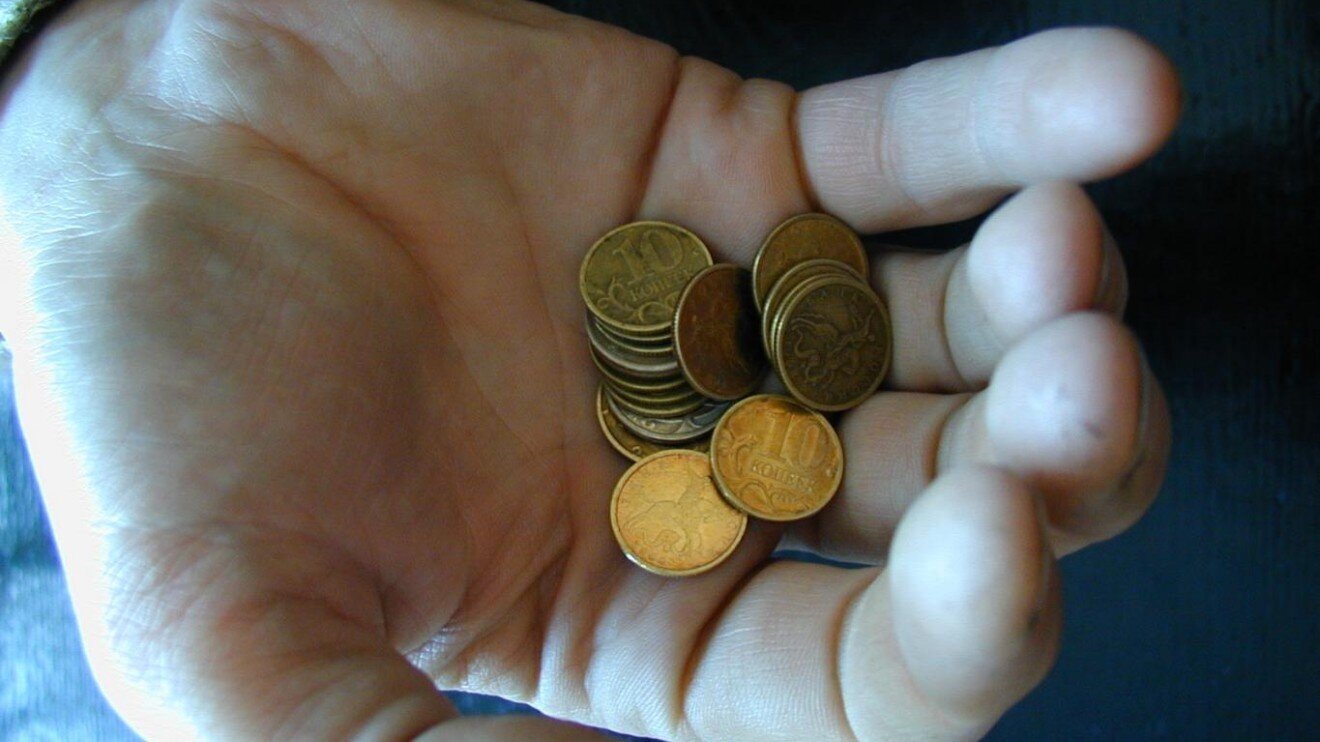
In the context of the novel's 1993 setting, "small change" referred to low-denomination currency that, amid hyperinflation, had lost its original purchasing power and was regarded as an insignificant sum.
Russia's monetary system in 1993
In 1993, the Russian Federation's monetary system was undergoing radical transformation. Until then, USSR State Bank banknotes had remained in temporary circulation, but that same year, new coins and banknotes of the Bank of Russia were introduced.
The new coin system included the following denominations:
- 1 and 5 rubles — struck in brass-plated steel
- 10 and 20 rubles — in 1992, of copper-nickel alloy; in 1993, of cupronickel-plated steel
- 50 rubles — in 1992, bimetallic (an aluminum-bronze center with a copper-nickel ring); in 1993, of aluminum bronze
- 100 rubles — in 1992, bimetallic (a copper-nickel center with an aluminum-bronze ring); in 1993, of copper-nickel alloy
The concept of "small change" amid inflation
The term "small change" took on a special meaning in 1993, tied to the sharp devaluation of money. Where in the Soviet era, kopecks had counted as small change, under the hyperinflation of the early 1990s that status shifted to ruble denominations.
Coins worth 1 and 5 rubles, which were formally the basic monetary units, effectively became "small change" due to their extremely low purchasing power. By 1993, these amounts could buy practically nothing.
The psychological side of how money was perceived
In everyday consciousness, people called "small change" any amount with no practical value for making a purchase. In 1993, that could mean not only 1- to 5-ruble coins, but even banknotes worth 10 to 50 rubles, depending on the specific situation and region.
It's notable that people stopped counting such small sums, treating them the way they had treated Soviet-era "kopecks." The phrase "give me some change" could mean asking for several rubles, which for many people was psychologically easier than naming a specific sum.
The practical use of coins in 1993
Small-denomination coins were used in a few specific situations:
Public transit
In some cities, fares could still be paid in coins, though fares kept rising, and banknotes were soon needed instead.
Payphones
Street payphones accepted coins of certain denominations. This is precisely why the novel's episode mentions a request for "five rubles for a phone call" — this reflected a genuine need of the time.
Making change for large bills
Coins were used to make exact change when paying for purchases with large banknotes.
Soviet coins in circulation
An important feature of 1993's currency circulation was the parallel use of Soviet and Russian coins. Soviet kopecks formally retained legal-tender status, but their real value was negligible.
The public perceived Soviet rubles and kopecks as follows:
- A Soviet ruble, in purchasing power, corresponded roughly to 10 Soviet-era kopecks
- Soviet kopecks had lost nearly all their value
- Russian rubles were also rapidly losing value, but remained the primary unit of account
Technical specifications of 1993 coins
Coins issued in 1993 had the following characteristics:
| Denomination | Diameter (mm) | Weight (g) | Material |
|---|---|---|---|
| 1 ruble | 19.45 | 3.3 | Brass-plated steel |
| 5 rubles | 21.9 | 4.1 | Brass-plated steel |
| 10 rubles | 21 | 3.5 | Cupronickel-plated steel |
| 20 rubles | 24.2 | 5 | Cupronickel-plated steel |
| 50 rubles | 25 | 6 | Aluminum bronze |
| 100 rubles | 27 | 7.3 | Copper-nickel alloy |
The design of the 1992-1993 coins
All coins from this period shared a uniform design:
Obverse
- An image of a double-headed eagle (a draft of the new state coat of arms, which later became the Bank of Russia's emblem)
- The inscription "Bank of Russia"
- On the 50- and 100-ruble coins, the denomination was also spelled out in words
Reverse
- The denomination in numerals
- A floral ornament
- The mint mark (M, MMD, L, LMD)
- The year of minting
Mints and markings
Coins were struck at two facilities:
- The Moscow Mint — marked M or MMD
- The Leningrad Mint (now the St. Petersburg Mint) — marked L or LMD
These markings made it possible to determine where a particular coin was produced, which mattered to collectors and specialists.
The social context of using "small change"
In 1993, attitudes toward small denominations took on a particular social coloring. A request for "change" could be read in different ways:
Everyday level
In daily life, people often asked for "change" for specific needs: bus fare, a phone call, buying a newspaper. Such requests were considered normal and were usually granted without issue.
Criminal undertones
In the criminal world, as shown in the novel's episode, receiving even a small sum "on credit" could carry symbolic weight, creating a psychological dependency of the debtor on the lender. This was used as a tool of pressure and control.
Economic consequences of small denominations losing value
The transformation of rubles into "small change" had serious economic consequences:
The breakdown of money's functions
- Medium of exchange — small-denomination coins essentially dropped out of active commerce
- Unit of account — people stopped bothering to count small sums
- Store of value — nobody sought to accumulate small change that kept losing value
Psychological effects
The constant devaluation of money led to a distinctive attitude toward money in general. People tried to spend whatever cash they received as quickly as possible, unwilling to hold onto it.
The end of the 1992-1993 coin era
Coins of the 1992–1993 design were withdrawn from circulation on January 1, 1999. Until December 31, 2002, they could still be exchanged for new currency at banks.
This decision was connected to the 1998 monetary reform (redenomination), in which 1,000 old rubles were equated to 1 new ruble. As a result of the reform, new kopeck coins entered circulation, along with rubles of a new design.
Collector's value
Today, 1992–1993 coins are of interest to collectors as evidence of a transitional period in the history of Russia's monetary system. The most highly prized are:
- Coins in excellent condition
- Rare mint-mark variants
- Specimens with production irregularities
Conclusion
The "small change" of 1993 is a unique phenomenon in the history of Russian currency, reflecting the deep economic and social transformations of the transitional period. Coins that, by their face value, were the primary monetary units in effect became symbolic "small change," owing to hyperinflation.
This period showed how quickly a society's perception of money can change, and how much weight the real purchasing power of currency carries, beyond its face value alone. Understanding this context helps convey a fuller sense of the atmosphere and realities of life in early-1990s Russia.