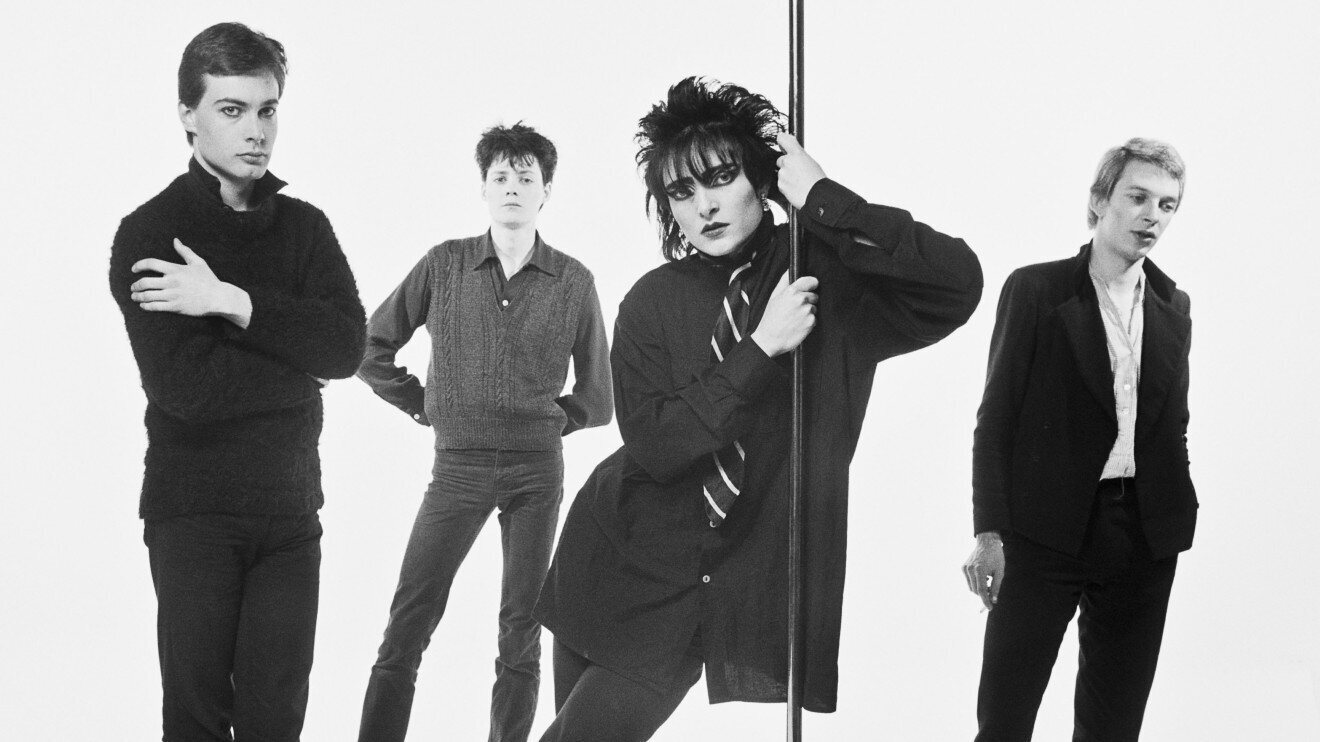
Siouxsie and the Banshees is a British rock band formed in London in 1976 by vocalist Siouxsie Sioux (born Susan Janet Ballion) and bassist Steven Severin (born Steven Bailey). The group is regarded as one of the founders of post-punk and had an enormous influence on the development of alternative music in the 1980s and 1990s.
Formation and Early Years
The band's story began in September 1975, when Siouxsie Sioux and Steven Severin met at a Roxy Music concert. Glam rock was already fading by then, and no new movement had yet emerged for young people to rally around. Starting in February 1976, Siouxsie, Severin, and their friends began following the then-unsigned Sex Pistols, becoming part of what was known as the «Bromley Contingent» — a group of young people from southeast London united by shared attitudes and style.
The band formed spontaneously on September 20, 1976, at a punk festival at the 100 Club in London. Learning that one of the scheduled acts couldn't perform, Siouxsie offered to play with Severin, despite having neither a band name nor any other members. Their debut performance was a 20-minute improvisation on «The Lord's Prayer,» with borrowed musicians Marco Pirroni on guitar and Sid Vicious on drums.
The group originally planned to disband after that one show, but were asked to keep playing. Over the following months, Siouxsie and Severin recruited drummer Kenny Morris and guitarist Peter Fenton. After a handful of shows in early 1977, it became clear Fenton wasn't the right fit, being «too much of a real rock guitarist.» John McKay took his place in July.
First Albums and a Developing Sound
The band's first television appearance came in November 1977 on Granada Television's «So It Goes,» hosted by Tony Wilson. That same month they recorded their first session for John Peel on BBC Radio, debuting a new song, «Metal Postcard.» The track showcased the band's characteristic «motorik» drum severity, «space in the sound,» and «jagged guitars.»
The band described their own music as «cold, machine-like, and passionate at the same time.» When they appeared on the cover of Sounds magazine, journalist Vivien Goldman wrote: «they sound like a 21st-century industrial plant.»
By early 1978 the band was already selling out London venues, but still struggling to land a recording contract that would give them «full creative control.» Polydor offered such guarantees and signed the band in June 1978.
Their first single, «Hong Kong Garden,» with its distinctive xylophone motif, reached the UK top 10. An NME reviewer praised it as «a vivid, vibrant vignette, something like snapshots from the window of a speeding Japanese train, charged with the energy of the most original, intoxicating guitar playing I've heard in a long, long time.»
The band's debut album, The Scream, was released in November 1978 to broad critical acclaim. Nick Kent of NME wrote of the record: «The band sounds like some unique hybrid of Velvet Underground crossed with much of the inventiveness of Can's Tago Mago era.» He added: «Certainly the traditional trio sound has rarely been used in a more unorthodox way to such stunning results.»
Lineup Evolution and Creative Growth
The band's second album, Join Hands, came out in 1979. During the tour supporting it, a dramatic event unfolded: Morris and McKay quit the band mid-tour after a fight at an autograph signing in September 1979. To fulfil the remaining tour dates, the band's manager brought in drummer Budgie (born Peter Edward Clarke), who had previously played with The Slits. Robert Smith of The Cure offered his services as guitarist, and the band accepted his help.
Budgie became a permanent member, and with guitarist John McGeoch (from Magazine) on board, the band recorded the single «Happy House.» The third album, Kaleidoscope, released in 1980, proved a landmark for the band. On it, Siouxsie and the Banshees explored new musical territory, using synthesizers, sitars, and drum machines. The band set out to make every song sound completely different from the last, without worrying about whether the material could be performed live.
Kaleidoscope was a commercial success, reaching number five on the UK album chart. This lineup made the band's first US tour in support of the album, playing their first New York shows in November 1980.
A Creative Peak in the Early 1980s
For Juju (1981), the band took a different approach, rehearsing the songs in a live setting before recording them. According to Severin, Juju became, without quite meaning to, a concept album that «leaned into darker elements.» Sounds magazine welcomed it as «intriguing, intense, dark, and powerfully atmospheric.» The album reached number seven on the UK chart, becoming one of the band's best-selling releases.
During the 1981 tour, Siouxsie and Budgie became a couple. Around the same time, they also launched a drums-and-vocals duo project called The Creatures, releasing their first EP, Wild Things.
1982 brought the psychedelic album A Kiss in the Dreamhouse. The record, which included strings on several tracks, was a deliberate contrast to their previous work. Severin later described it as a «sexual album.» The British press received it enthusiastically.
Lineup Changes and Experimentation
Around this time, McGeoch was struggling with alcohol problems and was hospitalized after returning from a promotional trip to Madrid. The band let him go shortly after. Severin asked Robert Smith to take up guitar duties again, and Smith joined the band in November 1982.
In 1983, band members worked on several side projects: Siouxsie and Budgie made The Creatures' first album, Feast, while Severin and Smith recorded as The Glove. Smith insisted on documenting his time with the Banshees, so the band released a cover of The Beatles' «Dear Prudence» in September 1983. It became their biggest UK hit, reaching number three on the singles chart.
The band also released a live double album and video, Nocturne, and completed their sixth studio album, Hyæna. Shortly before its release in May 1984, Smith left the band, citing health issues from an overloaded schedule split between two bands at once.
The Mid-1980s: New Directions
With former Clock DVA guitarist John Valentine Carruthers replacing Smith, the Banshees reworked four numbers from their back catalog with a string orchestra for the The Thorn EP. NME praised the project: «The power of a classical orchestra is the perfect foil for the band's relentless, insistent sound.»
The new lineup spent much of 1985 working on a new record, Tinderbox. The band finished the song «Cities in Dust» ahead of the album and rushed to release it as a single before their longest-ever UK tour. Tinderbox came out in April 1986.
After the long stretch of time spent on Tinderbox, the band wanted spontaneity and decided to record a covers album, Through the Looking Glass, in 1987. Mojo magazine later praised their version of «Strange Fruit.» After the album's release, the band concluded that Carruthers no longer fit and decided to work on new material as a trio.
Later Years and International Recognition
After a long break, the band recruited multi-instrumentalist Martin McCarrick and guitarist Jon Klein. The quintet recorded Peepshow in 1988, using instruments unusual for rock, including cello and accordion. Q magazine praised the album in a five-star review: «Peepshow takes place in some distorted fairground of the mind, where strange and wonderful shapes loom.»
The first single, «Peek-a-Boo,» was received by critics as a «bold move,» blending horns and dance elements. «Peek-a-Boo» became their first real breakthrough in the US.
In 1991, Siouxsie and the Banshees returned with the single «Kiss Them for Me,» mixing strings with a dance beat and an exotic flourish. The band collaborated with a then-unknown Indian musician, Talvin Singh, who played tabla and sang during the bridge. The single earned rave reviews and later reached number 23 on the Billboard Hot 100, winning them a new audience.
The album Superstition followed soon after, and the band toured the US as second headliners on the inaugural Lollapalooza tour. The following year, the Banshees were asked to write «Face to Face» as a single for the film «Batman Returns,» at director Tim Burton's request.
Winding Down and Legacy
In 1993 the band recorded new songs built around string arrangements, then performed them at overseas festivals. Back home, they brought in former Velvet Underground member John Cale to produce the rest of the record. Released in 1995, The Rapture was described by Melody Maker as «a compelling, transcontinental journey through danger and exoticism.»
A few weeks after the album's release, Polydor dropped the band from its roster, and Klein was replaced for the band's final tour in 1995 by former Psychedelic Furs guitarist Knox Chandler. In April 1996, the Banshees disbanded after 20 years together. Siouxsie and Budgie announced they would continue recording as The Creatures.
Influence on Music Culture
Siouxsie and the Banshees had a profound influence on the development of alternative and gothic music. Their experimental approach to sound, use of unusual instruments and rhythmic structures, inspired a great many musicians. The band was among the first to blend punk energy with more complex musical ideas, creating what would later be known as post-punk.
Their influence can be traced through bands like Radiohead, U2, The Cure (unsurprising, given Robert Smith's involvement), and many other alternative acts of the 1980s and 1990s. Their impact on the formation of the goth scene was especially significant, particularly after the release of Juju.
Musical Style and Innovation
Siouxsie and the Banshees's musical style was defined by constant experimentation and a refusal to stick to established formulas. Starting out as a punk band, they quickly evolved, incorporating elements of dub, funk, world music, and electronic sound. Their willingness to use unconventional instruments — from sitar to cello — and to experiment with rhythmic structures made them among the most innovative musicians of their time.
Siouxsie Sioux's vocal style, ranging from an aggressive punk scream to sensuous singing, became one of the most recognizable in alternative music. Her theatrical performance style and visual presentation also had a significant influence on the development of goth aesthetics.
Discography and Achievements
Over their career, Siouxsie and the Banshees released 11 studio albums and 30 singles. Their most successful albums were Kaleidoscope (1980), which reached number five on the UK chart, Juju (1981), which climbed to number seven, and Superstition (1991), which brought them commercial success in the US.
The band went through several lineup changes over the years, with Siouxsie Sioux and Steven Severin remaining the only constant members throughout its entire run. This consistency at the core of the band let them preserve their creative identity even while experimenting with a range of musical directions.
Significance in the Context of 1993
By 1993, when the novel takes place, Siouxsie and the Banshees were already recognized veterans of the alternative scene. Their influence on 1980s music was undeniable, and many grunge and alternative-rock bands of the era acknowledged them as an important source of inspiration. In Russia, where alternative Western music was only just beginning to spread widely after the fall of the Iron Curtain, familiarity with a band like Siouxsie and the Banshees marked a certain musical sophistication and openness to experimental art.
Listening to Siouxsie and the Banshees in Russia in 1993 marked someone as a connoisseur of Western alternative music, someone searching for more than just popular hits. It was music for those who valued artistic complexity and were ready for musical experimentation — qualities especially significant during a period of cultural liberation in post-Soviet Russia.