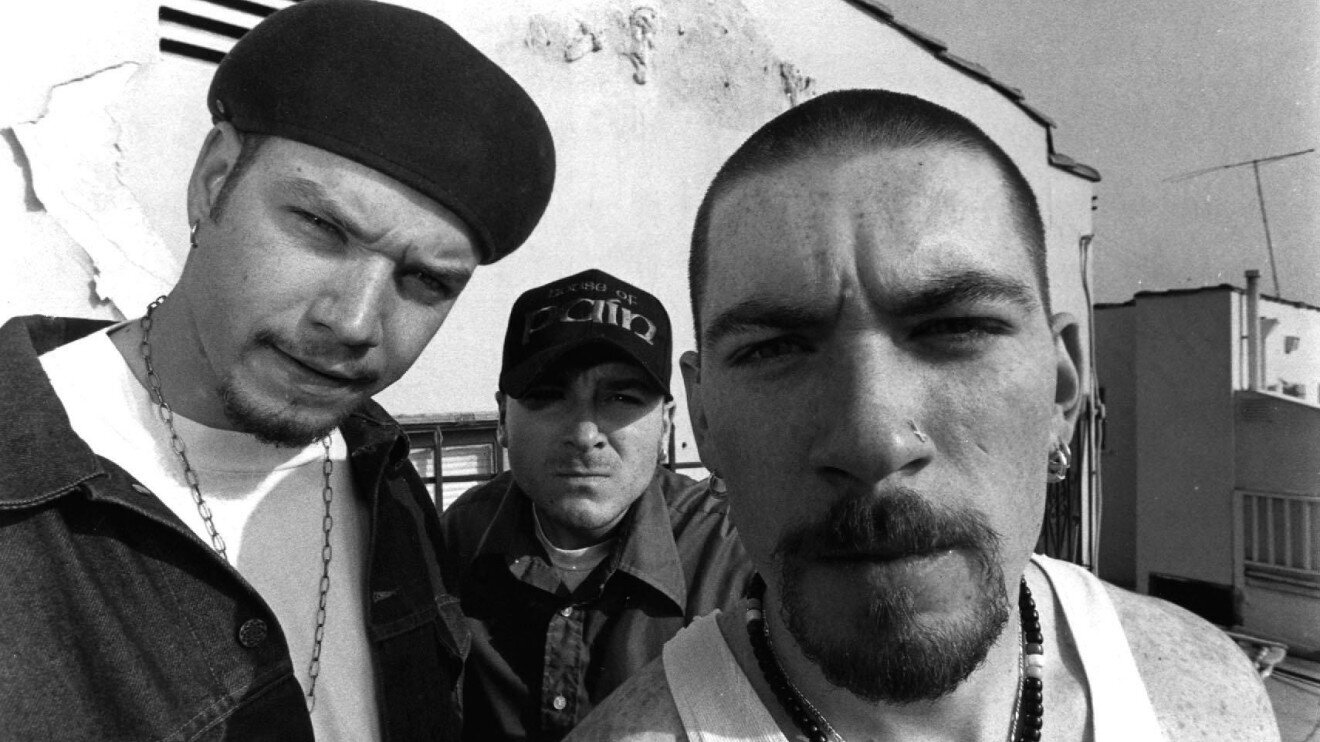
House of Pain is an American hip-hop trio that became one of the most recognizable acts of early-1990s alternative rap. The group shot to fame with the 1992 hit "Jump Around," which not only conquered the US charts but became a cult track heard on radio stations around the world, Russia included.
Lineup and Backgrounds
House of Pain was formed by three musicians of varied ethnic backgrounds, itself typical of the American music scene of the era. At its core were two Irish-American rappers: Erik Schrody, performing as Everlast, and Daniel O'Connor, known as Danny Boy O'Connor. They were joined by a DJ of Latvian descent, Leor Dimant, working under the name DJ Lethal.
The members' backgrounds played a significant role in shaping the group's musical style and image. Everlast's and Danny Boy's Irish-American roots formed the basis of a distinctive sound that blended traditional hip-hop elements with Celtic motifs and rock 'n' roll spirit, setting House of Pain apart from other rap acts of the early 1990s.
Origins and the Group's Name
House of Pain formed in 1990 in Los Angeles. Daniel O'Connor and Erik Schrody had known each other since their school years, when Schrody attended William Howard Taft High School in Woodland Hills, California (1984-1986). Their friendship deepened over a shared interest in hip-hop culture and attending rap events together as teenagers.
By the time he reconnected with O'Connor in 1990, Schrody already had a solo career behind him — he had released a rap album, "Forever Everlasting" (1990), which failed commercially. That setback pushed him to look for new creative outlets and partners.
The group's name has an interesting origin story. During one visit to O'Connor's home, Schrody noticed a cassette labeled "House of Pain." It turned out to be a demo recording of a punk band O'Connor had previously tried to start. Schrody liked the name so much that he proposed using it for their new hip-hop project.
The members later revealed a deeper layer of meaning behind the chosen name. It was a nod to H.G. Wells's novel "The Island of Dr. Moreau," where the phrase "house of pain" symbolizes a place of suffering and transformation. Originally, though, the musicians had first heard the phrase in the song "No Spill Blood" by the band Oingo Boingo, whose fans they were.
Debut Album and Breakthrough
After the demo was recorded, with cover art handled by the talented Daniel O'Connor, a genuine battle for label attention began. The quality of the material and its striking visual style caught the eye of several companies, sparking a "bidding war" between labels. The group ultimately signed with Tommy Boy Records, a label specializing in hip-hop, known for its work with artists like De La Soul, Digital Underground, and Naughty by Nature.
Representatives from Tommy Boy Records noted that it was O'Connor's artwork that first drew their attention to the group — underscoring how important visual presentation was to promoting hip-hop acts in the early 1990s.
In 1992 the group's self-titled debut album, "House of Pain," was released with the subtitle "Fine Malt Lyrics." The pun referenced quality malt whiskey, nodding to the group's Irish roots and their commitment to a "quality product" in their music.
"Jump Around" — A Global Phenomenon
The debut album's first single, "Jump Around," became more than a hit — it became a cultural phenomenon. The song was born from a creative collaboration with producer Lawrence Muggerud, better known as DJ Muggs of Cypress Hill. Muggerud and Schrody had known each other since their days with Rhyme Syndicate, a hip-hop collective bringing together various West Coast artists.
The story of "Jump Around" illustrates how the creative process worked in early-1990s hip-hop culture. Muggerud had a finished beat that he'd offered to several artists, but no one had managed to write suitable lyrics for it. When he approached Schrody, the rapper wrote the lyrics right there in his own backyard. The original version was longer and included lines inspired by the Jamaican dancehall artist Shabba Ranks; Muggerud suggested trimming the chorus down to the terse "Jump Around," which made the song far more memorable.
The famous horn sample that became the track's signature was added by Muggerud during the finishing stages of production. It gave the song a distinct energy and instant recognizability, making it ideal for radio play and club nights.
The commercial success of "Jump Around" exceeded all expectations. In the US the song reached number three on the Billboard Hot 100, a remarkable result for a debut single from a hip-hop group. The track also hit number five on the Hot Rap Songs chart, 13 on the Rhythmic Top 40, and topped the Hot Dance Music/Maxi-Singles Sales chart. Its international success was no less impressive: number six in Ireland and number eight in the UK.
The song went platinum in the US, meaning sales of over a million copies — a particularly significant achievement given that hip-hop was only just beginning to win over a mainstream audience in the early 1990s.
The Second Single and Consolidating Success
The debut album's second single, "Shamrocks and Shenanigans (Boom Shalock Lock Boom)," demonstrated the group's range beyond a single style. While it never matched the phenomenal success of "Jump Around," it performed respectably on the charts: number 65 on the Billboard Hot 100, 75 on Hot R&B/Hip-Hop Songs, 14 on Dance Club Songs, and 74 on Radio Songs.
The song's title played on the group's Irish themes: "shamrocks," a traditional symbol of Ireland, and "shenanigans," a word for mischief or pranks often associated with Irish folklore.
The debut album overall performed excellently, reaching number 14 on the Billboard 200 and going platinum — making House of Pain one of the most successful new hip-hop acts of 1992.
Film and Soundtrack Appearances
1993 proved important for the group in terms of expanding their media presence. House of Pain took part in director Ted Demme's film "Who's the Man?", a comedy-action film featuring various hip-hop artists. For the project the group recorded the title track, also released as a single.
"Who's the Man?" saw modest commercial success, reaching number 97 on the Billboard Hot 100, 77 on Hot R&B/Hip-Hop Singles & Tracks, and 10 on Hot Dance Music/Maxi-Singles Sales. Though these numbers were smaller than their earlier hits, the film appearance broadened the group's audience.
Particularly significant was House of Pain's contribution to the soundtrack of "Judgment Night" (1993). The project was revolutionary for its time, being one of the first to systematically pair hip-hop and rock artists in joint compositions. House of Pain collaborated with the heavy-metal band Helmet, demonstrating their openness to experimentation and their ability to work with musicians from other genres.
The "Judgment Night" soundtrack became a cult release that anticipated the later popularity of rap-rock as a genre. Participation in the project positioned House of Pain as a progressive group open to genre-crossing experiments.
Second Album: "Same as It Ever Was"
The group's second studio album, "Same as It Ever Was," came out in 1994. Its title referenced the Talking Heads song "Once in a Lifetime," showing House of Pain's broad musical horizons and their taste for clever allusion.
The album performed strongly, reaching number 12 simultaneously on several charts: the Billboard 200, Top Current Albums, Top R&B/Hip-Hop Albums, and Top Album Sales. It went gold, meaning sales over 500,000 copies.
Critical reception was mixed, reflecting differing views on the group's development. The influential outlet AllMusic gave the album four stars out of five, noting the musicians' professional growth.
Matt Carlson of The Michigan Daily reviewed the album positively, writing that "the music is laid back, but with a powerful driving force underlying and reinforcing it." This assessment captured House of Pain's evolution from an energetic debut to more mature, layered material.
Especially notable was the review from influential critic Robert Christgau, who had not been fond of the group's previous or later albums but gave "Same as It Ever Was" a high grade of A-minus, calling it "the toughest hip-hop of the year." This praise from one of the most respected critics in the business affirmed the record's artistic merit.
Not all reviews were positive, however. J.D. Considine of The Baltimore Sun criticized the album for its monotony and lack of imagination. Roger Catlin of the Hartford Courant, while acknowledging the album as "tough and convincing," also noted its repetitiveness.
Third Album and the Group's Split
1996 marked the final year for the original House of Pain lineup. The group released its third studio album, "Truth Crushed to Earth Shall Rise Again." The title, taken from a speech by the abolitionist William Cullen Bryant, reflected the seriousness of the group's intentions and their commitment to socially meaningful work.
Commercially, though, the album fell well short of previous releases. "Truth Crushed to Earth Shall Rise Again" reached only number 47 on the Billboard 200 and comparable positions on other major charts, signaling waning interest from the broader audience.
Critical reception was mixed. Sputnikmusic praised the release, calling it "the trio's most well-rounded, consistent, and memorable album, underrated." Steve Juon of RapReviews gave it seven out of ten, indicating solid material.
But Dave Ferman of the Fort Worth Star-Telegram gave the album a mere one and a half stars out of five, calling it "a sorry mess." AllMusic rated the release 2.5 stars out of five, reflecting critical disappointment.
At the party celebrating the album's release, an event occurred that became a turning point in the group's history: Erik Schrody (Everlast) announced the dissolution of House of Pain. The decision came as a surprise to many, given the group's successful history and significant standing in hip-hop culture.
Solo Careers
After House of Pain broke up, each member went their own way, demonstrating a range of musical interests and abilities.
Everlast (Erik Schrody) made a dramatic pivot toward blues-rock. This genre shift surprised hip-hop fans but showed the breadth of his musical talent. His solo career included both blues-rock projects and membership in the supergroup La Coka Nostra, where he reunited with DJ Lethal.
DJ Lethal (Leor Dimant) found commercial success as a member of the rap-rock group Limp Bizkit, one of the most popular nu-metal acts of the late 1990s and early 2000s. His experience in House of Pain proved valuable in shaping Limp Bizkit's distinctive sound, blending hip-hop and heavy music.
Danny Boy O'Connor continued working in music, though with a lower profile than his former bandmates.
The 2010 Reunion
In 2010, a notable event took place: House of Pain reunited for a world tour. The reunion was brief but let fans see the legendary trio on stage once again.
The tour was named "He Who Breaks the Law," another nod to H.G. Wells's "The Island of Dr. Moreau." The title underscored continuity with the group's original concept and their commitment to its founding ideas.
The 2010 reunion demonstrated the enduring interest in House of Pain's music and their significant place in hip-hop history. Many of the group's songs, especially "Jump Around," remained popular nearly two decades after their peak.
Cultural Influence and Legacy
House of Pain had a significant impact on the development of hip-hop culture in the early 1990s. Their success demonstrated that rap music could successfully integrate elements from different ethnic traditions, creating unique artistic products.
The group became one of the earliest examples of successful "white hip-hop," paving the way for many artists who followed. They avoided accusations of cultural appropriation thanks to a sincere respect for hip-hop culture and a professional approach to their craft.
"Jump Around" became a genuine anthem for a generation, heard at sporting events, in films, and on radio stations around the world. In early-1990s Russia, as Western music was only just beginning to flood into the country en masse, House of Pain was among the acts introducing Soviet and post-Soviet audiences to contemporary American hip-hop.
Their music played on the country's first emerging commercial radio stations, spread via cassette tapes and CDs through a nascent network of music shops. For many Russian listeners, House of Pain was one of their first introductions to hip-hop culture, alongside artists like Cypress Hill and Naughty by Nature.
The group's influence on the development of rap-rock as a genre is hard to overstate. Their willingness to experiment and collaborate with artists from other genres anticipated the later popularity of bands like Rage Against the Machine, Limp Bizkit, and Linkin Park.
Conclusion
House of Pain remain one of the most significant hip-hop groups of the early 1990s. Their brief but bright career demonstrated the possibilities of genre fusion and the importance of authenticity in music. The group managed to forge a unique sound, blending traditional hip-hop elements with Celtic motifs and rock 'n' roll energy.
House of Pain's success in 1992-1993 coincided with a period of active cultural exchange between the West and the post-Soviet world. Their music became part of the soundtrack of an era of change, heard across a Russia in the midst of political and social transformation.
The group's legacy continues to live on in the work of many contemporary artists, and their hit "Jump Around" remains one of the most recognizable songs in hip-hop history. House of Pain proved that music can cross cultural and geographic borders, uniting people of different nationalities and beliefs through a shared rhythm and energy.