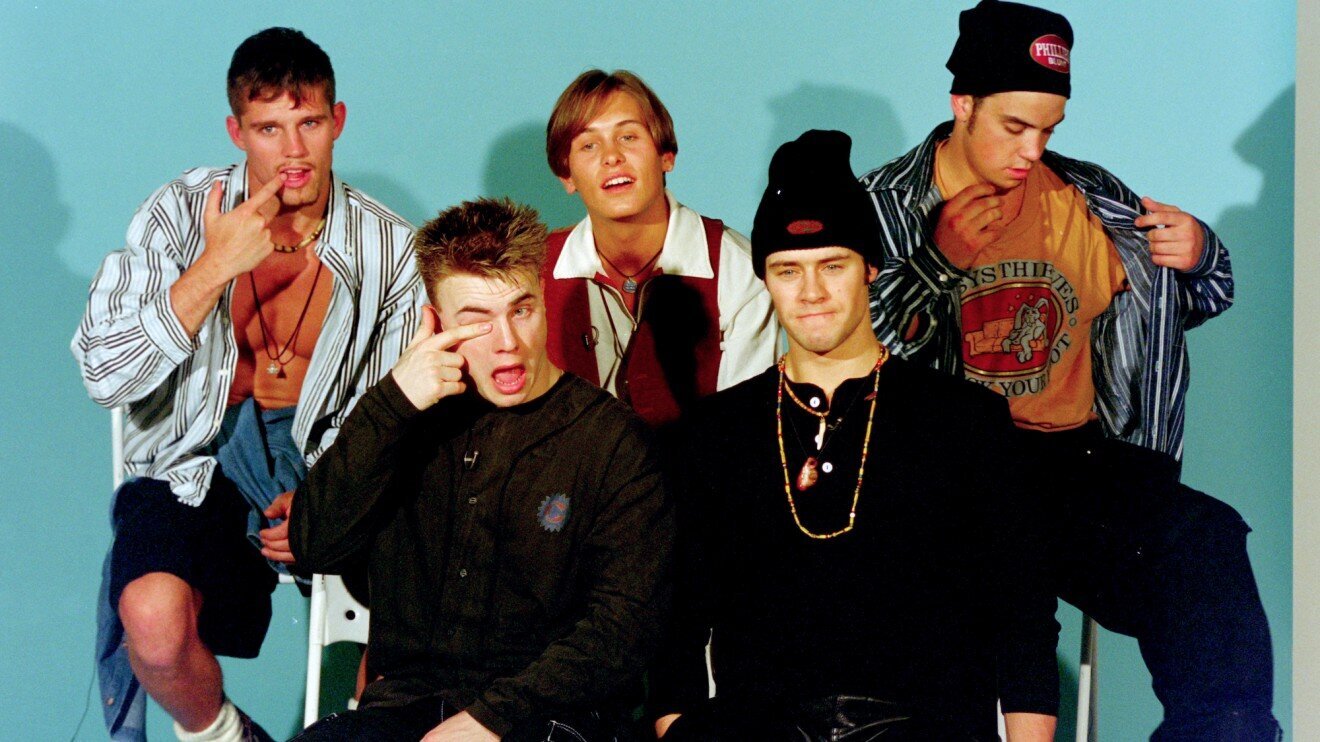
Take That is a British pop group formed in 1990 in Manchester, which became one of the most successful British musical acts of the 1990s.
Lineup and Formation
The original lineup included five members: Gary Barlow, Howard Donald, Jason Orange, Mark Owen, and Robbie Williams. The group formed in 1990 and initially performed in clubs and schools around Manchester.
What set Take That apart from other boy bands of the era was that the members wrote their own songs, which gave their work greater artistic value and authenticity.
Peak Popularity (1993–1996)
The years 1993 to 1996 were the group’s golden era. In that short span, Take That topped the UK national singles chart eight times, a staggering commercial achievement.
A particular milestone was their international breakthrough with the single «Back For Good» (1995), which cracked the top five of the American Billboard Hot 100 — a rarity for British pop groups at the time, underscoring the scale of their success.
By 1996 the group was at the absolute peak of its popularity when Robbie Williams suddenly announced his departure. That event became a turning point in the band’s history.
The Band’s Breakup
In February 1996 the remaining four members released a farewell hit — a cover of a well-known Bee Gees ballad — and announced the group’s dissolution. The decision set off a wave of teenage hysteria across Britain, a testament to the scale of their popularity.
After the breakup, Gary Barlow and Mark Owen tried to build solo careers, releasing a number of fairly successful hits, though their individual projects couldn’t match the success of the group’s work.
Cultural Influence in 1996
By the time of the novel’s events — 1996 — Take That were a cultural phenomenon. Their music symbolized mid-1990s British pop culture, blending melody, energy, and a contemporary sound.
Songs like «Pray,» «Everything Changes,» «Never Forget,» and «Back For Good» became a generation’s soundtrack and were played worldwide, including in Russia, where Western pop music was enjoying a particular surge in popularity.
Musical Style
Take That performed pop music with elements of R&B, dance, and ballads. Their songs were marked by memorable melodies, quality arrangements, and professional vocals. The group skillfully combined dance hits with lyrical ballads, giving them a broad audience.
A hallmark of their work was the ability to produce both energetic dance tracks for clubs and parties, and romantic songs for a more intimate setting.
Influence on Russian Audiences
In the mid-1990s, Take That’s music actively made its way into the Russian market through various channels — radio stations, music TV programs, pirated cassettes, and CDs. Their hits played in discos, nightclubs, and house parties.
For Russian audiences, Take That represented a model of modern Western pop culture — stylish, high-quality, fashionable. Their music became part of the emerging lifestyle of Russia’s new middle class, striving toward European standards.
Historical Note
Commentators later called Take That «the most successful British band since the Beatles,» underscoring their exceptional place in the history of British popular music. The group became a symbol of the revival of British pop in the 1990s and had a significant influence on the development of the boy-band genre.
Their success paved the way for many subsequent British pop acts and demonstrated that quality pop music could achieve both commercial success and artistic recognition.