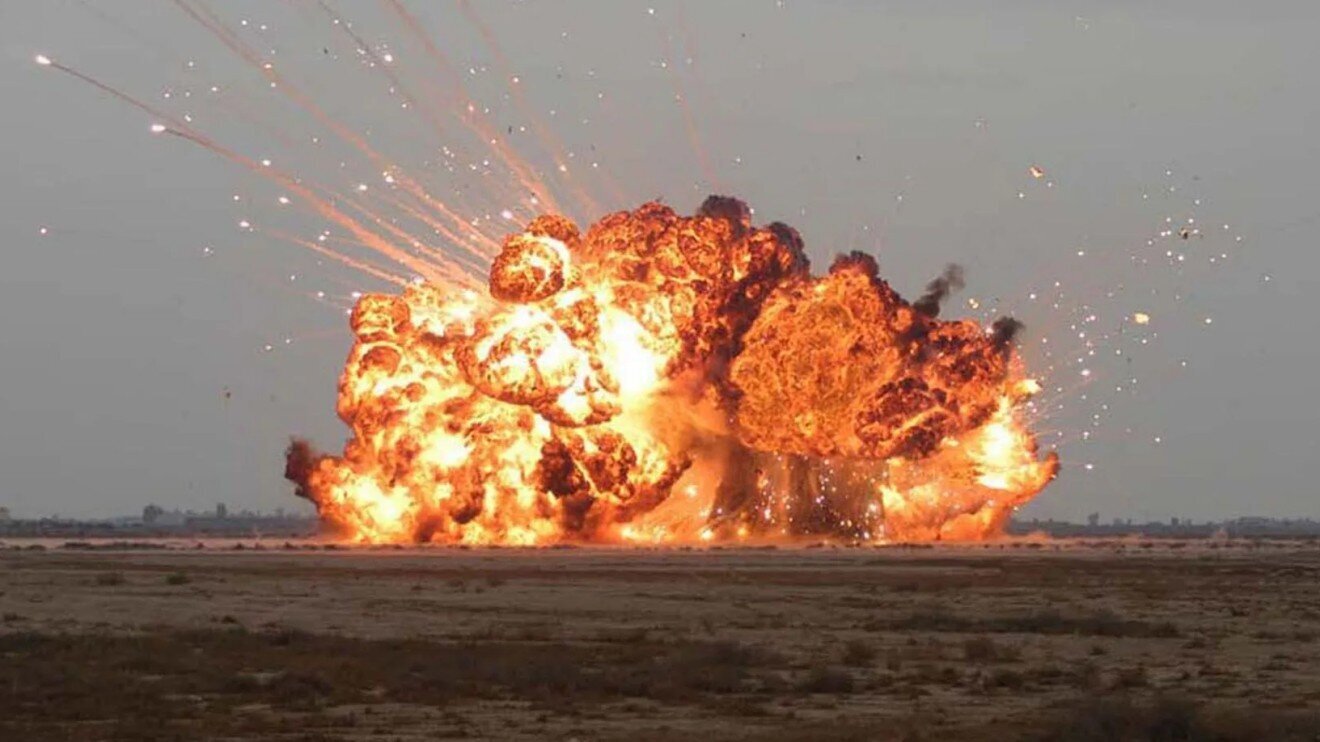
Thermobaric charges (also known as fuel-air explosives or volumetric-detonation munitions) are among the most destructive types of non-nuclear weapons, working on the principle of generating a powerful shock wave by detonating a cloud of combustible aerosol.
How it works
The mechanism of a thermobaric charge differs fundamentally from that of conventional explosives. The blast happens in two stages: first, a small charge of ordinary explosive disperses a combustible substance, creating an aerosol cloud several times larger than the munition itself. Then, a fraction of a second later, a second charge ignites this cloud, triggering a volumetric detonation.
The key difference from traditional explosives is that thermobaric charges use atmospheric oxygen as an oxidizer, allowing more combustible material to be delivered to the target for the same weight of munition. This makes them exceptionally effective in terms of weight-to-destructive-power ratio.
Damaging effects
Thermobaric charges produce a shock wave with unique characteristics. Because of the large volume of the detonating mixture, the wave has a longer duration of effect and a pronounced negative pressure phase — which is why the press sometimes, incorrectly, calls them "vacuum" bombs.
The damaging effect is achieved through several mechanisms: the powerful shock wave destroys buildings and structures, the sharp pressure differential causes barotrauma in people, and the high temperature combined with oxygen depletion in enclosed spaces creates additional lethal effects. Such charges are especially effective against targets in shelters, tunnels, and bunkers, where the shock wave can penetrate through any opening.
Combustible substances
A range of chemical compounds is used as the combustible component in thermobaric charges: ethylene oxide, oxetane, propyne, and dimethylacetylene, as well as butyl and propyl nitrites. The choice of a specific substance depends on the munition's required characteristics and its intended conditions of use.
The technology's development in the 1990s
By the mid-1990s, thermobaric munitions were no longer new — their development had begun back in the 1960s in the USSR and the United States. It was during this period, however, that the technology reached significant maturity. Soviet, and later Russian, designers created a broad lineup of such munitions: from the RPO-A "Shmel" ("Bumblebee") shoulder-fired rocket flamethrower to aerial bombs of up to 1,500 kg.
By 1996, the Russian army had already fielded thermobaric shells for the "Smerch" and "Uragan" multiple rocket launcher systems, anti-tank missiles with thermobaric warheads for the "Shturm" missile systems, S-8DM unguided aircraft rockets, and ODAB volumetric-detonation aerial bombs of various calibers.
Use and effectiveness
Large-caliber thermobaric charges are comparable in destructive power to tactical nuclear munitions, but without radioactive contamination of the area. This makes them attractive for military use in situations where maximum damage to the enemy is needed while preserving the possibility of later using the territory.
Such munitions prove especially effective against personnel in shelters, underground structures, and urban blocks, where conventional high-explosive fragmentation shells are less effective. The shock wave's ability to wrap around obstacles and penetrate hard-to-reach places makes thermobaric charges an extremely dangerous weapon.
In the context of the criminal world of the mid-1990s, access to such munitions could indicate connections to military structures or the security services, since thermobaric charges were high-tech weapons out of reach for ordinary criminal groups.