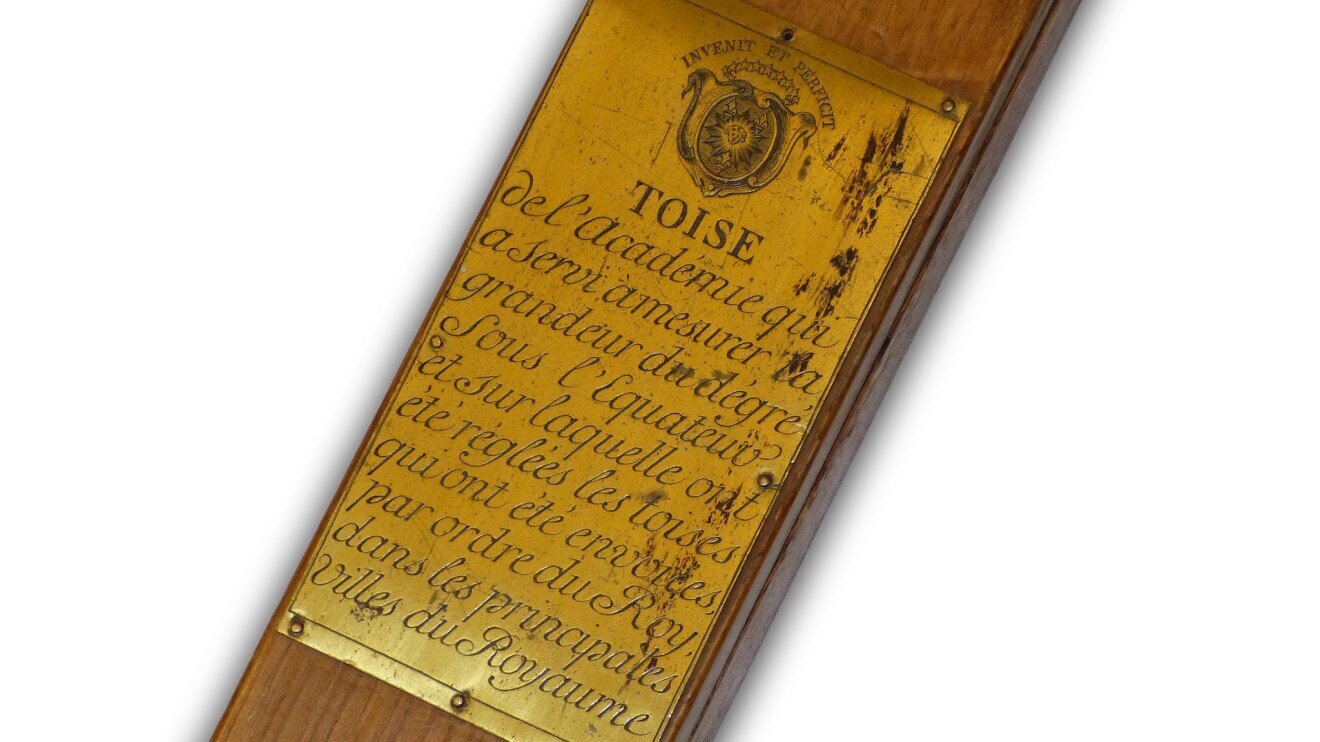
Origin and Etymology
The toise (pronounced [twaz]) is an old unit of length, area, and volume, dating back to pre-revolutionary France. The name comes from the Latin phrase tensa brachia, meaning «outstretched arms.» The etymology reflects an ancient method of measurement — the length of a person’s arms spread out to either side.
The System of Measurement
Before 1812, France used the following division of the toise:
- 1 toise = 6 French feet (pieds)
- 1 toise = 72 inches (pouces)
- 1 toise = 864 lines (lignes)
Metric Equivalents
Standard value: 1 toise ≈ 1.949 meters (about 6 feet 5 inches)
So the «hundred toises» mentioned in the text worked out to roughly 195 meters — a perfectly reasonable distance from a castle to a peasant’s house.
The Historical Evolution of the Standard
The history of the toise as an official unit reflects the development of French metrology:
Before 1394
The standard was an iron bar set into the wall of the Grand Châtelet in Paris.
1667
A new standard was created after the old one warped. The new toise was roughly 0.5% shorter than its predecessor.
1668–1776
The «Toise of Châtelet» served as the official French standard of length.
1766
The «Toise of Peru» became the official standard and was renamed the «Toise of the Academy.»
Link to the Metric System
In 1799, when the metric system was introduced, the meter was defined as 3 feet and 11.296 lines of the Toise of the Academy, establishing a precise ratio between the old and new systems. Interestingly, between 1812 and 1840, France used so-called «customary measures» (mesures usuelles), under which 1 toise was set at exactly 2 meters.
Geographic Reach
The toise was used not only in France but also in French colonial territories in North America: New France, French Louisiana, Acadia, and Quebec. A related unit, the toesa, was used in Portugal, Brazil, and other parts of the Portuguese Empire before the metric system was adopted.
Literary Significance
Using the toise in the text creates an authentic medieval atmosphere and underscores the historical grounding of the hero’s dream. A distance of «a hundred toises» reads as a natural unit for describing the layout of a feudal estate.