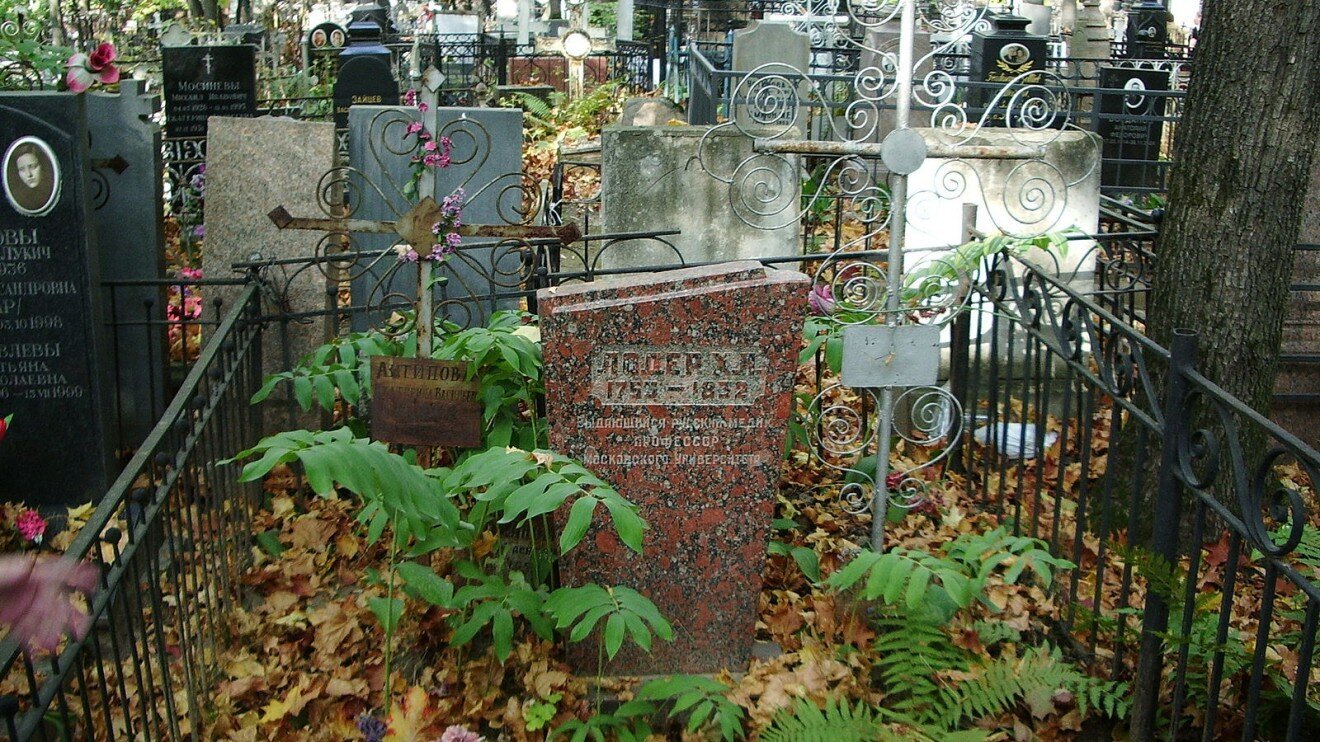
Justus Christian Loder (1753–1832) was an outstanding German anatomist and physician who became a legendary figure in the history of Russian medicine. Born in Riga, he received a brilliant European education, defending his doctoral dissertation at the University of Göttingen in 1777.
Loder spent the first half of his career in Germany, working as a professor of anatomy at the prestigious universities of Jena and Halle. In Jena, he built a new anatomical theater, founded a maternity hospital and a natural history museum, and became personal physician to the Duke of Saxe-Weimar. It was during this period that Loder taught anatomy to none other than Johann Wolfgang Goethe himself, a testament to his exceptional scholarly reputation.
In 1810, fleeing the political upheavals of the Napoleonic Wars, Loder moved to Russia, where his talents earned him new recognition. Emperor Alexander I appointed him his personal physician and granted him the rank of Active State Councillor.
During the Patriotic War of 1812, Loder proved himself an outstanding organizer of military medicine. He was tasked with building a massive military hospital for 36,000 people, and later a network of hospitals in Kasimov, Melenki, and Yelatma. The results of his work astonished his contemporaries: hospitals under Loder’s direction achieved a 77% recovery rate among the wounded — an unheard-of figure for the time.
In 1819, the Russian government purchased Loder’s unique anatomical collection of 5,000 specimens for Moscow University, for 125,000 rubles. Loder not only sold the collection but built, to his own design, an anatomical theater costing more than 100,000 rubles, then taught anatomy there to medical students free of charge until 1831.
Beyond his scholarly work, Loder was also active in medical practice in Moscow. He took part in fighting a cholera epidemic, organized city hospitals, and in 1828, together with a colleague, opened a mineral-water spa on Ostozhenka Street — one of the first such establishments in Russia.
A Curious Fact
There’s a folk etymology linking the Russian word «lodyr’» («slacker») to Doctor Loder’s name. According to this version, the German professor’s high standing led Russian nobles to imitate his habits — taking the waters and going on long walks. Ordinary people saw this way of spending time as idleness, and supposedly that’s where the expression «chasing the loafer» («gonyat’ lodyrya») came from. Linguists, however, including the authoritative etymologist Max Vasmer, dispute this charming legend.
Loder died in Moscow in 1832, leaving behind not only a scholarly legacy but a reputation as a physician who combined European professionalism with genuine service to Russian society. His name became a byword for a top-tier doctor with a taste for unconventional treatment methods.