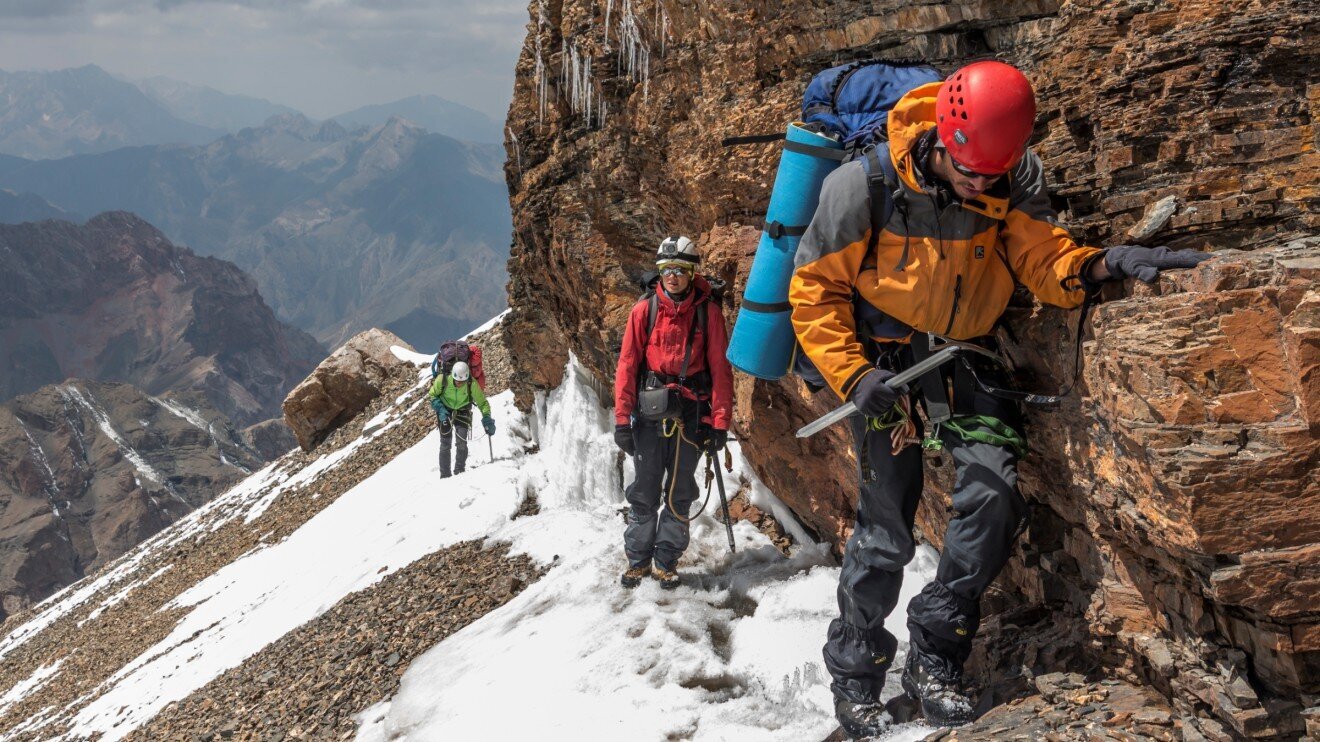
The term traverse has several meanings depending on context, but here it most likely refers to a mountaineering term:
Traverse in Mountaineering and Hiking
Traverse (from the French traverse) is a route that crosses a mountainside, ridge, or crest — that is, one that neither gains nor loses elevation. It’s a horizontal crossing of a slope, allowing an obstacle to be bypassed without climbing to the summit or descending.
Features of a traverse:
- On a traverse, the route stays at roughly the same elevation
- Technically, a traverse is often harder than climbing or descending, since it demands particular footwork and balance
- On steep slopes, a traverse can be seriously dangerous because of the risk of slipping
The phrase "came out onto a traverse right after the first bout of shortness of breath" indicates that the characters, having climbed to a certain height (up to the point where "the first shortness of breath" appeared), began moving horizontally across the slope.
Other Meanings of the Term
Besides its mountaineering sense, the word "traverse" is also used in:
- Nautical usage
- A direction perpendicular to a vessel’s course. "To come abeam" (or "on the traverse") means to be positioned on a line drawn perpendicular to the ship’s long axis.
- Fortification
- A lateral rampart or wall protecting a fortification from flanking fire.
- Military usage
- A lateral movement, a flanking maneuver by troops.
- Downhill skiing
- A method of descending across a slope.