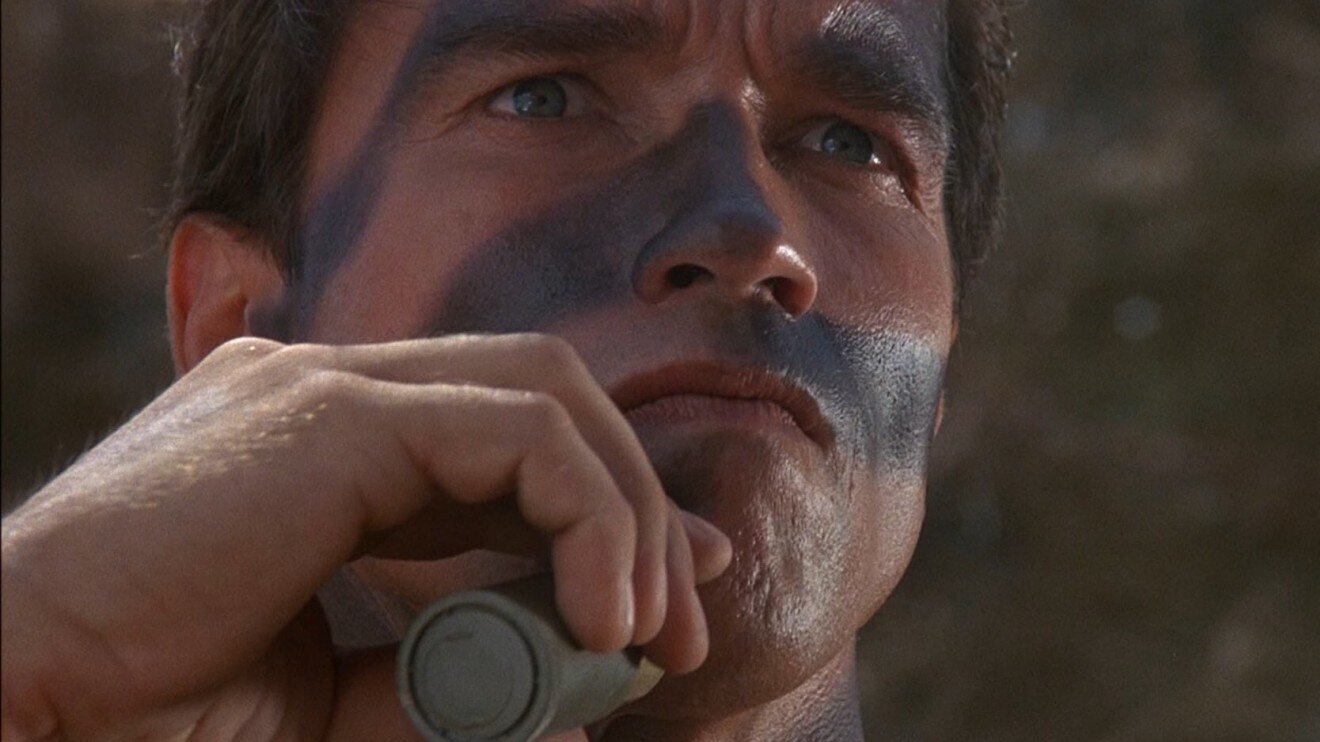
a scene from the film Commando (1985)
«Commando» — an Action Film of a Changing Era
The film «Commando,» released in October 1985, became one of the cult action films that defined the aesthetic of 1980s American cinema. In Russia of the early 1990s, films like it became especially popular — they filled the video parlors and became part of the new cultural reality of the post-Soviet space.
Director Mark L. Lester created a picture that, despite its minimalist plot, turned into a vivid showcase for its lead: retired Colonel John Matrix, played by Arnold Schwarzenegger. Over 45 days of filming in California (starting April 22, 1985), the film became one of the symbols of the video-boom era.
Plot and Its Symbolism
The story of retired Colonel Matrix, who single-handedly takes on an army of mercenaries to save his daughter, turned out to be strikingly in tune with the mood of Russians during a period of social upheaval. In 1993, many Russians, like the film’s hero, felt abandoned by the system and forced to defend their own families against an uncertain future on their own.
The former dictator Arius, dreaming of reclaiming power over the fictional country of Val Verde, serves as a metaphor for a departed regime. The film also has the traitor Bennett — a former comrade of Matrix’s — which likewise mirrored the realities of Russia in 1993, when many former colleagues found themselves on opposite sides of political and economic barricades.
Cultural Significance in Post-Soviet Russia
In the early 1990s, American action films flooded the Russian video market. «Commando,» with its bluntness, its abundance of action sequences, and its charismatic lead, was a typical representative of that wave. The film gained enormous popularity for several reasons:
- The image of a strong lone hero appealed to viewers at a time when many social institutions were in crisis
- A simple, clear plot about good versus evil offered an escape from a complicated, contradictory everyday life
- The visual effects and staging of the action sequences set a new standard of spectacle for Russian audiences
«Commando» as Part of Video Culture
Video parlors — a uniquely Russian phenomenon of that period — often included «Commando» in their programs. Watching such films became a collective experience that shaped new cultural codes. Cassette copies of the film passed from hand to hand, were copied and resold, creating a distinct economy of exchange.
The poor quality of the translation, often performed by a single voice for every role (the so-called «nasal translation»), paradoxically added a peculiar charm to the film in the eyes of Russian viewers.
Influence on Popular Culture
The film had a notable influence on popular culture. Remakes of «Commando» appeared in various countries: in 1988, India released a film of the same name starring Mithun Chakraborty, and in 2008 a Russian remake, «Den D» («D-Day»), came out starring Mikhail Porechenkov. In 2013, another Indian film appeared that kept both the title and the main plot elements of the original.
Interestingly, the script for an unrealized «Commando» sequel was reworked and became the basis for another cult action film — «Die Hard,» starring Bruce Willis.
In early-1990s Russia, «Commando» and films like it served not only as entertainment but as a kind of primer for a new life: they showed a different world, an unfamiliar aesthetic, other values. For many Russians, the era of video parlors and Western action films also became a time of reconsidering their own identity.