Trekhgornaya Manufaktura
Trekhgornaya Manufaktura is Moscow's oldest textile enterprise, founded in 1799 by the merchant Vasily Prokhorov. By the 1990s, the enterprise was officially named "Trekhgornaya Manufaktura imeni F.E. Dzerzhinskogo."
The enterprise took its name from the Trekhgorye locality in Moscow. Throughout the 19th and 20th centuries, "Trekhgorka" was one of Russia's largest textile producers.
In the 19th century, Trekhgornaya Manufaktura specialized in producing printed fabrics, including the famous kumach (a bright red cotton fabric), as well as patterned fabrics, headscarves, shawls, and bedspreads. The enterprise included cotton-spinning, cotton-weaving, and calico-printing operations, along with departments for bleaching and dyeing fabric.
The factory's products earned high acclaim: in 1848 it was granted the right to display the state coat of arms on its goods, and at international exhibitions it repeatedly won gold and silver medals — in London (1851, 1862), Paris (1867, 1886), Vienna (1873), Antwerp (1887), and Chicago (1893).
In the Soviet era, the factory reached peak output in the 1980s, producing up to 200 million meters of various fabrics per year.
Fun fact: Russia's first vocational school was opened at the factory in 1820, along with the country's first factory theater, library, and outpatient clinic for workers.
By the early 1990s, the enterprise was going through a serious crisis tied to its outdated equipment. According to a former chief engineer, in 1963 the plant had 1,300 looms still in use that dated from 1895. The situation had changed little by the time the USSR collapsed.
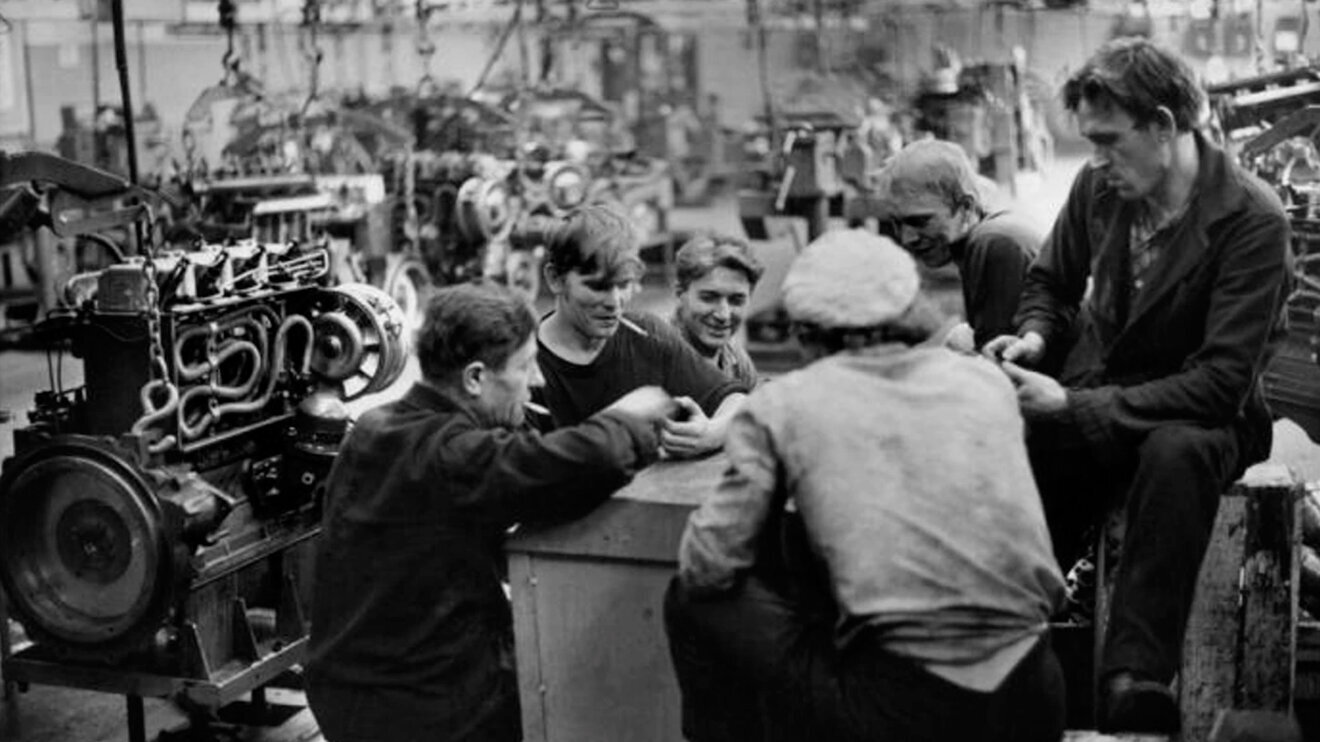
The Likhachev Plant (ZIL)
ZIL was the first automobile manufacturing enterprise in the Russian Empire and the USSR, founded in 1916 as the "Joint-Stock Partnership of the Moscow Automobile Society" (AMO).
The plant was named after Ivan Alekseyevich Likhachev in 1956. By the 1990s, it was one of the country's largest automobile manufacturers, known for producing the ZIL-130 and ZIL-133 trucks, government limousines, and household refrigerators.
Trekhgornaya Manufaktura
- Founded: 1799
- Focus: Textile production
- Peak output: 200 million meters of fabric per year (1980s)
- Status in 1993: Crisis, outdated equipment
ZIL
- Founded: 1916
- Focus: Automobile manufacturing
- Peak output: 195,000-210,000 trucks per year (1975-1989)
- Status in 1993: A sharp decline in output
"Limitchiki" and factory dormitories
Both enterprises relied heavily on "limitchiki" — workers who had come to Moscow from other regions of the USSR under a special residency quota (limit). Limitchiki made up a significant share of the capital's industrial workforce.
Who were the limitchiki?
Limitchiki were workers who came to Moscow and other major Soviet cities under a special permit (limit) to work at industrial enterprises. They received Moscow residency registration only after several years of work at the enterprise.
Since getting separate housing in Moscow was extremely difficult, most limitchiki lived in factory dormitories for years, sometimes decades. This was a distinct subculture of Moscow's working-class districts — people formally living in the capital, but often feeling like temporary residents.
Dormitory life as a way of being
Factory dormitories were multistory buildings with rooms for 2 to 4 people, shared kitchens, and shared bathrooms. Conditions were spartan, but for many this was the only way to gain a foothold in Moscow. A particular kind of community formed in these dormitories — people became almost like family, sharing hardships and joys together.
"Thirty years in the dorm" is not just a mundane detail, but a symbol of an entire era, when getting one's own housing was a dream, and the dormitory was the reality for millions of Soviet people.
The crisis of the early 1990s
By 1993, both enterprises were in deep crisis. Trekhgornaya Manufaktura was operating on pre-revolutionary equipment, and demand for its products was falling. ZIL faced a sharp drop in government orders — while the plant had produced 195,000–210,000 trucks a year from 1975 to 1989, by the mid-1990s output had fallen to 7,200 vehicles.
Many workers, including limitchiki, faced a choice: stay at dying enterprises, or search for new work in a market economy. For those who had spent decades in the dormitories, this was an especially painful period — not only their accustomed way of working, but their entire way of life was collapsing.
Epilogue
Trekhgornaya Manufaktura permanently halted textile production in 2008, and ZIL ended automobile production in 2013. The territory of both enterprises is being redeveloped today with residential complexes and office centers, and the era of industrial Moscow, with its limitchiki and dormitories, has passed into history.