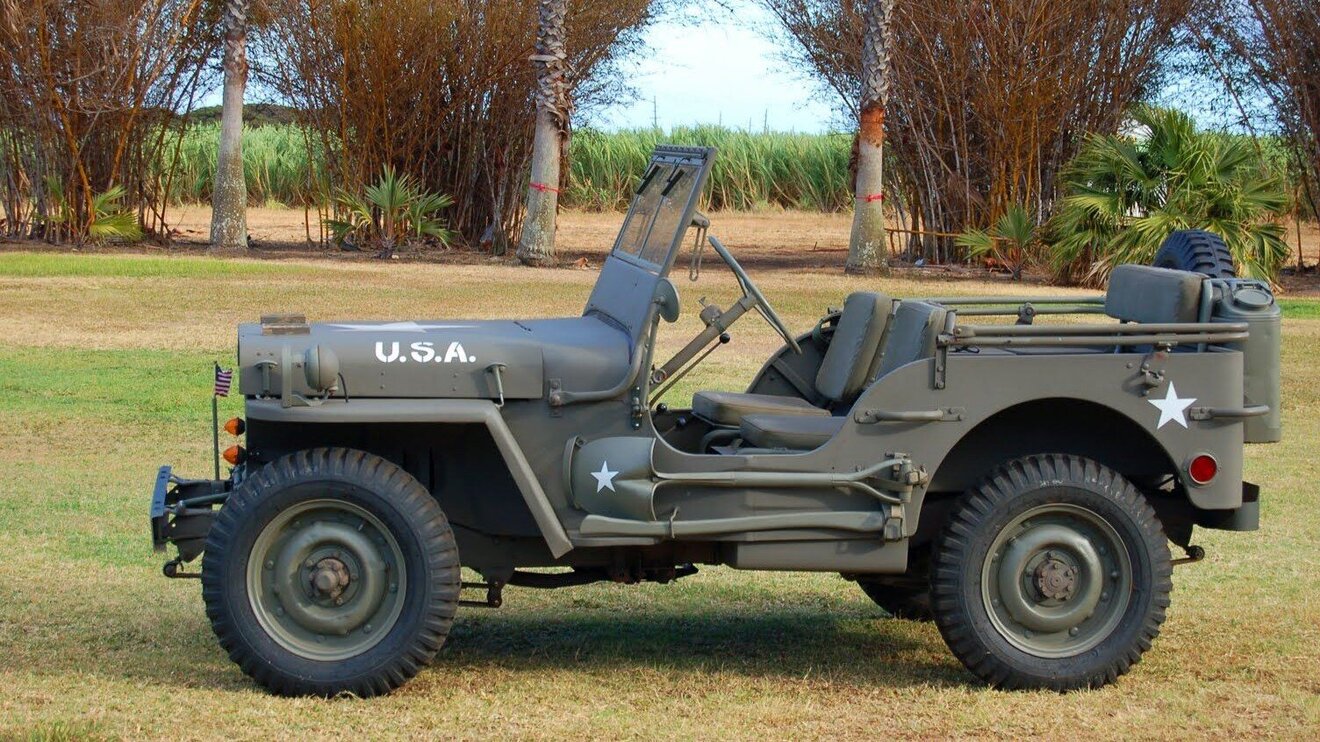
Obviously, a genuine military jeep can’t have a trunk — otherwise it’s not a military vehicle but a looter’s car. Where have you ever seen a soldier with luggage? It looks like the jeep had its rear bench removed, creating a space the narrator calls a «trunk.»
The Jeep was originally an American military off-road vehicle, created in 1941. It came out of a US Army tender, under which engineer Karl Probst designed the four-wheel-drive, open-bodied Bantam BRC. The design was later refined by Willys-Overland and Ford Motor Co., which received the main military contracts for the Willys MB and Ford GPW models.
The origin of the name «Jeep» has several versions. The most widespread has it coming from the abbreviation GPW (G for government contract, P for a car with a wheelbase up to 80 inches, W for the Willys type). Another version links the name to a comic-strip character, Eugene the Jeep. There’s also a version where the abbreviation GP («gee-pee») morphed into «jeep.» The Jeep trademark was only officially registered on June 30, 1950, by Willys-Overland.
During World War II, more than 51,000 Willys jeeps were shipped to the USSR under Lend-Lease, both assembled and in kit form. These vehicles stood out for their off-road capability, ruggedness, and reliability.
Military jeeps had an open body with a canvas top, folding rear seats, and a cargo platform. What the novel’s text calls the «trunk» is most likely that same cargo platform, exposed when the rear seat was folded down or removed. In the Russia of 1993, amid the socioeconomic crisis and rampant crime, both original military jeeps and their civilian modifications became widespread.
As early as the war years, Willys-Overland began developing civilian versions of its military vehicles, leading to the CJ (Civilian Jeep) series. The first such model, the CJ2A, went on sale in August 1945, becoming the first postwar American civilian passenger vehicle.