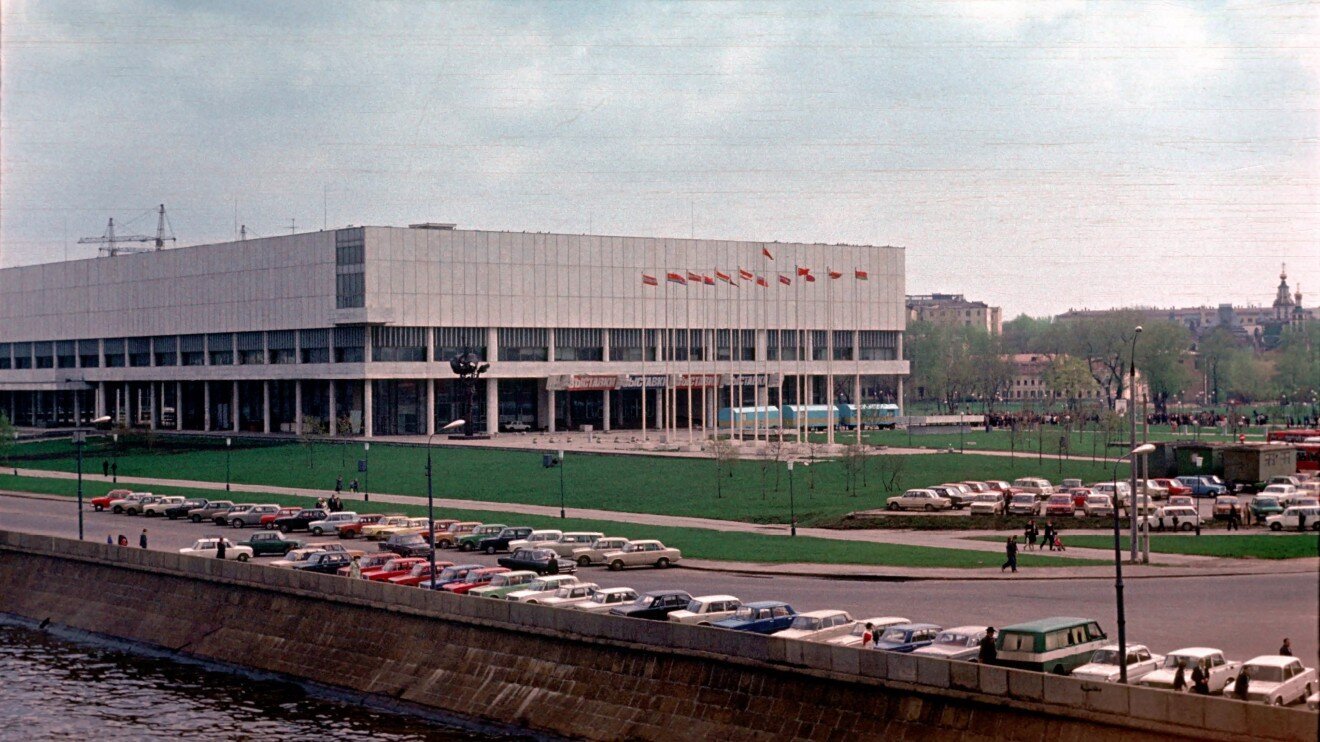
The Central House of Artists (TsDKh) is one of Moscow’s largest exhibition centers, opened in 1979 on Krymsky Val. In the 1990s, TsDKh became a vital hub of the capital’s art scene — a meeting place for artists, and a venue for exhibitions, concerts, and cultural events.
Key Facts
- Opened: November 1979
- Address: 10 Krymsky Val
- Area: 54,000 m²
- Halls: 27
- Screening room: 600 seats
By the Numbers
- Exhibitions per year: over 300
- Visitors: about 1 million a year
- Collection: over 46,000 items
- Parking: over 500 spaces
The History of Its Creation
The idea for the Central House of Artists took shape in the mid-1950s. In September 1956, the USSR Council of Ministers issued a decree calling for two separate buildings — one for the Tretyakov Gallery, one for the Union of Artists’ exhibition hall. Later, though, the decision was made to build a single complex that could house both institutions.
The project was designed in 1962–1963 by architects Nikolai Sukoyan and Yuri Sheverdyayev. Construction began in 1965 and lasted 14 years. The project was officially approved for construction in March 1964.
Architectural Features
The TsDKh building became one of the largest cultural centers in the USSR. Its architecture reflected the Soviet state’s ambitious plans for developing art and culture. The complex included not just exhibition halls but a screening room, a press center, workshops, and administrative offices.
Structure and Activities
From its opening, TsDKh shared its building with the Tretyakov Gallery (the New Tretyakov). That proximity created a unique atmosphere, where classical art coexisted with contemporary artistic practice.
Exhibition Program
TsDKh galleries hosted a wide range of exhibitions:
- Contemporary art — works by Soviet and Russian artists
- International projects — exhibitions of foreign masters
- Architecture and design — specialized shows
- Decorative and applied art — folk crafts and traditional trades
Famous Exhibitions of the 1980s–90s
In the 1980s, TsDKh hosted a series of exhibitions by world-renowned artists that became cultural events of the era:
European Masters
- Henri Cartier-Bresson (France)
- Yves Saint Laurent (France)
- Günther Uecker (Germany)
- Francis Bacon (England)
- Giorgio Morandi (Italy)
- Jannis Kounellis (Italy)
American and Other Artists
- Robert Rauschenberg (USA)
- James Rosenquist (USA)
- Salvador Dalí (Spain)
- Jean Tinguely (Switzerland)
- Rufino Tamayo (Mexico)
- Israel Zwaigenbaum (USA)
Cultural Life in the 1990s
During the period the novel is set (1997), TsDKh was in an especially active phase. After the collapse of the USSR, the building fell under the management of the International Confederation of Artists’ Unions, opening new possibilities for international cooperation.
Banquets and Society Events
TsDKh was not just an exhibition center but a venue for formal events. Banquets at TsDKh gathered the cream of Moscow’s artistic intelligentsia:
- Artists — painters, sculptors, graphic artists
- Actors — stars of stage and screen
- Critics and art historians — shapers of public opinion
- Collectors — connoisseurs and buyers of art
- Journalists — covering the cultural scene
The Atmosphere of the Banquets
Banquets at TsDKh had a particular atmosphere. Here you might meet established masters alongside young talents. Events unfolded surrounded by works of art, creating a unique setting for conversation and new acquaintances.
Concerts
The TsDKh screening room, seating 600, regularly hosted musical events. Both classical musicians and rock performers appeared there. Concerts by Boris Grebenshchikov and other Soviet rock stars were especially memorable.
The Tretyakov Gallery Inside TsDKh
The New Tretyakov, housed in the same building, showcased 20th-century art. Its collection included works by:
1920s Avant-Garde
- Kazimir Malevich
- Wassily Kandinsky
- Marc Chagall
- Mikhail Larionov
1920s–30s Masters
- Robert Falk
- Pyotr Konchalovsky
- Pavel Filonov
- Pavel Korin
Soviet Art
- Alexander Deineka
- Vera Mukhina
- Yuri Pimenov
- Artists of the «Severe Style»
Muzeon Park
TsDKh was surrounded by Muzeon Park — a unique open-air sculpture museum. The park complemented the exhibition complex, creating a cohesive artistic environment. It housed:
- Monuments from the Soviet era
- Contemporary sculptural installations
- Experimental art objects
- Children’s playgrounds
Its Significance for Moscow’s Cultural Life
By 1997, TsDKh had become an inseparable part of Moscow’s cultural landscape. Its importance is hard to overstate:
For Artists
TsDKh offered a platform for showing work, a chance to take part in prestigious exhibitions, and contact with peers.
For Visitors
Visitors gained access to the best examples of contemporary art, both Russian and foreign.
For the Cultural Elite
TsDKh served as a place for meetings, the exchange of ideas, and forming professional connections within the art world.
For the City
The center helped shape Moscow’s cultural image as one of the world’s art capitals.
Architecture and Layout
The TsDKh building was a monumental complex, characteristic of Soviet architecture of the 1960s–70s. Its features included:
Layout Solutions
- Large halls — for major exhibitions
- Small halls — for intimate shows
- Gallery corridors — additional exhibition space
- Screening room — for cultural events
- Foyer — venue for banquets and receptions
Technical Equipment
TsDKh was equipped with the most modern technology of its time:
- Climate-control systems to preserve artworks
- Special lighting for exhibition halls
- Modern security systems
- Sound equipment for the concert hall
Daily Life at TsDKh
In 1997, TsDKh was full of activity. Every day brought various events:
Morning
Preparation for exhibitions, hanging works, meetings with artists and curators.
Afternoon
Exhibitions open to the public, tours, press conferences, business meetings.
Evening
Gala openings, banquets, concerts, society events.
Its Social Function
TsDKh served an important social function, acting as a meeting place for different parts of society:
- The professional community — artists, critics, gallerists
- The intelligentsia — writers, actors, directors
- Collectors — connoisseurs and buyers of art
- Journalists — covering cultural life
- Art lovers — the general public
Its Influence on the Art World
TsDKh had a significant influence on the development of Moscow’s, and Russia’s, artistic environment:
Shaping Taste
Regular exhibitions by foreign masters broadened the horizons of Russian artists and audiences, helping shape modern artistic taste.
International Ties
TsDKh served as a bridge between Russian and world art, helping integrate domestic artists into the international context.
Supporting Young Talent
The center offered opportunities for young artists to debut, helping new names emerge in the art world.
Conclusion
By 1997, the Central House of Artists held a special place in Moscow’s cultural life. It was more than an exhibition center — it was a living space where different artistic currents intersected, where people of the arts met, and where new ideas and projects were born.
The banquets at TsDKh mentioned in the novel were an important part of the capital’s cultural life. Here you could meet established masters and rising stars alike, serious collectors and casual art lovers. The atmosphere of these events fostered professional and personal connections that often shaped participants’ futures.
TsDKh in 1997 was a symbol of cultural revival, creative freedom, and openness to the world — hallmarks of that era. That’s exactly why it feels natural in the novel that the protagonist would meet an actor and a painter at a banquet at TsDKh — the place drew in people of the arts and created conditions for fruitful meetings and new acquaintances.
The Central House of Artists existed until 2019, when the building was fully transferred to the Tretyakov Gallery. Today, the New Tretyakov stands on Krymsky Val, continuing the tradition of showing contemporary art.