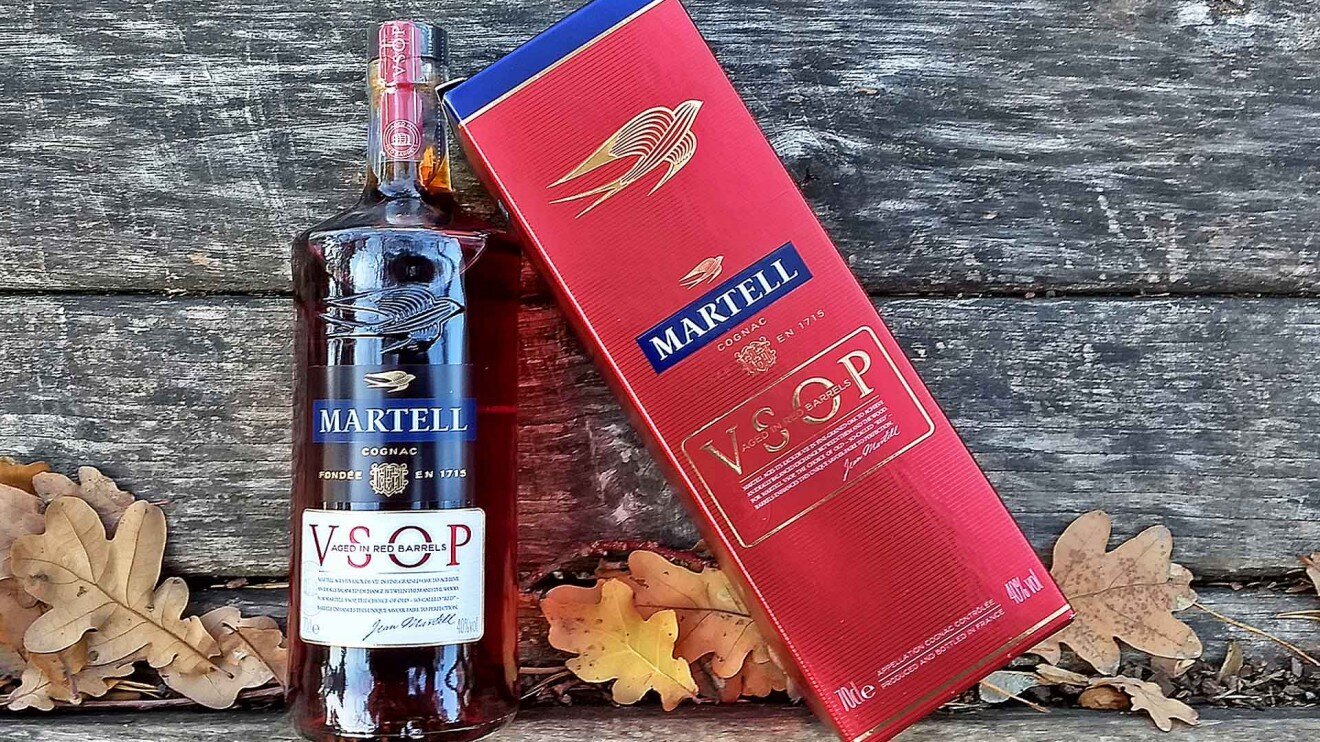
Founded in 1715
Founding History and Its Founder
Jean Martell was born in 1694 on the island of Jersey — a territory known at the time for its smuggling trade, which may have shaped his later career in spirits. At 21, in 1715, the young merchant founded his own business in the town of Cognac, on the banks of the Charente River, at a spot called Gatebourse.
The company logo Jean Martell chose — a swift bird paired with the Martell family crest — is still used today, though it has undergone some changes over the brand’s three centuries of existence.
Production Technique and Distinctive Features
From the very start, Martell stood out for its particular approach to making cognac. The founder used grapes from the vineyards of the Borderies sub-region to produce the spirits (eaux-de-vie), and aged them in oak barrels from the Tronçais forest. This combination gave Martell’s cognac its exceptionally smooth taste, which became the house’s calling card.
Distinctive Features of Martell Production
- Grapes: predominantly from the Borderies region
- Oak barrels: from the Tronçais forest (central France)
- Result: a soft, elegant taste with a characteristic smoothness
- Aging: strict adherence to traditional methods
Development After the Founder’s Death
After Jean Martell’s death in 1753, his widow carried on the business, followed by his two sons and then a grandson. The family not only preserved the production traditions but actively grew the export business. By 1814, Martell had become the most popular brandy in England — a significant achievement given the competition on the British market.
Key Milestones
- 1795 — a strategic alliance with the House of Hennessy through a dynastic marriage
- 1831 — creation of the first V.S.O.P. cognac
- 1865 — the alliance with Hennessy strengthened through a second dynastic marriage
- 1912 — the launch of the legendary Martell Cordon Bleu
Martell Cordon Bleu — the Flagship Product
In 1912, Martell Cordon Bleu was unveiled at the Hôtel de Paris — the house’s first post-phylloxera cognac. Phylloxera, a grape louse, had wiped out most European vineyards in the late 19th century, forcing cognac producers to essentially start from scratch.
Prestigious Events Featuring Cordon Bleu
- The coronation of King George V
- The maiden voyage of the ocean liner RMS Queen Mary
- Flights of the supersonic Concorde
- Numerous diplomatic receptions and state banquets
Growing Regions and Raw Materials
Martell selects grapes from four main sub-regions of the Cognac appellation, each lending the spirit its own particular character:
- Les Borderies — the smallest sub-region, giving softness and floral notes
- Grande Champagne — a prestigious region, providing long aging potential and complexity
- Petite Champagne — complements the Grande Champagne, adding elegance
- Fins Bois — the largest region, giving fruity notes and roundness
The Modern Product Range
By the end of the 20th century, the House of Martell had significantly expanded its product line, offering cognacs for various market segments:
The Core Range
- Martell VSOP Médaillon — a classic top-quality cognac
- Martell Noblige — a refined cognac for special occasions
- Martell Cordon Bleu — the flagship product since 1912
- Martell XO — a prestigious cognac, released in 2005
- Martell Chanteloup — an ultra-prestige line
- Martell Création — an art collection (2007)
- Martell L’Or de Jean — a tribute to the founder (2009)
- Martell Blue Swift — a modern take on the classic
Changes in Ownership and the Modern Era
In 1987, the Canadian company Seagram acquired Martell for roughly $600 million, drawn in by the profitability of the cognac business. However, according to the Wall Street Journal, Seagram did almost nothing to develop the brand.
While other cognac producers boomed in the 1990s, Martell’s sales declined. By 1998, the company was selling less cognac in the U.S. than any other member of the «big four» producers.
Revival Under Pernod Ricard
- Repositioning the brand to attract new consumers
- Launching numerous new product lines
- Expanding into the «ultra-prestige» segment
- Strengthening marketing campaigns
Cultural Significance and Symbolism
Martell holds a special place in world culture as a symbol of French elegance and craftsmanship. In 2006, the House of Martell joined the prestigious Comité Colbert — an association promoting French luxury houses internationally.
Cultural Ties
- Film: a bottle of Martell Cordon Bleu appears in the opening scene of «Apocalypse Now» (1979)
- Literature: the «Poe Toaster» — the mysterious figure who each year left a bottle of Martell at Edgar Allan Poe’s grave in Baltimore
- Sport: sponsorship of the prestigious Grand National horse race (1992–2004)
- Art: collaborations with artists and designers on exclusive bottle designs
Production Capacity and Market Position
Martell’s production figures as of 2015
- Roughly 14 million bottles of cognac a year
- Second place worldwide in cognac production volume (after Hennessy)
- A presence in more than 130 countries
- A workforce of several hundred employees
Tradition and Innovation
The House of Martell successfully blends centuries-old traditions with modern innovation. Its cellar masters still use methods laid down by the founder, but the company isn’t afraid to experiment with new approaches to aging and blending.
Supporting Cultural Heritage
Since 2007, Martell has been an official partner of the Palace of Versailles, supporting restoration work there. In 2010, the company financed the restoration of the Queen’s reception hall.
Conclusion
Martell is more than a cognac house — it’s a living record of French craftsmanship spanning more than three centuries. From Jean Martell’s modest trading venture to one of the world’s largest cognac producers, the company’s journey mirrors the evolution of the entire cognac industry.
Today, a bottle of Martell is more than a refined spirit — it’s a symbol of French culture, tradition, and unmatched quality. Every sip carries the history of generations of craftsmen who devoted their lives to creating the perfect cognac.