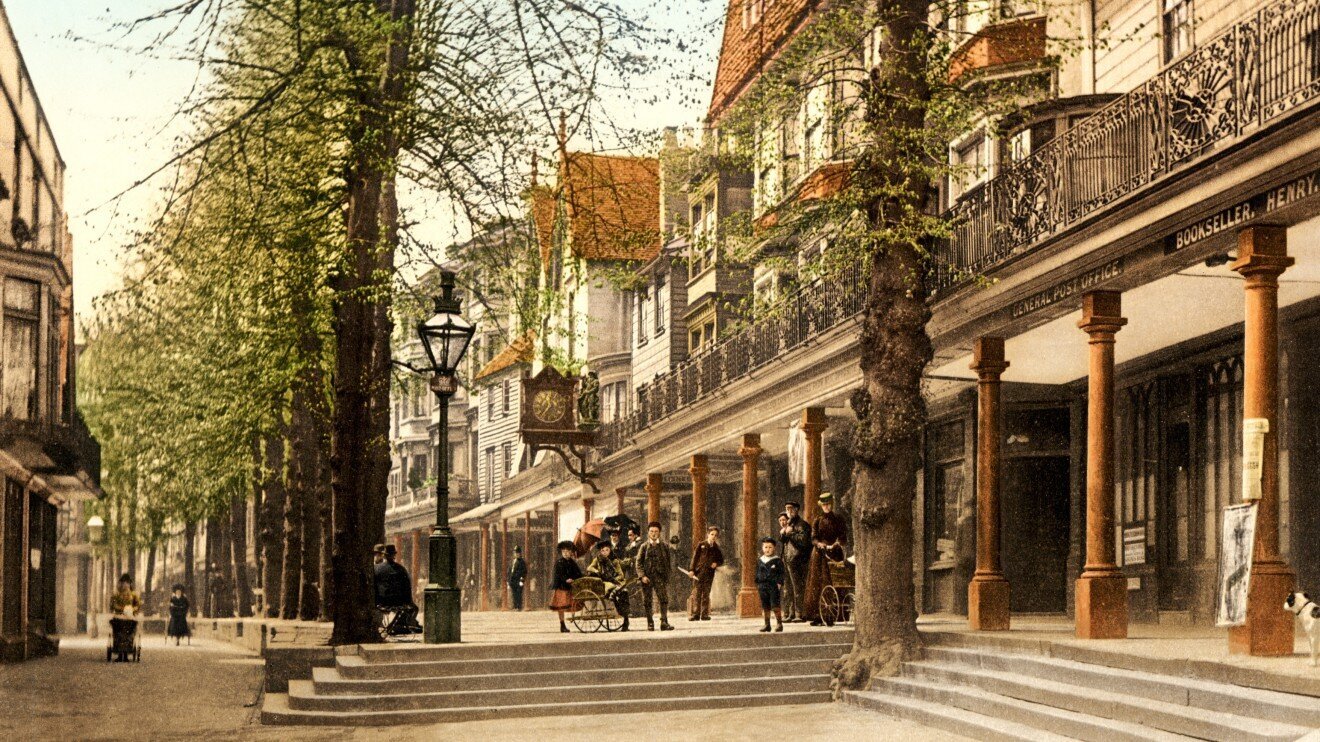
A resort town for the aristocracy and middle class of modern England
Royal Tunbridge Wells is a town in the county of Kent, 50 kilometers southeast of London. It’s one of only three towns in England granted the royal title "Royal," bestowed by King Edward VII in 1909 in recognition of its longstanding popularity with the royal family.
By the mid-1990s, the town’s population stood at roughly 56,000–57,000, making it a significant regional center in southeast England. It serves as the administrative seat of the Borough of Tunbridge Wells and the parliamentary constituency of the same name.
Key Facts
- Population: ~57,000 (1996)
- County: Kent
- Status: Royal town
- Distance from London: 50 km
The History of a Spa Town
Tunbridge Wells’s history as a spa town began in 1606, when a courtier of King James I, Lord Dudley North, discovered a mineral spring rich in iron here (a chalybeate spring). Convinced of the water’s healing properties after his own health improved, he brought his wealthy London friends to see it. By 1630, the spring had been visited by Queen Henrietta Maria, wife of Charles I, cementing the site’s reputation for good.
An interesting detail
The name "Wells" is plural, but actually refers to a single main spring, in the area now known as the Pantiles, where visitors would "take the waters."
The town’s heyday as a fashionable resort came in the 18th century, especially under the patronage of the famous Beau Nash, who served as "master of ceremonies" for all of Tunbridge Wells’s entertainments from 1735 to 1762. During this period, the town attracted figures like Samuel Johnson, David Garrick, and the actor and playwright Colley Cibber.
Architectural Heritage
The town’s main landmark remains the Pantiles — an elegant, colonnaded promenade 160 meters long, built in the 1680s. This is where the town’s famous healing spring is located, the very feature around which the whole town grew up. The name comes from the square ceramic tiles originally used to pave the walkway.
A significant contribution to the town’s architectural character came from Decimus Burton, who in the 19th century created the elegant Calverley Park complex, with its distinctive Empire-style terraced houses. Calverley Crescent, with its graceful curved colonnade, is considered one of the finest examples of Regency-era town planning in England.
The Church of King Charles the Martyr, built in 1684, was the town’s first permanent religious building and the center around which its growth began. The church sits right on the border between Kent and East Sussex.
Geography and Natural Features
Tunbridge Wells sits on the northern edge of the High Weald, a ridge of hard sandstone running across southern England. The local geology is clearly visible in the sandstone outcrops at Wellington Rocks and High Rocks, the latter of particular scientific interest and listed as a protected natural landmark.
The town sits at the head of a valley running southeast toward Groombridge. It’s here that the River Teise rises, one of the many tributaries of the Medway. The iron content of local rock is reflected in the name of the western suburb of Rusthall ("rusty hill").
Social Status and Reputation
"Disgusted of Tunbridge Wells"
The town earned a reputation as a stronghold of the English middle class and a stereotypical representative of "Middle England." This is reflected in the popular phrase "Disgusted of Tunbridge Wells" — the sign-off on letters to newspaper editors from a fictional author expressing conservative views and outrage at modern morals. The image emerged in the 1950s and became a household phrase.
By the 1990s, Tunbridge Wells was 97.5% white British, with 75% of residents identifying as Christian. The crime rate was significantly below the national average. The town traditionally voted Conservative — from the constituency’s creation in 1974 through 2024, Conservative candidates won without interruption.
The Mid-1990s Economy
By the mid-1990s, Tunbridge Wells’s economy rested on a few key sectors:
Retail and Services
Around 30% of all jobs. The Royal Victoria Place shopping centre, opened in 1992, became the largest between London and Hastings.
Finance and Business
Nearly a quarter of all jobs. The largest private employer was AXA PPP healthcare, with 1,700 staff across four offices.
Healthcare
The Kent and Sussex hospitals employed around 2,500 people, making healthcare the largest public-sector employer.
The town’s unemployment rate was traditionally far below the national average — roughly 1–2%, against 8–10% nationally in the mid-1990s.
Transport Links
Tunbridge Wells was an important transport hub for southeast England:
- Rail: Two active stations on the electrified Hastings line, with regular service to London (about an hour’s journey).
- Roads: A junction of the A26 (Maidstone–Newhaven), the A264 (toward Crawley), and the A267 (south to Heathfield). The A21, the main London–Hastings trunk road, runs nearby.
- Public transport: Regular bus routes to Tonbridge, Maidstone, Sevenoaks, plus express service to Bromley.
Cultural Life
By the mid-1990s, Tunbridge Wells still held its reputation as the region’s cultural center:
Theaters and Concert Halls
- • The Assembly Hall (1,020 seats) — the town’s main theater
- • The Trinity Arts Centre — an intimate venue in a converted church
- • The Opera House (opened 1902)
Cultural Institutions
- • The library, museum, and art gallery
- • The Salomons Museum (Jewish community history)
- • Several private galleries and antique shops
Tunbridge Wells in Literature and Film
The town has appeared repeatedly in classic and contemporary literature, underscoring its cultural weight:
"Tunbridge Wells is Tunbridge Wells, and there is nothing else in the world quite like it."
The town also turns up in the work of Arthur Conan Doyle (The Valley of Fear), Oscar Wilde (The Importance of Being Earnest), E. M. Forster (A Room with a View), Arnold Bennett (The Old Wives’ Tale), and many other writers.
On film, the town is mentioned in David Lean’s epic Lawrence of Arabia (1962) and in the Bond film On Her Majesty’s Secret Service (1969), where Tracy di Vicenzo dreams of the life of "Mr. and Mrs. James Bond of Acacia Avenue, Tunbridge Wells."
Parks and Green Spaces
One distinctive feature of Tunbridge Wells is its abundance of green space:
Calverley Grounds
A historic park in the town center, opposite the railway station, with manicured gardens. It holds a memorial to Air Marshal Lord Dowding, hero of the Battle of Britain, who lived and died in Tunbridge Wells.
Dunorlan Park
The town’s largest green space (32 hectares), once the private garden of the millionaire Henry Reed. It’s here that the River Teise rises, and the park includes a pond and a boating lake.
Tunbridge Wells and Rusthall Commons — 100 hectares of woodland and heath near the town center, a popular spot for picnics, with a cricket pitch by Wellington Rocks.
Local Government
The town is governed by a council of 48 councillors, representing 20 wards. Since 1973, local government has been dominated by the Conservative Party, with control briefly passing to the Liberal Democrats or a "no overall control" arrangement only between 1994 and 1998.
In Parliament, the town was represented by Sir Patrick Mayhew (1974–1997), then by former Asda chairman Archie Norman (1997–2005). Since 2005, its MP has been Greg Clark of the Conservative Party.
Climate
Like the rest of Britain, Tunbridge Wells has a temperate maritime climate with no extreme weather. Average annual rainfall is around 820mm; the record high is +34.7°C (August 1990), and the record low is -19.2°C (January 1940).
By the mid-1990s, Royal Tunbridge Wells was a thriving middle-class town, combining the historic legacy of its spa-town past with a modern economy and a convenient location relative to London. Its reputation as a bastion of conservative values and "quintessential Middle England" made it a symbol of stability and tradition in a rapidly changing world.