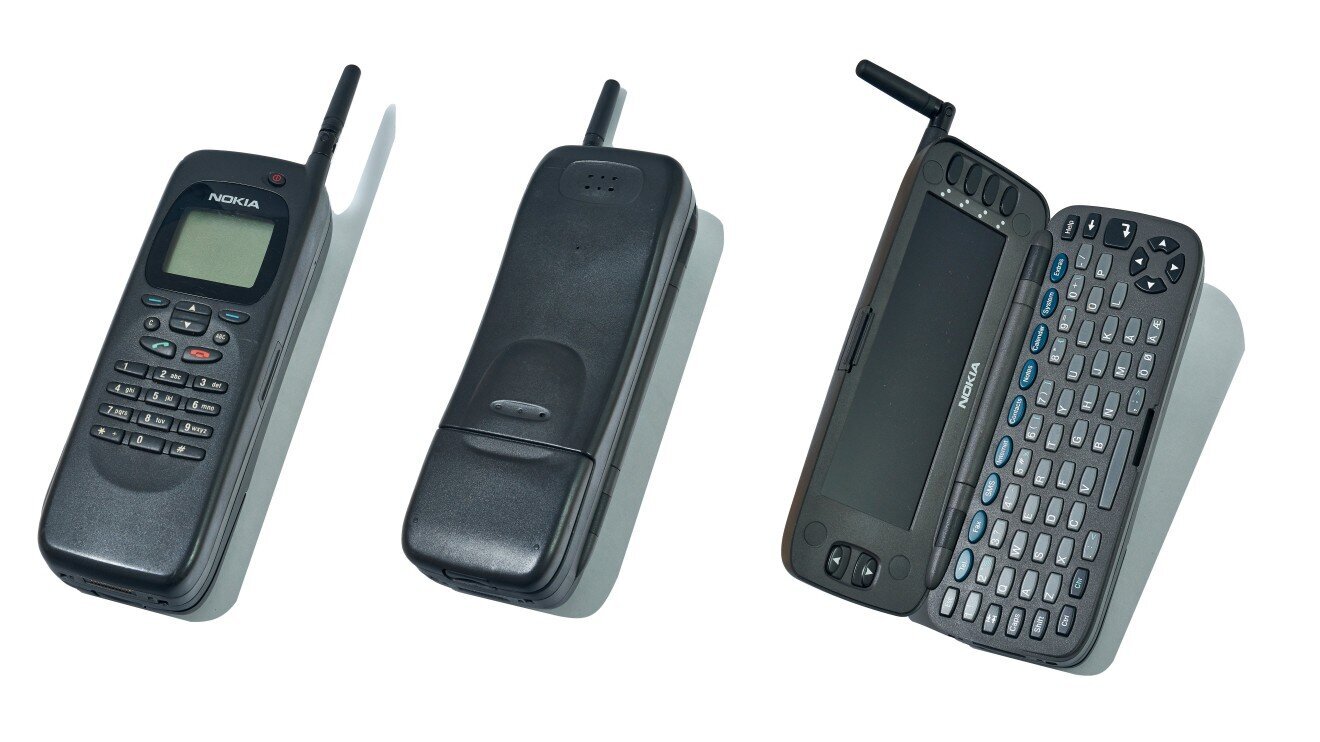
The novel refers to the Nokia Communicator as a dreary device «for the broke» – a remark that might seem strange to a modern reader. Understanding that assessment requires diving into the context of the Russian mobile market at the end of the 1990s, when entirely different criteria for prestige were in play.
The revolution in size: «smaller means cooler»
1998 was a turning-point year in the history of mobile communications in Russia. If mobile phones in the early part of the decade had been bulky «bricks» weighing nearly a kilogram, by the end of the ’90s the dominant trend was miniaturization. Owning a tiny phone demonstrated not only the owner’s financial standing but also their proximity to the most cutting-edge technology.
The Nokia Communicator looked archaic against that backdrop. Weighing nearly 400 grams (the Nokia 9000) or 253 grams (the Nokia 9110), it looked like a giant next to sleek handsets weighing 80–120 grams. For a status-conscious Russian at the end of the ’90s, carrying around such a «shovel» meant admitting to technological backwardness.
The technological paradox: being ahead of its time as a flaw
The irony of the situation was that the Nokia Communicator was a revolutionary device, years ahead of its time. When most Russians in 1998 were only just getting the hang of the most basic phone functions – calls and SMS – the Communicator offered capabilities that would only become commonplace in the smartphone era.
The device ran the GEOS operating system (later Symbian), had a full QWERTY keyboard, a monochrome LCD screen with 640×200 resolution, and could function as a pocket computer. Users could send and receive email, work with faxes, use a web browser, and keep a calendar and notes.
But in 1998 Russia, these capabilities were more exotic curiosity than necessity. The internet was only just beginning to penetrate the business world, email was accessible to a limited circle of specialists, and mobile internet existed only in theory. Data was transmitted via CSD (Circuit Switched Data) technology at 9.6 kbit/s – painfully slow even by the standards of the day.
The psychology of status: conspicuous consumption, Russian-style
Understanding attitudes toward the Nokia Communicator in late-1990s Russian society requires accounting for how the new elite was taking shape. After decades of shortages and enforced equality, the ability to display wealth became a crucial social marker. The mobile phone turned into one of the chief symbols of success – alongside the car, the watch, and one’s clothes.
In that value system, the visibility of status mattered most of all. A small, sleek phone instantly signaled to onlookers that its owner could afford the newest and most expensive things. The Nokia Communicator, despite its high price and advanced capabilities, didn’t fit that job – it looked like a work tool, not a luxury item.
«We were five years ahead of our time,» Jorma Ollila, Nokia’s CEO at the time, said in 2012. That phrase accurately describes the Communicator’s position in the Russian market: the device was too functional for a society that valued form over substance.
Rivals and alternatives: what was «on trend»
The scene described in the novel mentions three phones the promo-manager lays out on the table: the Motorola StarTAC, the Nokia 8110 (the «banana»), and a «microscopic Ericsson.» Each represented a distinct segment of the prestige market of 1998.
The Motorola StarTAC was seen as the standard of elegance and compactness. Weighing just 88 grams, it was the first truly pocket-sized phone and a symbol of technological progress. Its flip design added a futuristic touch.
The Nokia 8110, nicknamed the «banana» for its distinctive curved shape, became iconic after appearing in «The Matrix.» Its sliding keypad cover looked like a prop from a science-fiction film.
Ericsson (most likely the T28 model or similar) represented the Swedish school of design – minimalism, build quality, and compactness. These phones were especially prized for their reliability and elegant form.
Comparative specifications (1998)
| Model | Weight | Features | Status |
|---|---|---|---|
| Nokia Communicator 9110 | 253 g | QWERTY, email, fax, browser | «For old fogeys» |
| Motorola StarTAC | 88 g | Flip design, compactness | Top status |
| Nokia 8110 | 152 g | Sliding cover, design | Trendy |
| Ericsson T28 | 83 g | Ultra-compact | Premium class |
Cultural context: the mobile etiquette of the business world
The scene of laying three phones out on the table reflects a real practice of Russian business at the end of the ’90s. Having several mobile devices demonstrated not just wealth but also the owner’s business activity. Each phone might be set up for a particular kind of call: one for international calls, one for local calls, a third as backup.
The practice had practical grounding too. Cellular service in Russia was unstable, coverage was incomplete, and roaming between carriers was expensive or simply unavailable. Having phones from different carriers meant guaranteeing yourself a connection in any situation.
In that system, the Nokia Communicator played the role of a workhorse – a device for serious work, not for flaunting status. It was bought by people who genuinely needed its unique capabilities: journalists, IT specialists, employees of international companies. But in the eyes of the «golden youth» and the nouveaux riches, it looked like an anachronism.
A technical revolution at the wrong time
The Nokia Communicator was equipped with an AMD Élan SC450 Am486 processor running at 33 MHz (in the 9110 model) – serious computing power for a mobile device by the standards of the day. 8 MB of memory, MMC card support, and an infrared port for connecting a printer all made the Communicator a full-fledged pocket computer.
The GEOS operating system provided multitasking and a rich set of applications: a word processor, spreadsheets, calendar, address book, fax modem, and a terminal for connecting to servers. In terms of functionality, the device outclassed many desktop computers of the early 1990s.
But Russian infrastructure wasn’t ready for such capabilities. Mobile internet existed only in theory, email was exotic, and most business documents were still produced on paper. As a result, the Communicator offered solutions to problems most users didn’t yet have.
The price of the matter: the economics of prestige
The Nokia Communicator cost $2,000–$3,000 in 1998 Russia – a sum that could buy a used car or rent an apartment in central Moscow for an entire year. Meanwhile, more status-conferring and compact models cost about the same or even less.
This pricing created a paradoxical situation: the most technologically advanced device was perceived as less prestigious than simpler but trendier models. A Communicator buyer paid for functionality they couldn’t fully use, at the expense of image.
For comparison: the Motorola StarTAC cost around $1,500–2,000, the Nokia 8110 – $800–1,200, and compact Ericsson models – $1,000–1,500. All of them performed the core function – voice calls – no worse than the Communicator, but looked far more impressive.
Media culture and the perception of technology
Attitudes toward the Nokia Communicator were shaped not just by practical considerations but by cultural imagery. While compact phones regularly appeared in Hollywood blockbusters as attributes of stylish heroes, the Communicator was associated with the image of a serious businessman or technical specialist.
It’s telling that in «The Saint» (1997), the Nokia 9000 is used by Val Kilmer – a charismatic lone-wolf hero, but not a glamorous playboy. In «Terminator 3» the device is used for technical purposes. These examples reinforced the perception of the Communicator as a serious work tool rather than a fashionable accessory.
In the Russian context, the situation was made worse by the fact that most users judged phones by appearance, without delving into technical specs. To them the Communicator looked like a «half-phone» – too big, too complicated, too much like a calculator or an organizer.
Social stratification through technology
In late-1990s Russian society, the mobile phone became a tool of social stratification no less important than the car or one’s clothes. The type of device instantly signaled the owner’s status, taste, and financial capacity.
In that coordinate system, the Nokia Communicator fell into an unfortunate niche. It was too expensive for the middle class but not status-conferring enough for the elite. It was bought mainly by members of the «technical intelligentsia» – programmers, engineers, journalists – who valued function over image.
It’s characteristic that in the novel the hero carries his Communicator «in a bag,» not out in the open – that accurately reflects the real practice of the time. Owners often hid their «shovels,» pulling them out only for work, while using more compact models for public display.
Interesting fact: many Russian businessmen at the end of the ’90s carried 4–5 mobile phones at once – each for a particular purpose and situation. In such a collection, the Nokia Communicator played the role of a «workstation.»
A prophecy no one heard
In retrospect, the Nokia Communicator can be called a prophetic device. All of its key features – a large screen, a full keyboard, internet capability, multimedia functions, rich software – became standard in the mobile industry, just a decade later.
The iPhone, introduced in 2007, essentially realized the same concept as the Communicator, but with far more refined technical execution and in a suitable cultural context. By then users were ready for complex mobile devices, and infrastructure was ready to support them.
In 1998 the Communicator’s concept was ahead of its time. Russian users were only just learning to use the basic functions of mobile phones, while Nokia was offering them a pocket computer with capabilities that seemed excessive.
Epilogue: lessons from technological history
The story of the Nokia Communicator in late-1990s Russia shows how cultural and social factors can shape the perception of technological innovation. Even the most sophisticated device can fail in the market if it doesn’t match users’ ideas of prestige and status.
The paradox was that the Communicator really was a revolutionary product, but the revolution turned out to be premature. Russian society in 1998 was willing to pay for technology, but mainly for its symbolic value, not its practical functionality.
Today, when smartphones are an inseparable part of life, it’s hard to imagine a time when access to email and the internet from a mobile device was considered exotic. The Nokia Communicator was a bridge between eras – too early for one, too late for the other.
Calling the Nokia Communicator a device «for the broke» in the novel is an accurate capture of the era’s paradox, when the most advanced technology could be perceived as a sign of falling behind fashion. This detail helps us understand not just the technological but also the sociocultural atmosphere of Russia at the turn of the millennium – a time when form was often valued above substance, and status above functionality.