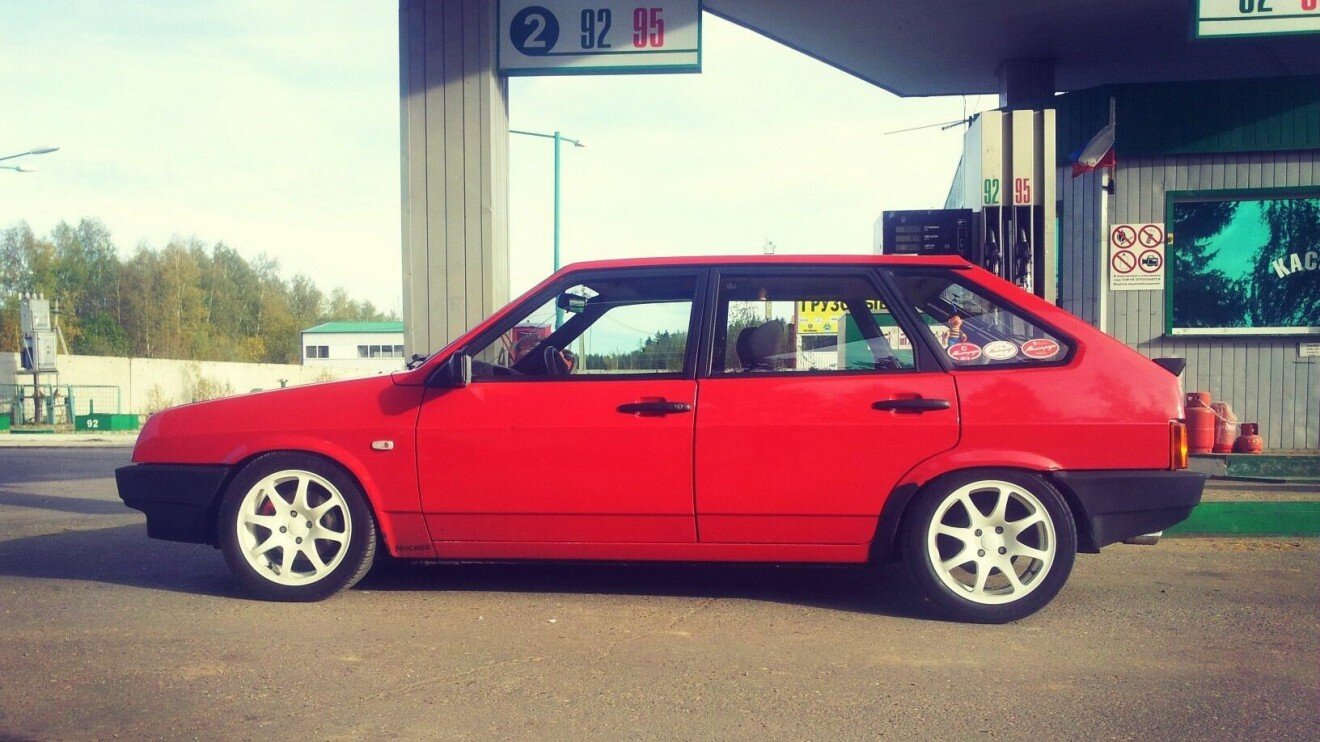
General information: The VAZ-2109, also known as the LADA Samara (on export markets) or the “devyatka” (“the Nine”) colloquially, was a compact front-wheel-drive hatchback produced by AvtoVAZ from 1987 to 2004. The model became one of the most popular cars in the USSR and the post-Soviet space thanks to its practicality, affordability, and, for its time, relatively modern design.
History: The VAZ-2109 is part of the family of cars developed on the base of the VAZ-2108 (a three-door hatchback). AvtoVAZ engineers’ main task in creating this model was to build a more affordable, practical, and modern car for the mass market. Development began in the late 1970s, with serial production starting in 1987.
Technical specifications
-
Body
- Body type: five-door hatchback.
- Dimensions: length — about 4 meters, width — 1.65 meters, height — 1.4 meters.
- Weight: about 950 kg.
-
Engines
- 1.1-liter carbureted engine (53 hp).
- 1.3-liter carbureted engine (64 hp).
- 1.5-liter carbureted and fuel-injected engine (72-80 hp).
- The engines were simple enough to service and repair, which made the car popular among motorists doing their own repairs.
-
Transmission
- Five-speed manual gearbox (early models also offered a four-speed).
- Front-wheel drive, providing good handling and road stability.
-
Suspension
- Independent front MacPherson-strut suspension.
- Dependent rear suspension on trailing arms with a torsion beam.
Features and advantages
-
Practicality: The five-door hatchback body offered ample room for passengers and cargo, making the VAZ-2109 a convenient family car.
-
Affordability: The VAZ-2109 was significantly cheaper than its Western counterparts, making it a popular choice for budget-conscious motorists.
-
Reliability and ease of repair: Thanks to its simple construction and available parts, the car was easy to repair and maintain even where a developed service infrastructure was lacking.
-
Fuel economy: The car was relatively economical on fuel, an important factor for Soviet and Russian drivers.
Conclusion: The VAZ-2109 became a symbol of mass automobile production in the USSR and Russia, embodying a combination of practicality, affordability, and simplicity. This car played an important role in motorizing the country and remained popular for many years. Despite the appearance of more modern models, the “devyatka” is still in demand on the secondary market thanks to its reliability and ease of repair.