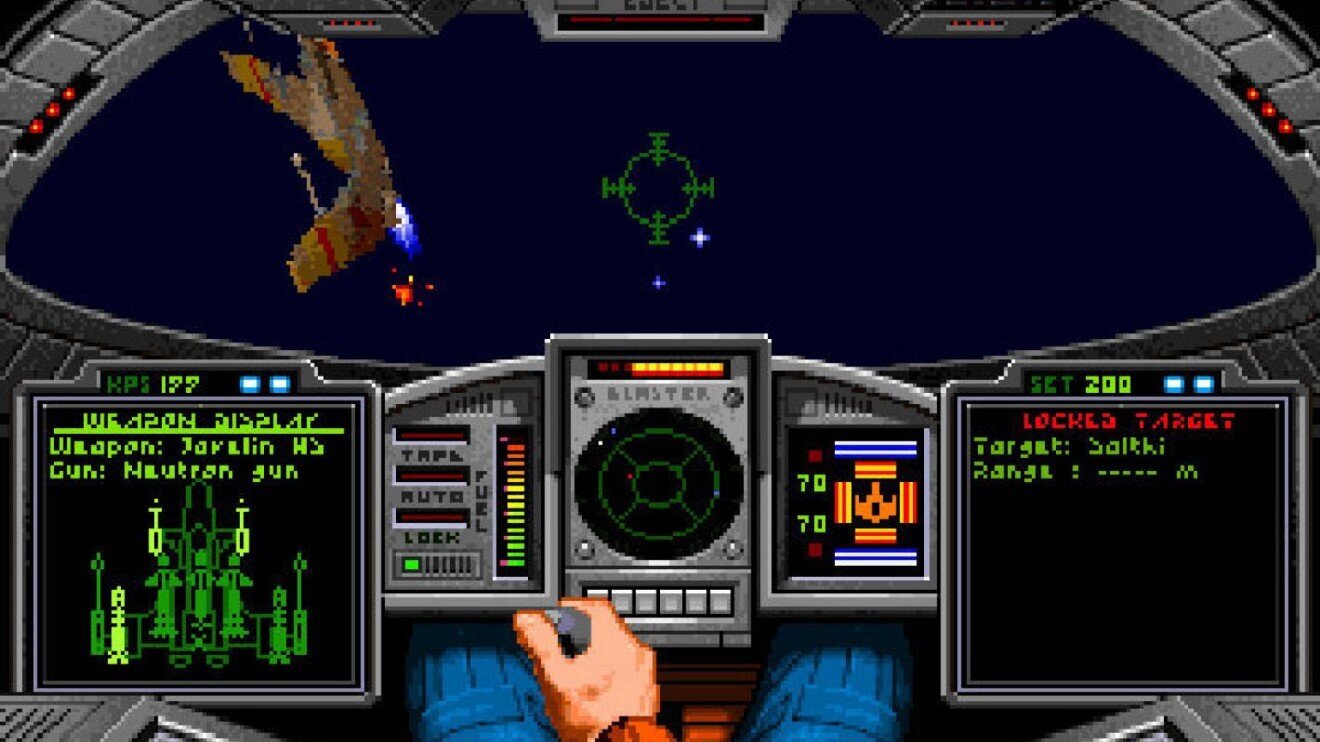
The mention of «Wing Commander» and «Civilization» in the context of 1993 Russia reflects a unique cultural moment — the era when Western computer games first flooded into the post-Soviet world on a mass scale.
Wing Commander: A Space Saga on Russian Computers
Wing Commander is the legendary space-combat simulator series created by Origin Systems under Chris Roberts. By 1993 the series already included its first two installments plus expansions, which spread widely across Russia through pirated copies and a handful of official channels.
The game revolutionized its genre, offering players not just space combat but a full cinematic story with live actors (in later installments), a nonlinear plot, and a deeply developed universe. Its central hook was the war between the Terran Confederation and the cat-like alien race, the Kilrathi.
«I wanted the WC universe to have a sense of presence — an alternate reality with no hints that it was just a game.»
In early-1990s Russia, Wing Commander became a symbol of unattainable Western luxury. Running the game required a powerful computer by the standards of the day — a 386 processor, several megabytes of RAM, and a sound card. Such a setup cost a small fortune, making anyone who owned one a genuinely lucky person.
Sid Meier’s Civilization: The History of Humanity in a Single Game
Civilization, released in 1991 by MicroProse, had already won worldwide acclaim by 1993 as the gold standard of the turn-based strategy genre. Created by legendary designer Sid Meier, the game let players guide a civilization’s development from 4000 BC to the present day.
A hallmark of the game was its technology tree — an innovative system, the first of its kind in computer games. Players could research 67 different technologies, from pottery to nuclear fusion, each unlocking new possibilities for their civilization’s development.
An Interesting Fact
In Civilization, you could play as one of 14 different civilizations, including the Russians, led by Joseph Stalin. Each civilization had unique music — the Russians’ theme drew on the folk song «Ey, Ukhnem» («The Song of the Volga Boatmen»).
The Russian Gaming Context of 1993
1993 was a turning point for the Russian computer industry. After the USSR’s collapse and the opening of the borders, Western games flooded in, though official distribution was practically nonexistent. A pirate industry flourished — games spread on floppy disks through computer clubs, markets, and word of mouth.
A typical scenario for a well-off young man of the time looked exactly like the one described in the text: with access to a powerful computer (most often a 486), a person could spend hours enjoying games that, for most of his countrymen, remained an unattainable luxury.
Technical Realities
- Computers: 386/486 processors, 2–8 MB RAM, MS-DOS
- Media: 3.5″ floppy disks, the first CD-ROM drives
- Sound: Sound Blaster or compatible cards
- Cost: a full setup cost as much as a car
Cultural Significance
Mentioning these games in a work of fiction about 1993 Russia is no accident. They symbolized more than entertainment — they marked entry into a Western digital culture that was only just beginning to reach the post-Soviet world.
Someone who could afford to «grind away» at these games until eight in the evening clearly belonged to a new generation of Russian entrepreneurs — people who’d managed to adapt to the market economy and gain access to previously unattainable Western goods and technology.
Both games went on to spawn entire franchises still being developed today, remaining classics of their genres and important milestones in the history of computer games.