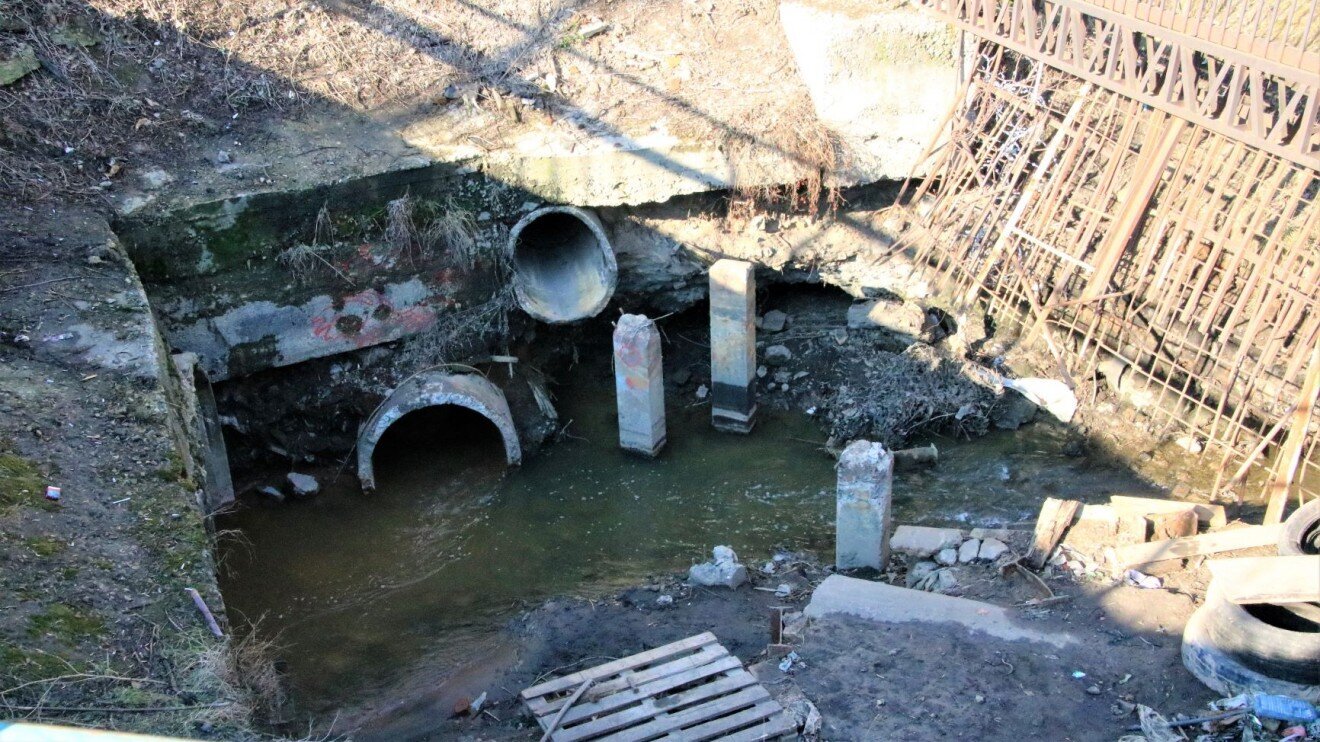
The novel’s text mentions a threat to «drown a bluecoat in the Nishchenka» – a reference to one of the capital’s darkest and most mysterious rivers, which by 1996 had been almost entirely swallowed underground.
Geography and history
The Nishchenka (also known as the Gravoronovka or Gravorna) is a left tributary of the Moskva River, running through the eastern part of the capital. At 12.4 kilometers long, it is the third-longest tributary of the Moskva River within the Moscow Ring Road. The river rises in Izmailovsky Park and empties into the Moskva River below the Pererva dam.
A distinctive feature of the Nishchenka is that, among all of Moscow’s small rivers, it takes in the largest number of tributaries: the Ponomarka, the Khokhlovka, the Kolomenka, as well as the Ugreshsky, Karacharovsky, Dangaurovsky, and Perovsky streams.
Origin of the name
There are two main theories about the origin of the river’s name. The first ties it to the river’s low water volume – «nishchaya,» meaning «beggarly» or scant. The second theory is more dramatic: in the river’s upper reaches, where the Vladimir Road once ran, exiles being sent off to penal servitude said goodbye to their families. Beggars traditionally gathered in these spots, which is said to have given the river its name («nishchiy» means «beggar»).
Disappearing underground
By the mid-twentieth century the Nishchenka had fallen victim to urbanization. After the Great Patriotic War, the river began to be enclosed in underground collectors, starting from its upper reaches. The process stretched out over decades: the main collector construction was finished in 1969, and the last stretch wasn’t completed until the mid-1980s.
By 1996, when the events of the novel take place, the river existed mostly within underground collectors, only rarely surfacing in the Perovo district and a few other stretches.
The criminal context
The novel’s mention of the Nishchenka is no accident. By the mid-1990s the river had become one of the most polluted in Moscow, with petroleum products and other contaminants far exceeding safe levels. Hidden underground, hard to access, and environmentally ruined, it became an ideal place for disposing of evidence of crimes.
The threat to «drown someone in the Nishchenka» was more than just a figure of speech in the criminal circles of the 1990s. The river’s underground collectors, its many technical access points, and the settling ponds at its mouth offered plenty of opportunities for getting rid of evidence and bodies.
Symbolic meaning
In the novel, the Nishchenka becomes a metaphor for Moscow itself in the 1990s – a city where so much happened in the shadows, underground, away from prying eyes. Just as the river was sealed into concrete collectors, the capital’s criminal life flowed through channels hidden from the official world.
The river’s history – from a free-flowing stream to imprisonment underground – mirrors the transformation of the city itself and its inhabitants during the turbulent years of perestroika and the birth of the new Russia.