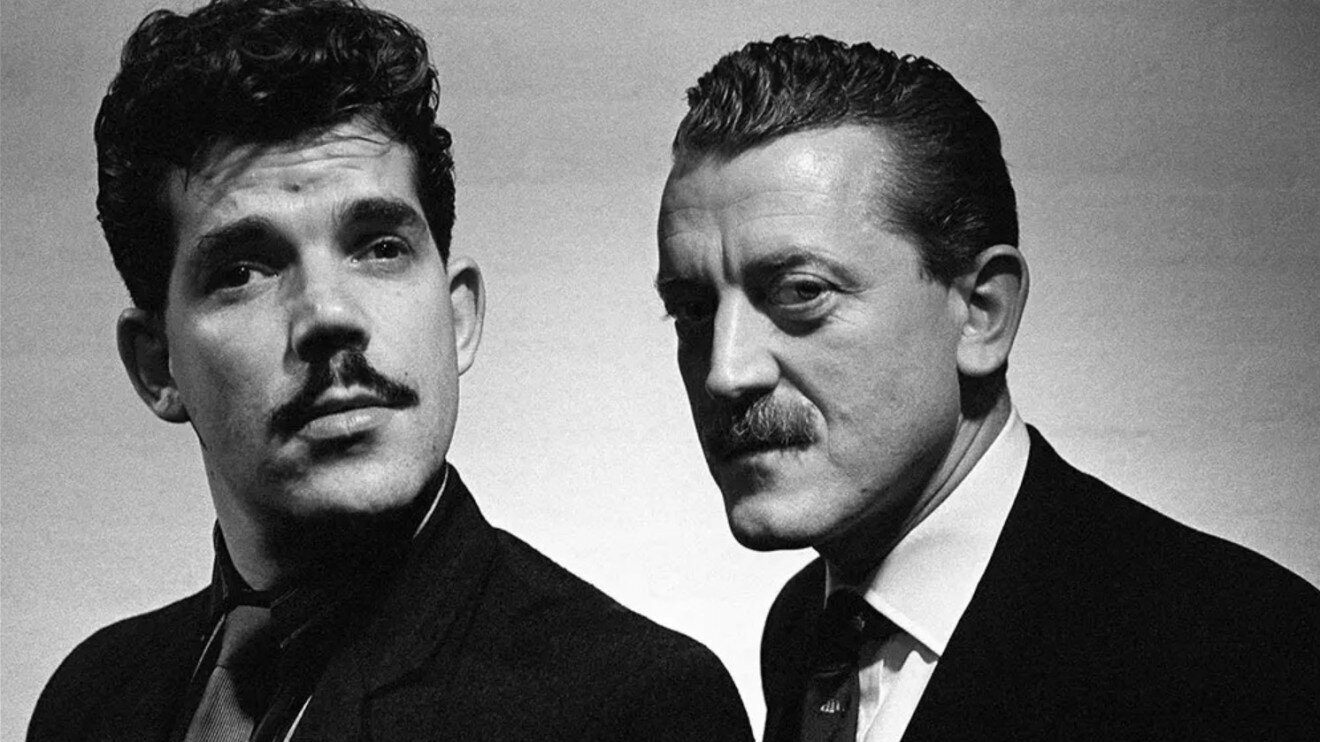
Yello is a legendary Swiss electro-pop band from Zurich, founded in 1978 by three musicians: Boris Blank, Dieter Meier, and Carlos Peron. By the mid-1990s, when the events of the novel take place, the band had already achieved worldwide recognition and become one of the symbols of high-quality European electronic music.
A unique sound and creative approach
Yello's story began back in 1967, when Boris Blank started experimenting with recording sounds on a tape recorder. Lacking traditional musical instruments, he used the most unexpected objects: kitchen utensils, wooden stands, crystal glasses, keys, and knives. These experiments with unconventional sound sources later became the band's defining trait, laying the groundwork for their revolutionary approach to sampling.
The turning point came when Blank met sound engineer Carlos Peron, with whom he was able to build his first professional studio. In 1978 the pair traveled to San Francisco to meet the avant-garde band The Residents — their idols — an encounter that significantly shaped their artistic vision.
Members and creative roles
Boris Blank (born January 15, 1952, in Bern) became the composer and the primary architect of Yello's distinctive sound. With no formal musical training, he started out as a truck driver, but was always drawn to music. Blank handles the sound engineering and melody-writing, along with experimenting with recording techniques and creating new sounds and samples.
Dieter Meier (born March 4, 1945, in Zurich) is the band's frontman, with a rich and eccentric biography. The son of a wealthy banker, he tried his hand at a wide range of pursuits: he studied law at university (but dropped out), worked as a journalist, wrote children's books, made experimental films, and even played on Switzerland's national golf team. In the band, Meier writes the lyrics and serves as the primary vocalist, producer, and manager.
Carlos Peron (born June 9, 1952, in Zurich), together with Blank, founded the Tranceonic studio, where Yello's famous sound was developed. Before work began on the album "Stella" in 1983, however, Peron left the band, reportedly unable to bear Blank's creative dictatorship any longer. After leaving Yello, he went on to a solo career and production work.
Peak popularity and worldwide recognition
The real breakthrough came with the release of the album "You Gotta Say Yes To Another Excess," which won over both the public and critics. The tracks "I Love You" and "Lost Again" became international hits. The band skillfully blended Dadaist wordplay lyrics with elements of contemporary electronic music, creating a sound entirely their own.
The album "One Second" (1987), recorded with contributions from the legendary Shirley Bassey and Billy MacKenzie of Associates, is considered by many critics to be the band's finest work. The song "Oh Yeah" from that album became a genuine hit, later used in numerous films and TV series.
The album "Flag" (1988) returned the band to the charts with the track "The Race," showing the musicians' ability to catch even the subtlest shifts in contemporary musical fashion without ever locking themselves into a single style.
Yello in the 1990s
By the mid-1990s, Yello remained one of the most influential bands in electronic music. In 1990, they wrote the score for the film "Nuns on the Run," demonstrating their versatility. On their albums from the '90s — "Baby" and "Zebra" — the band continued to experiment with sound, though critics noted the musicians sometimes struggled to find new sounds and textures.
In 1995, Yello wrote the soundtrack for the English-language version of the Japanese animated film "Space Adventure Cobra," showing their readiness to work across a wide range of genres and formats.
The band's mention in the context of Russian cultural life in 1996 is no accident — Yello was genuinely seen as a benchmark of quality Western electronic music, an alternative to commercial pop. Their experimental approach, elaborate arrangements, and unusual lyrics appealed to an educated urban audience that valued originality and artistic daring.