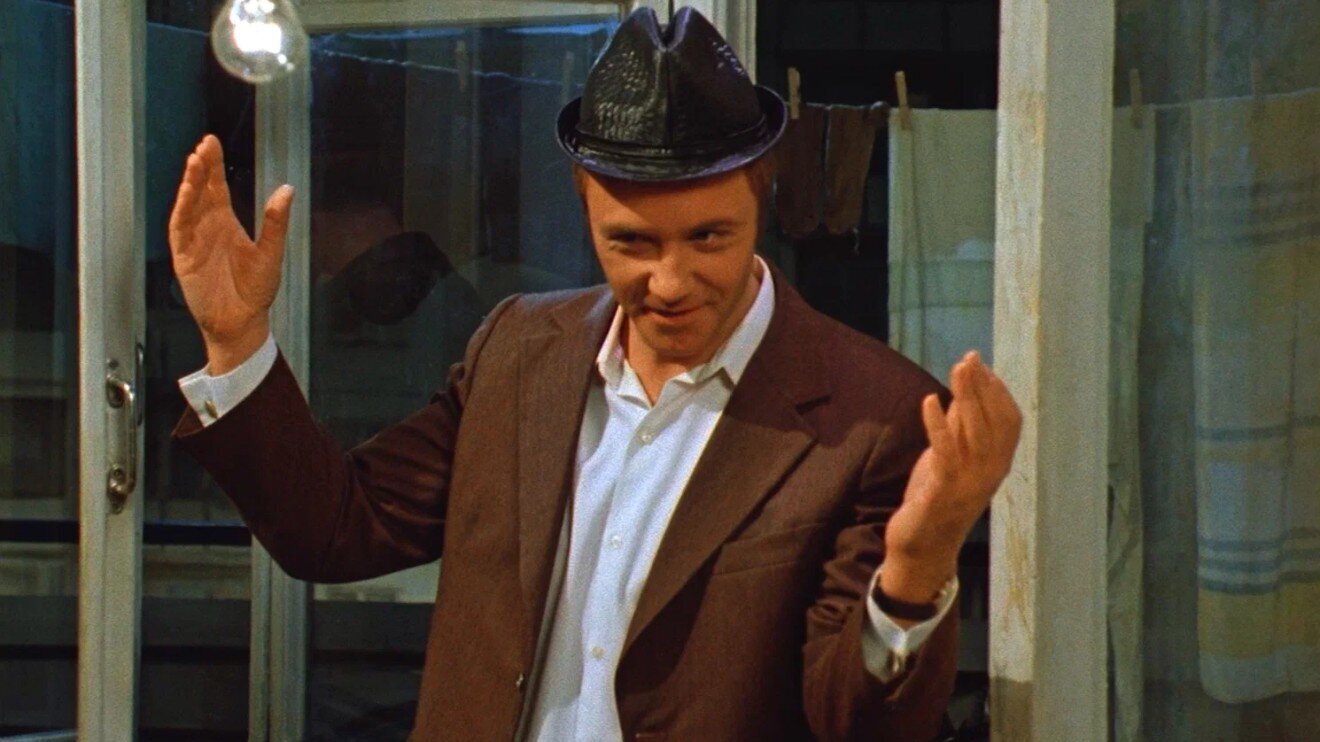
The name «Afonya» in the text is a reference to the legendary Soviet film Afonya (1975), directed by Georgy Daneliya. The picture became a genuine cultural phenomenon, drawing 62.2 million viewers and taking first place at the box office in the year of its release.
The film’s hero is Afanasy Borshchev, whom everyone simply calls Afonya, a fourth-grade plumber at a municipal housing maintenance office. He is a typical Soviet «little man» — feckless, given to drink, but charming in his own way. Afonya lives one day at a time, takes bribes from customers, and is forever looking for a chance to «get at the bottle» with his loader friend Fedul.
The figure of Afonya became a byword in Soviet and post-Soviet culture. The character’s name came to denote a careless, frivolous man living for the day. In the context of the 1990s, when the novel takes place, the reference acquires a particular resonance — a time when many Soviet values and stereotypes were still alive in the popular mind, and the heroes of classic films were recognized as familiar types.
Leonid Kuravlyov as Afonya
The role of Afanasy Borshchev was played by the outstanding Soviet actor Leonid Vyacheslavovich Kuravlyov (1936–2022). It was one of the most memorable performances of his career and won him nationwide affection. Kuravlyov managed to create a living, credible portrait of an ordinary Soviet man in whom audiences recognized themselves or their neighbors.
The actor himself admitted that he hadn’t needed long to inhabit the role, since he had been «that sort of fellow» himself — from a working family, brought up on the Moscow outskirts. Kuravlyov was born to a fitter at an aircraft plant, lived through a hard wartime childhood (his mother was arrested and sentenced), and grew up in postwar poverty. That life experience allowed him to convey his character with unusual authenticity.
The cultural weight of the character
The film Afonya touches on deep themes of loneliness, the search for meaning, love and human relations. For all its comic form, it raises serious questions about how to live a life with dignity rather than squander it. The ending, in which Afonya meets the nurse Katya at the airfield, stands for the possibility of spiritual renewal and of finding happiness.
In popular memory Afonya remains a symbol of the «golden age» of Soviet cinema in the 1970s, when films were made about ordinary people with their joys and their sorrows. The character became part of the cultural code: to call someone «an Afonya» was to describe him as careless but kind, perhaps not very responsible, but sincere.
By the mid-1990s, when the events of the novel take place, Afonya was twenty years old but remained one of the best-loved and most recognizable works of Soviet cinema. Lines from the picture had become catchphrases, and the hero’s name a common noun. The mention of Afonya in the novel instantly creates in the reader an association with a particular type of character and behavior, which makes the literary image sharper and more immediately legible.