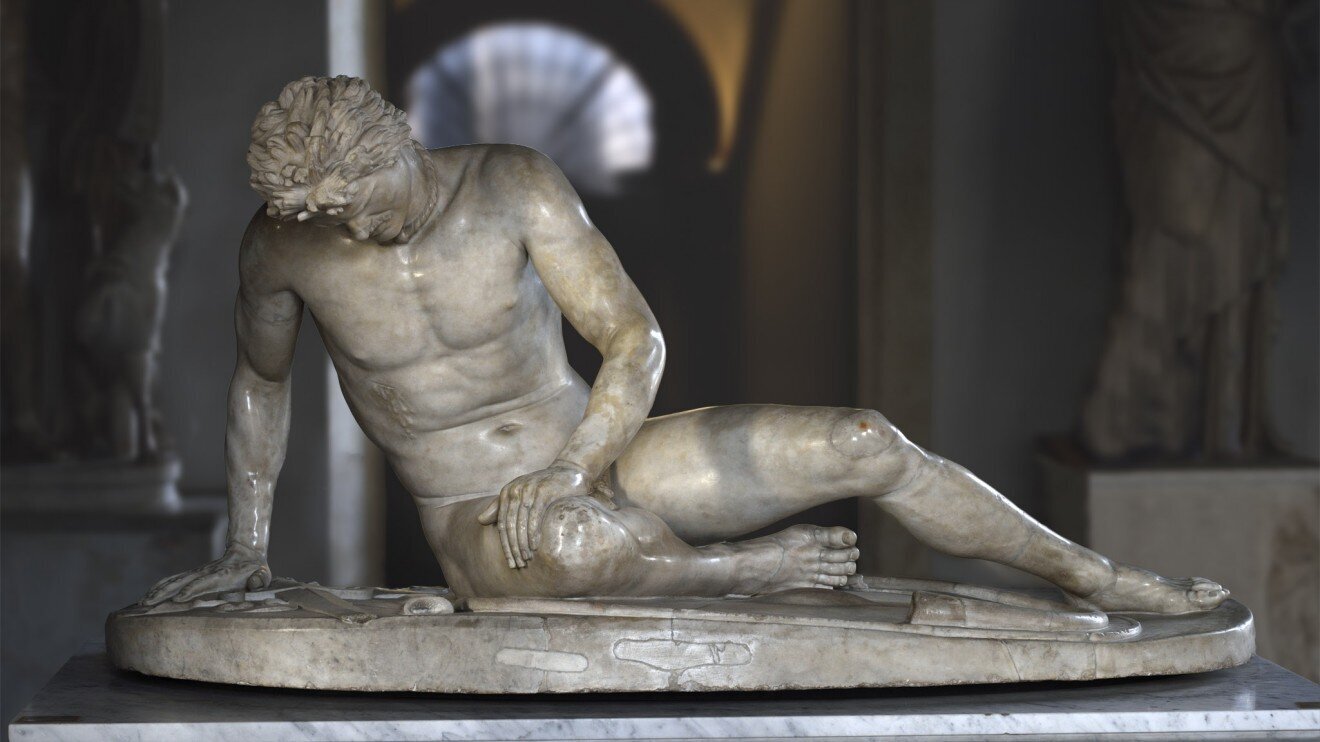
The line "Butchered to make a Roman holiday" became one of the most recognizable poetic images associated with ancient Rome and gladiatorial combat.
Origin
This famous line comes from George Gordon Byron's poem "Childe Harold's Pilgrimage" (1812–1818), specifically from its fourth canto, written in 1817–1818. In the original, stanza 140 contains these lines about a gladiator:
I see before me the Gladiator lie:
He leans upon his hand – his manly brow
Consents to death, but conquers agony,
And his drooped head sinks gradually low –
And through his side the last drops, ebbing slow
From the red gash, fall heavy, one by one,
Like the first of a thunder-shower; and now
The arena swims around him – he is gone,
Ere ceased the inhuman shout which hailed the wretch who won.
He heard it, but he heeded not – his eyes
Were with his heart and that was far away;
He recked not of the life he lost nor prize,
But where his rude but by the Danube lay,
There were his young-barbarians all at play,
There was their Dacian mother – he, their sire,
Butchered to make a Roman holiday –
All this rushed with his blood – Shall he expire
And unavenged? – Arise! ye Goths, and glut your ire!
In Ivan Kozlov's 1826 Russian translation, these lines read: "Slaughtered for the amusement of unruly Romans"; a later translation by V. Levik rendered the phrase in the form that became proverbial: "Butchered for the amusement of the Roman rabble."
Historical context
Byron wrote these lines under the impression of the ancient sculpture "The Dying Gaul" (often mistakenly called "The Dying Gladiator"), which he saw at the Capitoline Museum in Rome. This marble copy of a 3rd-century BC bronze original depicts a dying Celtic warrior, not a gladiator. In Byron's time, however, the sculpture was believed to depict a wounded gladiator, and this belief inspired the poet to write these piercing lines.
Mark Twain on Byron's line
This line's popularity was so great that Mark Twain, in "The Innocents Abroad" (1869), ironically prides himself on describing the Colosseum without ever quoting it:
"So far, so good. If any man has a right to feel proud of himself, and satisfied, surely it is I. For I have written about the Coliseum, the gladiators, the martyrs, and the lions, and yet have never once used the phrase, 'butchered to make a Roman holiday.' I am the only free white man of mature age who has accomplished this since Byron wrote it."
This passage shows just how much of a cliche any mention of this line had become, in any 19th-century conversation about ancient Rome and gladiatorial combat.
Fun fact
The sculpture "The Dying Gaul," which inspired Byron, was created by a sculptor from Pergamon, commemorating the Galatians' defeat in battle against Attalus I. The Romans knew this sculpture through marble copies.
Influence on Russian literature
The image of a gladiator dying for the crowd's amusement left a significant mark on Russian poetry and prose:
- Mikhail Lermontov, in his poem "The Dying Gladiator" (1836), directly echoes Byron's image:
"Riotous Rome rejoices... the wide arena
solemnly resounds with applause:
but he — pierced through the chest — lies silent,
his knees sliding in the dust and blood..." - Alexander Herzen used the image of the gladiator in his political journalism, comparing revolutionaries to gladiators dying for a future freedom.
- Alexander Blok, in his poem "Ravenna" (1909), recalls "the arena of Rome's mighty walls," an allusion to the Colosseum and gladiatorial combat.
- Valery Bryusov, in his poem "Tertia Vigilia," likewise invokes the image of a gladiator dying for the crowd's amusement.
The image in modern culture
The image of the gladiator, "butchered to make a Roman holiday," lives on in modern culture as a symbol of sacrifice, tragic heroism, and the individual's confrontation with the crowd. It can be found in film (Ridley Scott's "Gladiator"), in literature, and in journalism, whenever the subject is a lone figure standing against the masses.
A literary note
Byron's line is notable for its double meaning: on one hand, it literally describes a gladiator's death in the arena; on the other, it condemns the cruelty of empire and of a crowd demanding spectacle. Byron, as a Romantic and a liberal, sets the dignity of the dying warrior against the soullessness of the mob and the tyranny that feeds it.
This line became a striking example of Romantic poetics, combining lofty pathos, exotic setting, and social protest — which is exactly what secured its long life in culture.