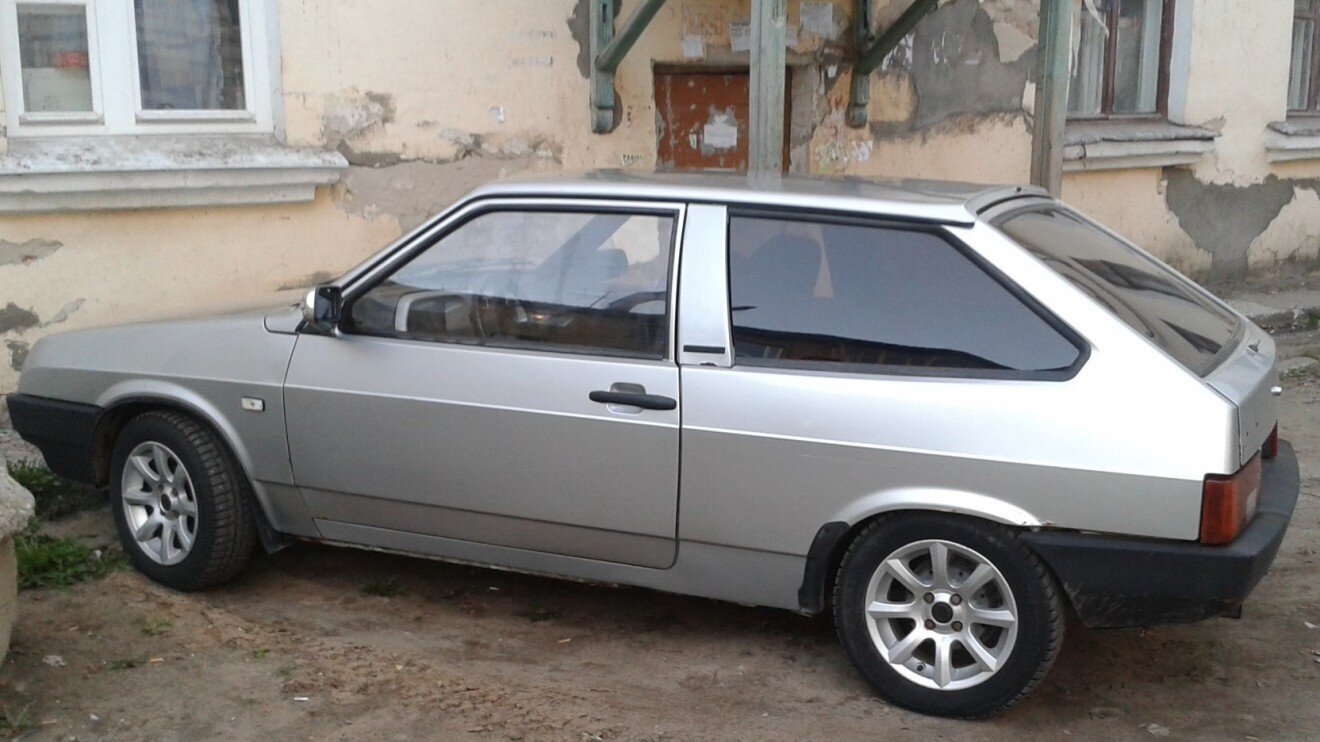
In early-1990s slang, the VAZ-2108 picked up the vivid nickname «zubilo» («the chisel»), alongside the more neutral popular name «vosmyorka» («the eight»). The nickname stuck because of its angular, aggressive styling, which contrasted sharply with the rounded lines of earlier Lada models.
A Revolution in the Soviet Auto Industry
The arrival of the VAZ-2108 in 1984 was a genuine revolution for Soviet car manufacturing. For the first time, the Volga Automobile Plant put a front-wheel-drive, transverse-engine car on the assembly line — technical solutions that had already become standard in Europe, but were still novel for the USSR.
The project had been in development since 1971, with input from Western firms including Porsche and the Italian design house Bertone. Enormous resources went into the new model — 80% of all the hard currency the State Committee for Science and Technology allocated for buying licenses and equipment. Licenses were bought from leading global manufacturers: Lucas (brakes), Zahnradfabrik (steering), Volkswagen (rear suspension), Michelin (tires).
The Car of the Wild Nineties
By the early 1990s, the VAZ-2108 had become one of the most popular cars in criminal circles. Its compact size, relatively high speed, and maneuverability made the «zubilo» ideal transport for urban gangs. Unlike flashier foreign cars, the «eight» didn’t draw unwanted police attention while still being fast enough for operational work.
The car’s distinctive angular design, penned by Italian stylists at Bertone, was radically different from every previous Soviet car. The sharp body lines, rectangular headlights, and overall «chopped» shape gave rise to a host of folk nicknames, of which «zubilo» proved the stickiest.
A Technical Leap
The VAZ-2108 came with a four-cylinder engine ranging from 1.1 to 1.5 liters, specially designed for a transverse layout. Front-wheel drive was delivered through CV joints, a technology licensed from Britain’s Hardy Spicer.
Rack-and-pinion steering, front disc brakes, independent MacPherson-strut suspension — all of this made the «eight» far more modern than the classic Zhiguli. At a curb weight of around 900 kg, it could reach speeds of 150–155 km/h, a solid figure for mid-1980s Soviet auto manufacturing.
A Symbol of the Era
In the context of a 1993 novel, the VAZ-2108 stands as a vivid symbol of the transitional era. It was the last «people’s car» of the USSR, designed back in Soviet times, yet it became truly ubiquitous only in the wild 1990s. For criminal crews of the time, the «zubilo» was the optimal choice: modern enough not to be embarrassing, but not so expensive as to draw unwanted attention.
The mention that a crew gets issued «one zubilo for every two men» captures the realities of the time precisely — even gangsters didn’t always have the means to give every member their own ride. The VAZ-2108 was the workhorse of the criminal world, combining practicality with a certain status.
Over its production run (1984–2003), 884,657 VAZ-2108s were built, making it one of the most mass-produced models in the history of Russia’s domestic auto industry.