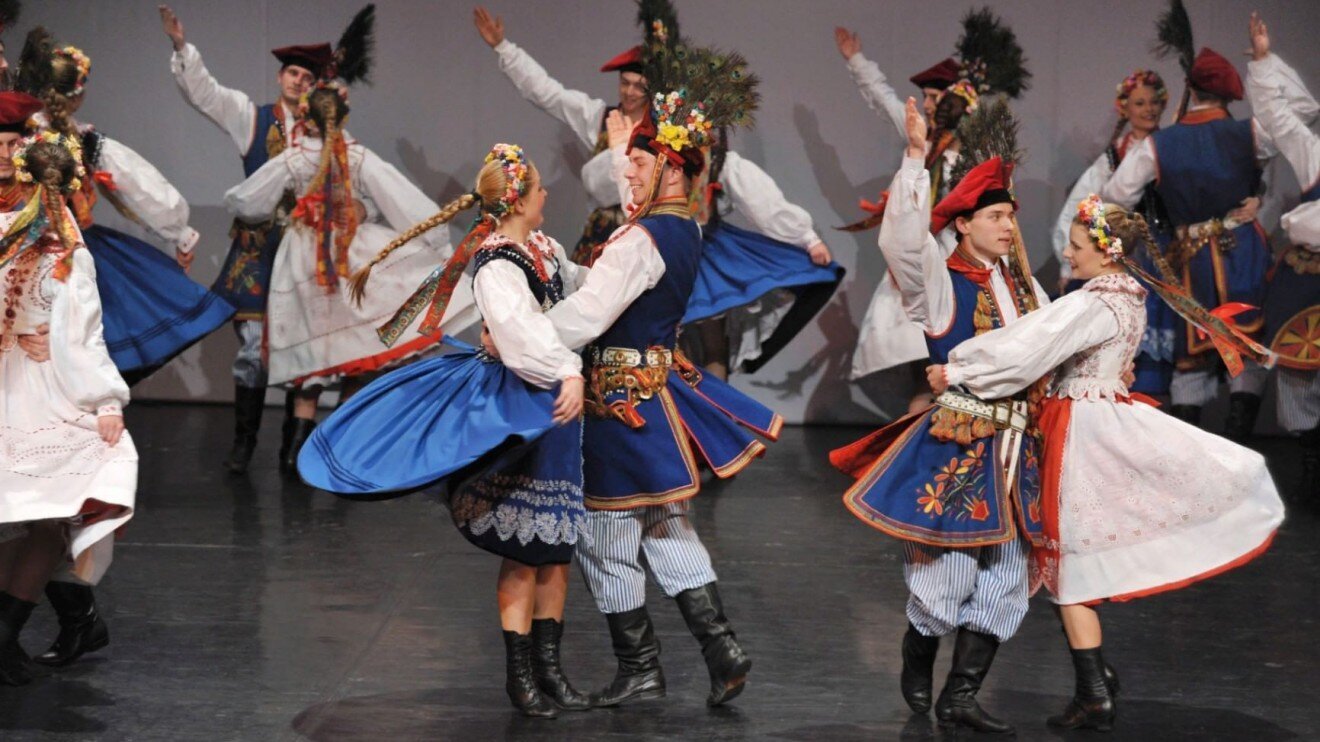
The krakowiak (Polish: Krakowiak) is a Polish folk dance which by the end of the nineteenth century had become one of the most popular ballroom dances in the Russian Empire, and kept its place in Russian dance culture right up to the middle of the twentieth century.
Origins and character
The dance arose among the Krakowiacy — the inhabitants of the Kraków voivodeship in medieval Poland. As early as the fourteenth century it had spread among the szlachta, where at first it was danced exclusively by men. It was a dance of male daring, strength and nobility on display. Later the krakowiak became a couples dance, in which the man displayed his skill in partnership with a lady.
The krakowiak’s meter is 2/4, its tempo fast, with characteristic syncopation and accents on the second eighth-note of the bar. The melody has a lively, festive character. The dance is performed with temperament and a proud bearing, which underlines its aristocratic origin.
The krakowiak in nineteenth-century Russian culture
The krakowiak appeared in the Russian Empire in the second half of the eighteenth century and quickly won popularity in gentry circles. It spread especially widely in the nineteenth century, when it became an inseparable part of the ball program of the Russian nobility. The krakowiak was danced at court balls, on country estates, and in the dance halls of Petersburg and Moscow.
The Russian dancing master N. Gavlikovsky created a special ballroom version of the krakowiak adapted to the Russian dance tradition. That version went through many changes and eventually became an independent historical-domestic dance, differing considerably from its Polish prototype.
The krakowiak in Russian music
The rhythm and melodic character of the krakowiak inspired Russian composers. The best-known uses of it in serious music are Glinka’s opera A Life for the Tsar and Asafyev’s ballet The Fountain of Bakhchisarai. The Polish composer Frédéric Chopin also turned to the dance, writing his famous Rondo for piano and orchestra on a krakowiak theme.
Technique
The folk-stage version of the krakowiak is built on complex jumping movements performed with lightness and plasticity. Its principal elements include the gallop, hops, krzesany (striking steps), the triple stamp, various forms of the golubets, side steps and turns. It can be danced in couples or with ensemble figures — circles, stars and other formations.
The ballroom version was more restrained and ceremonial, adapted for performance in ballrooms in appropriate dress. It demanded good choreographic training and a knowledge of complex figures.
The krakowiak at the turn of the twentieth century
By the end of the nineteenth century the krakowiak was still popular at balls and in dance halls, though it had yielded in fashionability to newer dances arriving from the West. In the early twentieth century it survived mainly as a historical-domestic dance, performed at themed balls and in theatrical productions.
Among the people, various versions of the krakowiak went on living their own life, especially in regions with a Polish population. The dance became part of folk tradition and of village festivals, where it was danced to the accompaniment of folk instruments.
A reference to the krakowiak in a work of fiction set in the 1990s may signal a connection to the cultural traditions of the past, a nostalgia for gentry culture, or simply convey the hero’s particularly festive, celebratory mood.