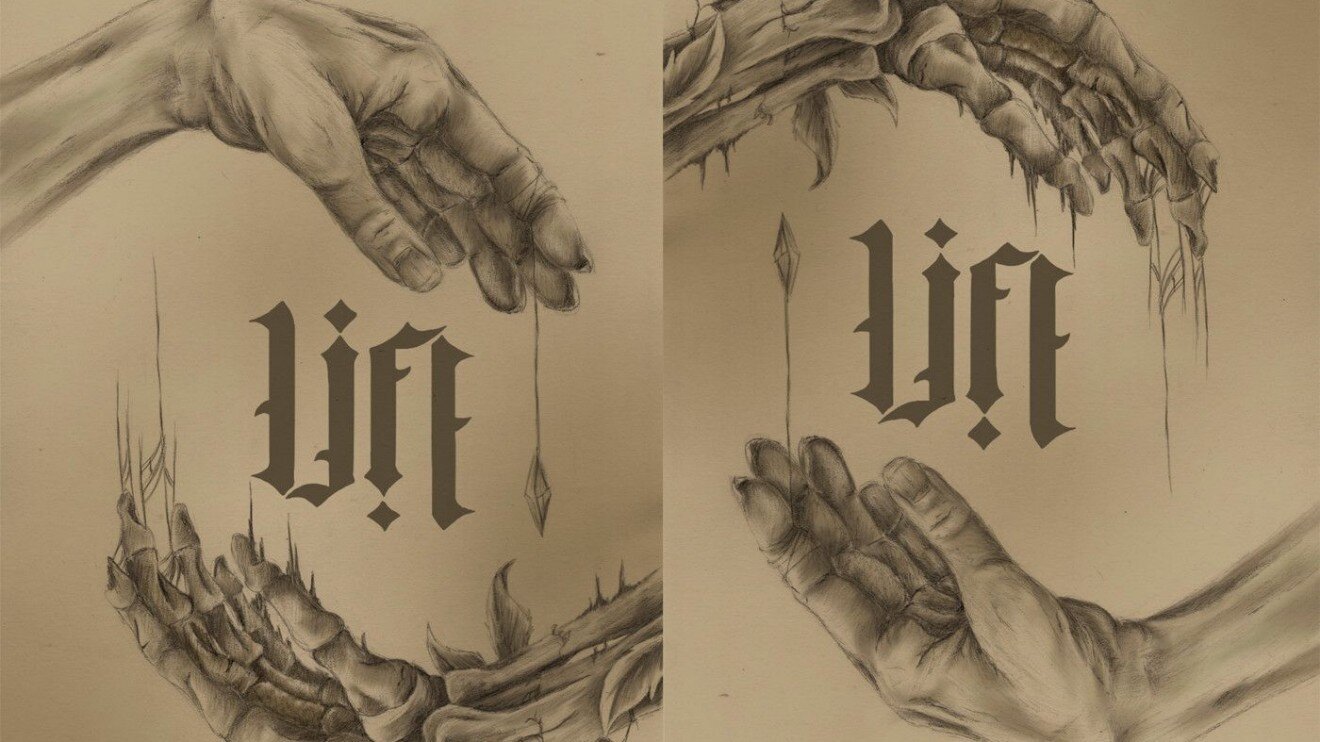
An ambigram (from Latin ambi, «double,» and Ancient Greek γράμμα, «letter») is a calligraphic design that combines two different readings within one and the same set of lines.
Origins and development
As an artistic phenomenon, ambigrams have deep roots in the history of writing and calligraphy. Their literary forerunner is the palindrome — a word or phrase that reads the same in both directions. But where the palindrome plays with the order of letters, the ambigram plays with the shape of the letters themselves, with their geometry and their visual perception.
Ambigrams began to develop as an art form in their own right in the middle of the twentieth century, though isolated examples of such visual puzzles turn up earlier. The first systematic publications of ambigrams appeared in the British press, where they were presented as intellectual entertainment for readers.
Principles of construction
The basic principle of the ambigram is that one and the same set of lines can be read in different ways depending on the angle of view, the direction of reading, or the mode of interpretation. This is achieved through:
Symmetry
The use of symmetrical elements that look the same when rotated or reflected.
Ambiguity of form
The creation of letters that can be read as different characters depending on context.
Classifying ambigrams
By mode of transformation
By structure
Symmetrical ambigrams
Built on exact geometric symmetry, in which every letter either has a symmetrical partner or is itself symmetrical.
Asymmetrical ambigrams
These use optical illusion and visual trickery to produce the double-reading effect without strict symmetry.
Numeric ambigrams (strobograms)
Numeric combinations form a class of their own. They rely on digits that remain legible when rotated or reflected, or that turn into other digits:
| Type of digit | Examples | Behavior |
|---|---|---|
| Symmetrical | 0, 8, (sometimes 1) | Look the same when turned through 180° |
| Transformable | 6↔9, (sometimes 2↔5) | Turn into one another under rotation |
| Combined | 69, 808, 1001 | Form readable sequences |
Three-dimensional ambigrams
A revolutionary step in the development of the form was the appearance of three-dimensional versions. The best-known example is the ambigram on the cover of Douglas Hofstadter’s Gödel, Escher, Bach: An Eternal Golden Braid. That sculptural object casts three different shadows, corresponding to the initials of three geniuses: the philosopher Kurt Gödel (G), the artist M. C. Escher (E) and the composer Johann Sebastian Bach (B).
The principle of the three-dimensional ambigram
A three-dimensional ambigram is a solid construction that, lit from different angles, throws shadows in the shape of different letters or symbols. It requires complex mathematical calculation and a deep understanding of the geometry of light and shade.
The Russian school of the ambigram
In Russia the development of the ambigram is associated with the poet and artist Dmitry Avaliani, who not only made visual ambigrams but worked out their theoretical basis. Avaliani introduced Russian terms for the various types of ambigram and showed how Cyrillic could be used to make works of this kind.
Peculiarities of Cyrillic ambigrams
Cyrillic offers particular opportunities and particular difficulties for the ambigram maker. Some letters (О, Н, П) lend themselves easily to symmetrical transformation, while others (Ч, Щ, Ы) demand substantial creative reworking. Russian artists have found ways of working with these peculiarities and produced unique pieces.
Techniques
Making an ambigram is a complex process combining artistic craft with mathematical precision. The main stages are:
- Analyzing the word or phrase — identifying the letters that transform easily and those that will need a creative solution.
- Building the basic structure — working out the overall composition and fixing the points of symmetry.
- Detailing the letters — careful work on each character with its double function in mind.
- Balancing — adjusting proportion and weight so the piece stays legible in both positions.
- Final polishing — removing visual inconsistencies and improving the aesthetic appeal.
Use in design
Ambigrams have found broad application across design. They are used for logos, book covers, posters, tattoos and other artworks. They are especially popular in branding, where the double reading can carry an extra layer of meaning.
Logos
Memorable brands with a hidden meaning
Business cards
An unusual way to present a name or a company
Artworks
Pieces that stand on their own as art
The psychology of perception
Ambigrams have a particular effect on human perception. They force the brain to work in an unusual mode, switching between different ways of interpreting the same visual information. That effect makes ambigrams not merely beautiful but intellectually stimulating.
The cognitive effect
Looking at ambigrams activates the areas of the brain responsible for spatial thinking and the processing of visual information. This makes them useful not only as artworks but as tools for developing cognitive ability.
Contemporary development
In the digital age, ambigrams have acquired new room to grow. Computer graphics allow more complex and more precise compositions, and make it possible to experiment with animation and interactivity. Programs for automatically generating ambigrams have appeared, though the best examples are still made by hand.
Ambigrams remain a unique phenomenon at the intersection of art, mathematics and the psychology of perception. They demonstrate how a creative approach can turn simple lines and letters into intricate intellectual puzzles that give aesthetic pleasure and make one think about the nature of visual perception.
This article is reference material setting out the main aspects of the art of the ambigram — from its historical roots to its contemporary uses in design and art.