A palindrome (from the Ancient Greek πάλιν, «back, again,» and δρόμος, «running, movement») is a number, a string of letters, a word, or a text that reads the same in both directions. In Russian it also goes by the name pereverten, «the turnabout.»
Definition and examples
Palindromes come in several kinds:
Numeric palindromes
Numbers that read the same both ways: 101, 121, 676. The date February 22, 2022 is a palindrome too: 22022022.
Word palindromes
Words and phrases: English «level», «rotator»; in Russian «topot» (the sound of tramping feet), «shalash» (a hut), and the famous line «A roza upala na lapu Azora» – «And the rose fell onto Azor’s paw.»
Vadim’s Bank, backwards
In the passage in question the character proposes calling the bank «Amidavknab» — the Russian phrase Bank Vadima, «Vadim’s Bank,» spelled backwards. This approach to naming was popular in the 1990s, when a great many new commercial structures were springing up with inventive names.
Varieties of palindrome
Several types of palindromic construction exist:
The reversal (oboroten) — a text that reads differently left to right and right to left. For example, Russian «MIR UDOBEN» («the world is convenient») reversed gives «NEBO DURIM» («we fool the sky»).
The syllabic palindrome — a text that reads the same syllable by syllable from either end: «LIKHACHI NA VSEKH NACHIKHALI» («the reckless drivers sneezed on everyone»).
Bilingual palindromes — the text reads in one language in one direction and in another language in the other.
A history of palindromes
Palindromes have been known since deep antiquity. The oldest surviving one is the SATOR square from Herculaneum, first century AD. Such formulas were often credited with magical or sacred meaning.
The SATOR magic square
A R E P O
T E N E T
O P E R A
R O T A S
It reads in every direction, and has been glossed as: «The great sower unhurriedly turns the millstones of life.»
Russian palindromes
In Russian literature the earliest reliably attributed palindrome is Derzhavin’s «Ya idu s mechem sudia» («I go with a sword, judging»). The palindromic line «A roza upala na lapu Azora» has been known since the middle of the nineteenth century and is attributed to Afanasy Fet.
The Russian literary palindrome flourished between the 1970s and the 1990s in the work of authors such as:
Nikolai Ladygin — one of the pioneers of the modern Russian palindrome.
Vladimir Gershuni — author of many witty palindromic pieces.
Dmitry Avaliani — a master of complex palindromic construction, author of the line «Muza, ranyas shilom opyta, ty pomolishsya na razum» («Muse, wounded by the awl of experience, you will pray to reason»).
Examples of modern Russian palindromes
- «Lyosha na polke klopa nashyol» – «Lyosha found a bedbug on the shelf»
- «Argentina manit negra» – «Argentina beckons the black man»
- «Uchuya moloko, ya okolo myauchu» – «Smelling milk, I miaow nearby» (German Lukomnikov)
- «Iskat taksi» – «To look for a taxi»
- «Lider brediL» – «The leader was raving»
Velimir Khlebnikov and the palindrome
A special place in the history of the Russian palindrome belongs to the avant-garde poet Velimir Khlebnikov, who wrote the celebrated poem «Pereverten» («The Turnabout»), every line of which is a palindrome in Russian – a feature no translation can reproduce. The Russian text opens:
Koni, topot, inok,
No ne rech, a cheren on.
Idem, molod, dolom medi.
Chin zvan mechem navznich.
[and so on…]
Roughly: «Horses, tramping, a monk. / But not speech – he is black. / We walk, young, down a valley of copper. / Rank was called by the sword, flat on its back.»
The problem of authorship
Short palindromes raise a problem of authorship, since simple ones may occur independently to a great many people. In 2000 the palindromist Sergei Fedin proposed the concept of the «Niktonym» — a renunciation of authorship over palindromes of six words or fewer.
Palindromes elsewhere
In mathematics
Numeric palindromes are studied in number theory. There is the famous «196 problem» — the conjecture that any number can be turned into a palindrome by repeated reverse-and-add.
In biology
DNA molecules contain between a hundred thousand and a million short palindromic sequences, which play an important role in genetics.
In music
Musical palindromes are pieces that sound the same played in either direction. One example is the «Table Melody for Two» attributed to Mozart.
Palindromes around the world
Palindromes exist in many languages:
English: «Madam, I’m Adam» (the classic).
Latin: «Sum summus mus» («I am the mightiest mouse»).
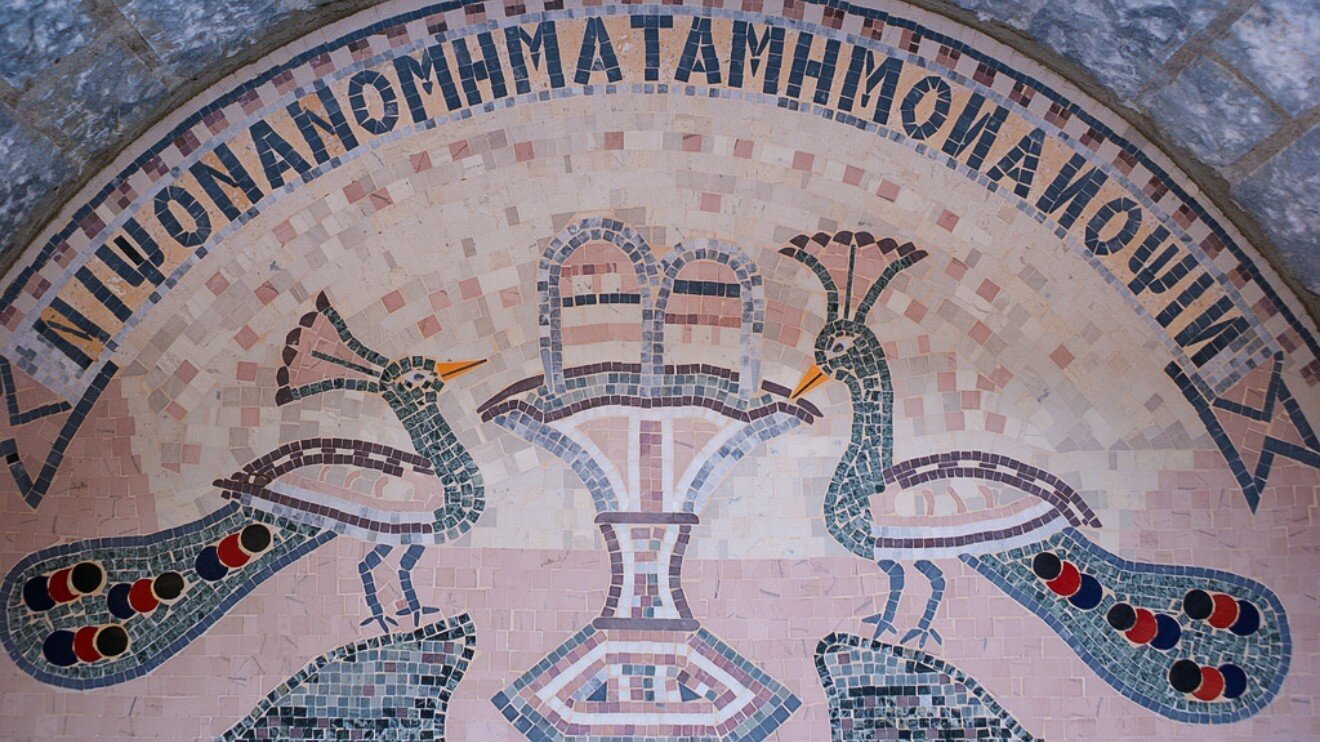
Greek: the palindromic inscription on the marble font of Hagia Sophia in Constantinople means: «Wash not only your face, but your sins.»
In conclusion
The palindrome is not merely a language game but a distinct form of verbal art, demanding inventiveness and craft from its author. From ancient magical formulas to modern literary experiment, palindromes go on fascinating people with their symmetrical beauty and their intellectual challenge.
Within the novel, the palindrome «Amidavknab» («Bank Vadima» backwards) serves not only as a witty piece of wordplay but as a reflection of the spirit of the age — a time when unusual names were being invented for new commercial structures, and a creative approach to language was in particular demand.
Palindromes remain popular in internet culture, in programming (as a classic algorithm exercise) and in contemporary poetry, proving their undiminished relevance.