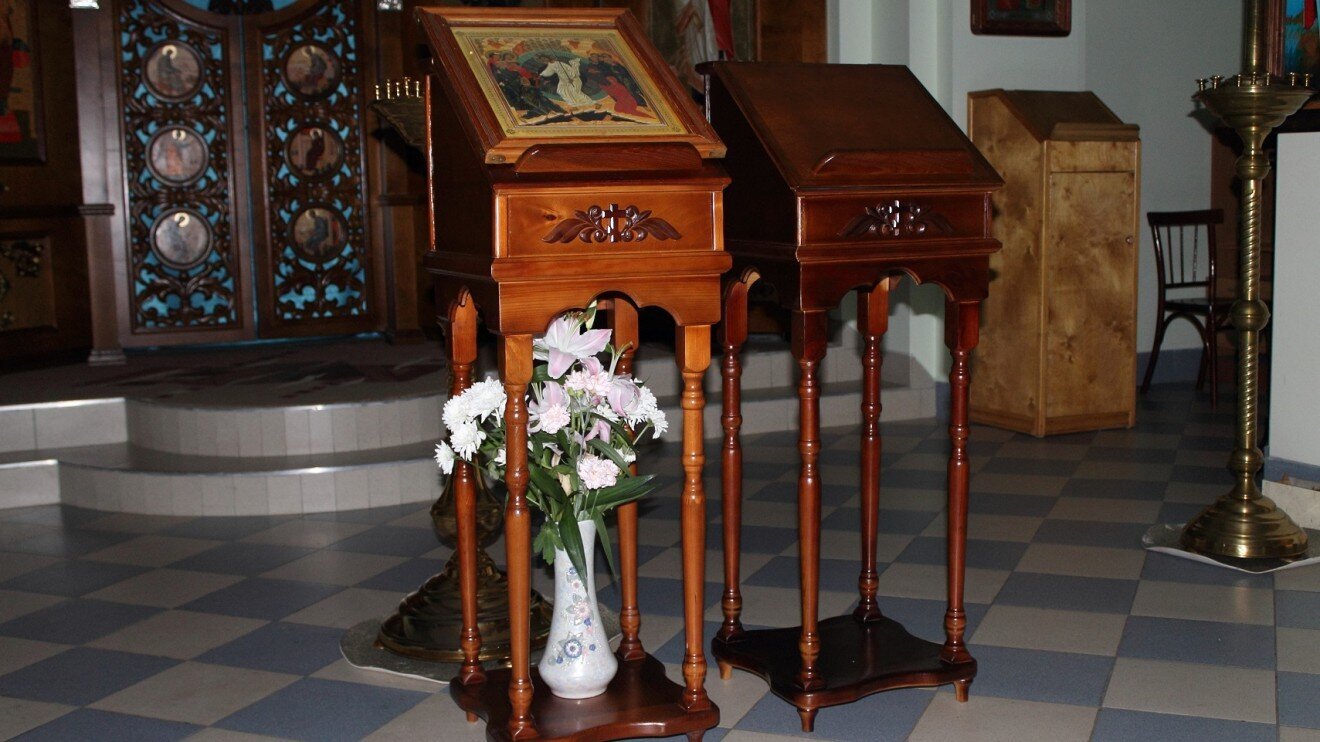
The lectern (Russian: analoy, from the ancient Greek ἀναλογεῖον — a stand for icons and books) is one of the most important pieces of furnishing in an Orthodox church: a tall, four-sided stand with a sloped top, used during services.
What a Lectern Is
In any Orthodox church in 1990s Russia, you could find this particular piece of furniture: the lectern. It’s essentially a tall stand, usually wooden, with a slanted surface, resembling a school desk or a musician’s stand, only considerably taller. The sloped top is designed specifically to make reading books and viewing icons easier.
The main lectern always stands in the center of the church, in front of the iconostasis — the wall of icons that separates the altar from the main body of the church. It’s to this lectern that worshippers come to venerate an icon, light a candle, or pray.
Purpose and Use
The Central Lectern (Proskynetarion)
An icon always rests on the church’s main lectern. This may be:
- A feast-day icon — during church holidays
- The church’s patronal icon — matching the church’s dedication
- A menologion — a special icon case with saints for each day
In the mid-1990s, as the Russian Orthodox Church was going through a period of revival after decades of Soviet persecution, lecterns took on special significance. Many churches were only just being restored, recovering icons and church furnishings lost long before. The lectern was often one of the first items to appear in a church being brought back to life.
Besides the central lectern, other types of these stands could be found in a church:
Choir Lecterns
Located in the kliros, the area where the church choir stands. Sheet music and liturgical books for singers and readers rest on them. In the 1990s, choirs in many churches were only just forming, since the tradition of church singing had been interrupted for decades.
Altar Lecterns
Located within the altar, usually to the left of the holy table. Used by the priest to read liturgical books during the service.
Confession Lecterns
Small, special lecterns used for the sacrament of confession. A cross and the Gospel rest on them, and the lectern itself is covered with a special cloth — a pall.
Materials and Appearance
In the 1990s, lecterns were made from various materials, depending on a parish’s resources and the craftsmen available:
🌳 Wooden Lecterns
The most common option. Made from oak, beech, or pine. Often decorated with carving or painted religious motifs.
⚡ Metal Lecterns
Made from brass or bronze, sometimes gilded. Such lecterns were more expensive, but also more durable.
A lectern’s shape could vary too. The classic version is a four-sided stand with a sloped surface. But more elaborate designs existed as well: multi-sided columns with rotating pyramidal tops, folding lecterns for easy transport.
In some Greek traditions, lecterns could even take the shape of a dove — a symbol of the Holy Spirit. Such unusual shapes were rare in 1990s Russia, since most churches adhered to traditional Russian designs.
Spiritual Significance
Etymology and Symbolism
The ancient name for the lectern — proskynetarion (from the Greek for «veneration») — points directly to its purpose: to help worshippers venerate a holy object. The lectern isn’t just a stand, but a sacred object that facilitates prayerful communion with God.
For a believer in the 1990s, the lectern held special meaning. After years when openly expressing one’s faith had been difficult, the freedom to walk up to a lectern, venerate an icon, light a candle, or write a note asking for prayers for the living or the departed felt like a great blessing.
In the churches of that time, it was common to see people standing at the lectern for a long while, especially elderly parishioners who had kept their faith through every trial of the Soviet era. For them, the lectern was a meeting place with a spiritual world once lost and now found again.
Features of the Era
1997 was a period of active church restoration across Russia. Many churches, destroyed or converted into warehouses and clubs during the Soviet era, were being returned to believers. In such churches, lecterns were often newly made — crafted by contemporary artisans following old models.
Practical Features of the 1990s
- Many lecterns were built by parishioners themselves, or by local craftsmen
- Available materials were used — often plain wood, without elaborate carving
- In churches still being restored, lecterns could be temporary, homemade
- Workshops producing church furnishings gradually appeared, offering higher-quality pieces
In major cities like Moscow or St. Petersburg, by 1997 specialized workshops were already producing quality lecterns following traditional designs. But in the provinces, it was common to find simple wooden stands, made by parishioners’ own hands with great love, if without much artistic refinement.
Rules of Conduct
For someone stepping into an Orthodox church for the first time in the 1990s, it mattered to know how to behave properly at the lectern:
What to Do
- Approach with reverence
- Cross yourself before the icon
- Venerate the icon (kiss it)
- Light a candle in the candle-stand
- Pray
- Cross yourself again
What to Avoid
- Talking loudly
- Jostling at the lectern
- Lingering too long if there’s a line
- Touching the icon with your hands (other than kissing it)
- Turning your back to the icon
In the 1990s, many people were getting reacquainted with church etiquette for the first time, so priests and church staff showed particular patience toward those who didn’t yet know all the customs.
Conclusion
The lectern is more than a piece of church furniture. In the context of 1990s Russia, it became a symbol of a faith’s revival, a place where people could openly express their religious feelings after long years of forced silence.
Every lectern in a church of that era carried its own story — whether it was an antique piece, miraculously preserved through every trial, or a newly made one, crafted by the hands of contemporary artisans for a parish coming back to life. Either way, it served the same purpose it had served hundreds of years earlier — helping believers in their turn toward God.
The lectern remains an unchanging companion of Orthodox worship, a witness to the prayers and hopes of many generations of believers.