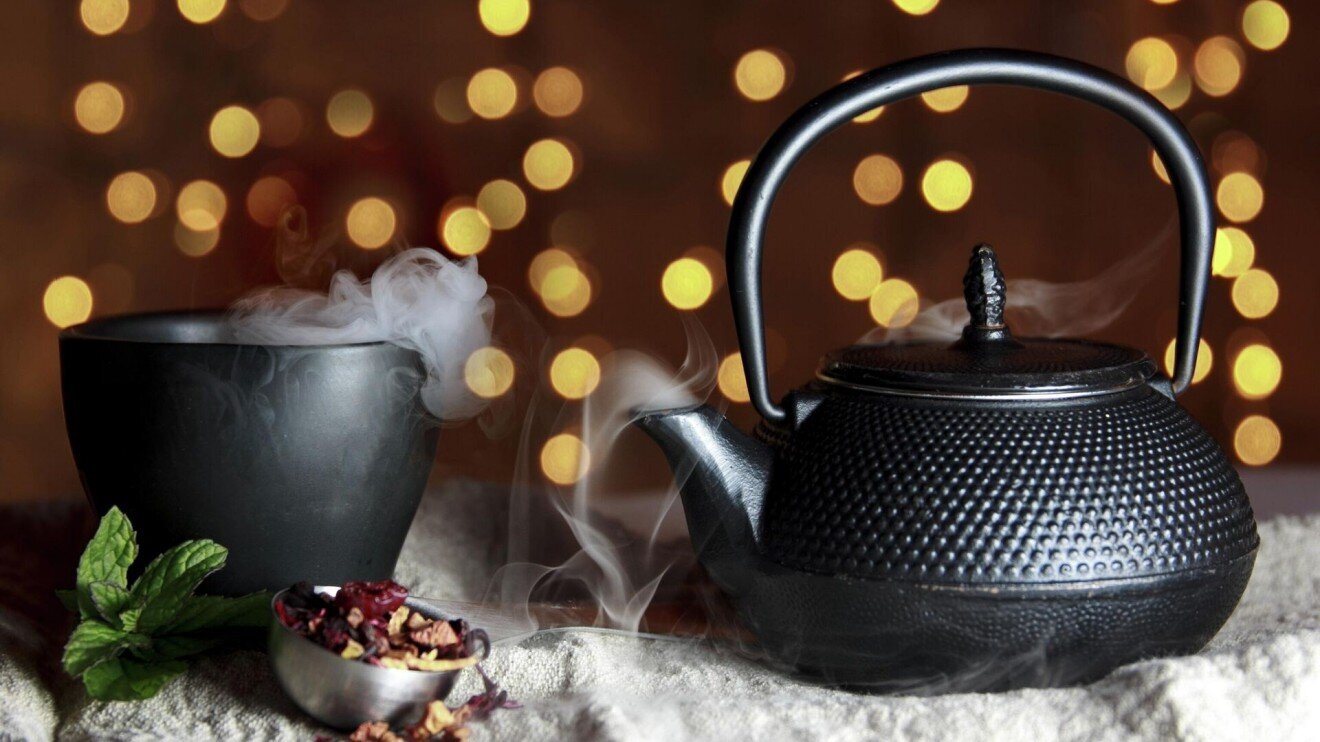
Gunpowder (from the English «Gunpowder tea,» Chinese 珠茶 — «pearl tea») is a distinctive style of green tea whose leaves are rolled into small, tight pellets resembling gunpowder or fine shot.
Origin and history
The technique for producing gunpowder tea originated in China as far back as the Tang dynasty (618–907 AD). The name «gunpowder» came much later, when European traders first saw the tea and noticed its resemblance to gunpowder – small, dark-gray, irregular granules. There is also an alternative theory about the name’s origin: it may derive from the Chinese phrase «gang pao de» (刚泡的), meaning «freshly brewed,» which sounds similar to the English word «gunpowder.»
In China itself, this tea is traditionally called «zhu cha» (珠茶) – «pearl tea» or «tea pearls,» which accurately describes the appearance of the rolled leaves. The main production region for gunpowder tea is Zhejiang province, although similar varieties are also made in Taiwan and other tea-growing regions.
Production technology
Making gunpowder tea involves several stages. First, the fresh tea leaves are withered, then steamed to halt oxidation. After that, the leaves are rolled into small, tight balls. Traditionally this was done by hand, but by the late twentieth century most producers had switched to machine rolling, reserving hand processing for premium grades only.
The final stage is drying, or «heat fixing,» by pan-firing. This process can be repeated several times and gives the tea a light smoky note. Such processing is characteristic specifically of Chinese green teas, unlike Japanese ones, where oxidation is halted by steam alone.
Varieties
By the late 1990s, several main varieties of gunpowder tea were on the market:
Pinghui gunpowder (平水珠茶) — the original and most widespread variety, with larger «pearls,» the best liquor color, and a more pronounced aroma. Often sold under the trade names «Temple of Heaven Gunpowder» or «Pinhead Gunpowder.»
Formosa gunpowder — the Taiwanese variant, produced in the Keelung area. It has its own distinctive aroma, different from mainland Chinese tea.
In addition, leaves from various other cultivars could be rolled into gunpowder form: Chun Mee, Tie Guanyin, Huang Guanyin, Dong Ding, and many other high-quality oolongs and jasmine teas.
Grading system
The quality of gunpowder tea is determined by a letter-and-number grading system. The top grade is marked 3505AAA, while 9375 is considered a relatively low grade. The main quality criteria are:
- Pellet size — the finer and more tightly rolled the leaves, the higher the quality
- Sheen — fresh, high-quality gunpowder has a characteristic sheen to its pellets
- Uniformity — all the pellets should be roughly the same size
- Liquor color — quality gunpowder gives a clear yellow-green infusion
Brewing method
To brew gunpowder tea, water at 70–80°C is recommended. About one teaspoon (5 ml) of dry tea is used per 150 ml of water. The first two infusions steep for about a minute each. Before brewing, it’s recommended to rinse the teapot or cup with hot water to warm the vessel.
When brewed, the tightly rolled leaves «explode,» unfurling into full-sized tea leaves – one of the reasons the tea earned the name «gunpowder.» Properly brewed gunpowder tea has a yellow or yellow-green liquor color.
Gunpowder tea in Russia at the end of the 1990s
In Russia at the end of the 1990s, gunpowder tea was a fairly exotic drink, available mainly in large cities and specialty shops. Ordering gunpowder tea at a restaurant or café could signal a genuine knowledge of tea culture and a certain status on the part of the patron.
This tea cost considerably more than the Indian or Ceylon black teas Russians were used to. It could be found in upscale grocery stores, specialty tea shops, or ordered in restaurants with pretensions to refinement. Many Russians were first introduced to gunpowder tea precisely at this time, when the country was actively opening up to Western and Eastern culinary traditions.
Cultural significance
Gunpowder tea plays an important role in the tea culture of North Africa, especially Morocco, where it is used to prepare traditional mint tea – the foundation of all social gatherings. In Moroccan tradition, gunpowder tea is mixed with mint and sugar or honey, producing a drink served both at informal get-togethers and at ceremonial occasions.
A particular feature of gunpowder tea is that, thanks to the tight rolling of its leaves, it stores and travels well, keeping its aroma and flavor far longer than loose-leaf teas. This quality made it a popular trade good for international commerce as far back as the era of the Great Silk Road.
Flavor characteristics
The taste of gunpowder tea can vary depending on the growing region and processing method. Classic Pinghui gunpowder has a fresh, slightly grassy flavor with light smoky notes from the pan-firing process. The aftertaste is usually mildly sweet, with a slight astringency.
Taiwanese varieties can have more floral notes, especially if oolong-type cultivars were used in their production. Quality gunpowder tea shouldn’t taste bitter when properly brewed and can withstand several infusions, revealing new flavor nuances each time.
Ordering gunpowder tea at a Moscow restaurant or café in 1998 demonstrated not just familiarity with Eastern tea culture, but a certain sophistication in matters of gastronomy – a quality especially prized, in an era of rapid change and newly opening horizons, among the urban intelligentsia and the new middle class.